

 Track Order

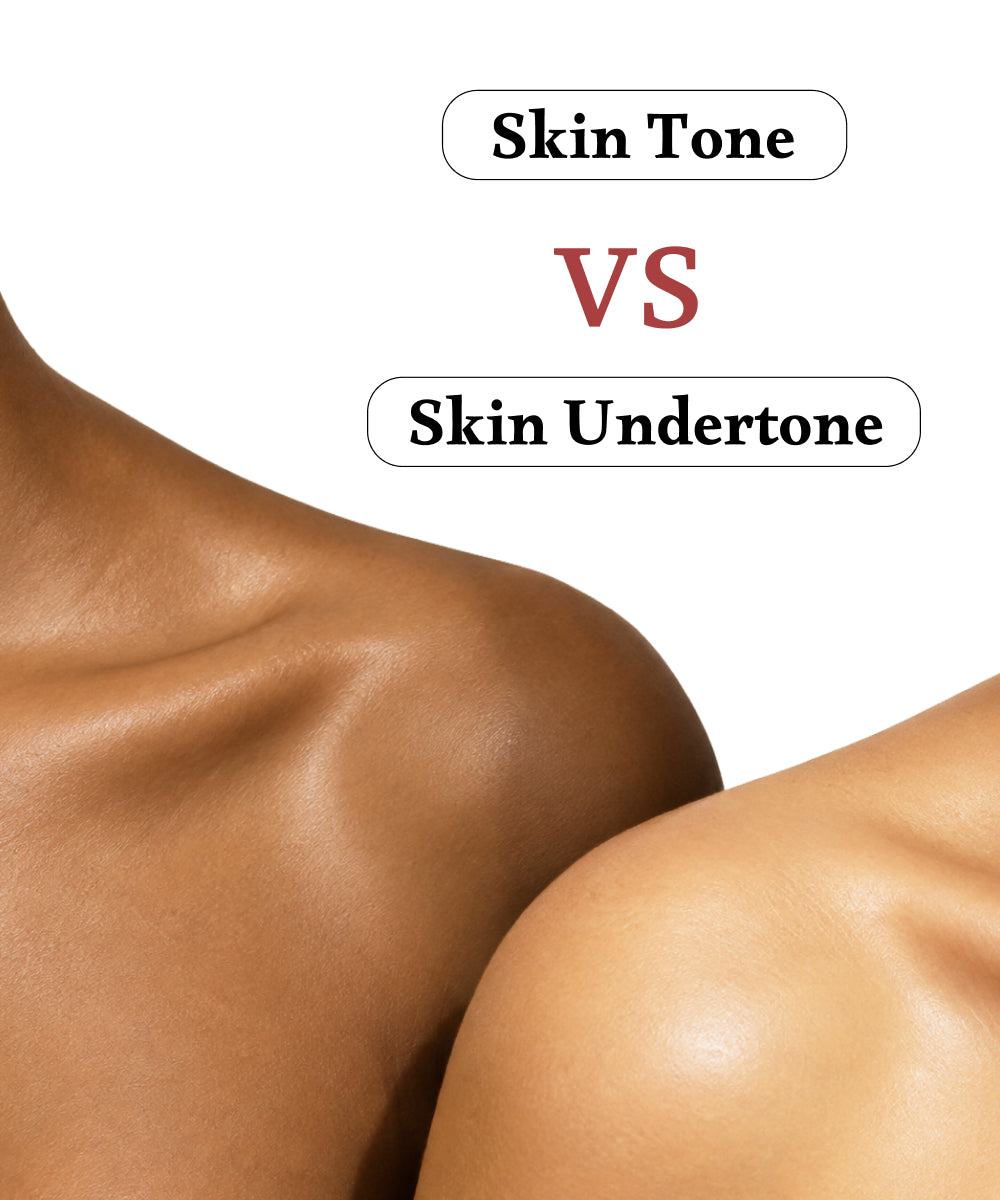
Two people stand in the same shop holding the same foundation bottle. Both have wheatish skin. One walks out with a shade that disappears into her face, the other with a shade that turns orange by evening. Same depth, different result, and the reason is that they were shopping on only half the information.
Skin tone and skin undertone are two separate measurements. Most Indian beauty content treats them as one thing, which is why so many purchases go wrong. Around 2,900 people a month in India search for skin undertone and another 2,400 search for undertone meaning, while 14,800 look for a skin tone chart. The volume is there. The clear distinction mostly is not.
This guide draws the line between the two, then does the part almost nobody does, which is spelling out exactly which purchase decisions each one governs. One of them decides your colour match. The other decides your pigmentation risk. Confusing them costs money on the first and costs results on the second.
The one-line difference
Skin tone is how light or deep your skin is. Skin undertone is the hue sitting beneath that depth.
Tone answers "how much pigment". Undertone answers "what colour is the pigment mix". You need both to describe skin accurately, in the same way you need both a shoe size and a width.
Vilvah covers the depth categories in detail in types of skin tones and how to know yours, and covers the at-home identification method in the companion piece on how to find your skin undertone at home. This article is about what changes once you know both.
What skin tone actually measures
Skin tone comes from melanin produced in the epidermis. Melanocytes make two chemically distinct types, brown-black eumelanin and yellow-red pheomelanin, and the total quantity along with melanosome size and distribution is what sets your depth on the scale from fair through wheatish, dusky and deep.
Two forms of pigmentation combine to produce what you see in the mirror. Constitutive pigmentation is the genetically determined baseline you have without sun exposure. Facultative pigmentation is the increase above that baseline caused by ultraviolet exposure and hormones, which is what most people call tanning.
Depth moves. It moves seasonally, it moves with sun exposure, and it moves with hormonal shifts. Anyone who has compared their face against their inner upper arm in April has measured the gap between constitutive and facultative pigmentation without knowing the terms.
What skin undertone actually measures
Undertone comes from the same melanin, plus two smaller contributors. Carotenoids and both oxygenated and deoxygenated haemoglobin in the dermal capillaries add a minor amount of colour underneath the melanin layer, and the balance between all of these tips the overall hue warm, cool, neutral or olive.
Warm reads golden, yellow or peach. Cool reads pink, red or bluish. Neutral reads balanced. Olive reads slightly green or muted, and it functions as a fourth category rather than a shade of warm.
Undertone does not move. It is set by your constitutive pigmentation, so tanning changes your depth without changing your hue. This single fact is the reason the two measurements govern different purchases.
The decision split, in one table
|
Purchase decision |
Governed by tone (depth) |
Governed by undertone (hue) |
|
Foundation and concealer shade number |
Yes |
No |
|
Foundation and concealer base colour |
No |
Yes |
|
Sunscreen SPF and broad-spectrum need |
No, everyone needs it |
No |
|
Sunscreen finish and cast risk |
Yes |
Yes, olive most affected |
|
Pigmentation and dark spot risk |
Yes |
No |
|
Which brightening actives work |
No |
No |
|
How a dark spot looks on you |
No |
Yes |
|
Clothing and jewellery colours |
Slightly |
Yes |
Read that table once more, because two rows in it do the heavy lifting.
Why tone decides your pigmentation risk
Post-inflammatory hyperpigmentation, meaning the dark mark left behind after acne, injury or irritation, is not distributed evenly across skin depths. It is observed more frequently in Fitzpatrick phototypes III to VI than in types I to III, and the mechanism is increased size and quantity of melanosomes rather than anything to do with hue.
The numbers are substantial. In an international study of 324 acne patients across Southeast Asia, most of whom had mild to moderate acne, 58.2 percent had acne-induced post-inflammatory hyperpigmentation. It persisted for at least a year in more than half of them and for five years or longer in 22.3 percent. A separate Middle East study of 262 subjects at phototype IV and above found acne-induced marks in 87.2 percent.
A 2025 expert panel built a severity grading tool for this and made phototype the single most heavily weighted parameter in it, scoring phototypes IV to VI at two points, phototype III at one point and phototypes I to II at zero. Most Indian skin sits in that top band, though the Fitzpatrick scale itself needed adapting for it. When researchers modified the questionnaire for 70 healthy Indian volunteers, they removed the two items about tanning habits because the subjects' responses showed those questions were not discriminating anything useful.
The practical consequence is uncomfortable. If you have medium, dusky or deep skin, a spot you pick at today is far more likely to leave a mark that outlives the spot by a year. That risk comes from your depth. Your undertone has no say in it. Vilvah covers the management side in how to reduce hyperpigmentation and how to remove acne scars naturally.
Why undertone decides your colour match
Depth gets you into the right shade family. Undertone gets you the right shade inside it.
A foundation labelled for medium skin can be built on a yellow base, a pink base or a neutral base. Pick the wrong one and the depth still matches while the colour reads wrong, which is where "ashy" and "orange" complaints come from. Warm skin needs a yellow or golden base, cool skin needs a pink or neutral base, and olive skin needs a green-leaning or genuinely neutral base.
The same logic applies to concealer under the eyes, to lip colour, and to which clothing and jewellery metals flatter you. None of it has anything to do with your pigmentation risk, and all of it has everything to do with whether you like how you look.
Where the two overlap: sunscreen
Sunscreen is the one purchase where both measurements matter, for different reasons.
Tone governs the cast risk. Mineral filters sit on the skin surface and scatter light, which produces a white or violet film that becomes more visible as depth increases. Undertone modifies it further, since olive skin shows the violet edge of a cast more obviously than warm skin at the same depth does.
Neither governs how much protection you need. Higher melanin content offers a baseline of photoprotection, and it does not remove the requirement for daily broad-spectrum coverage. Expert guidance for phototypes III to VI recommends broad-spectrum SPF 50 or higher as the standard, with anti-pigmentation dermocosmetics applied alongside it in the morning.
Worth being straight about one detail. The same guidance notes that tinted formulas containing iron oxides add protection against visible light, which is relevant to pigmentation-prone skin. Vilvah's sunscreens are untinted, so they meet the broad-spectrum SPF requirement without adding that particular layer. The Skin Finish Sunscreen SPF 50 PA++++ is a lightweight gel-cream built for Indian weather with new-age UV filters and no white cast, and the Melt-in-Milk Sunscreen SPF 50 uses soy milk extract in a formula designed for humid conditions. If visible-light protection is your specific priority, layer accordingly and read how to apply sunscreen on your face for technique.
What neither one decides
Three things get blamed on tone or undertone and belong to neither.
Which actives work on you. Tyrosinase inhibitors such as arbutin reduce melanin production through the same pathway regardless of your depth or hue, and niacinamide acts on melanosome transfer the same way in every skin. Vilvah's Milk Drops Brightening Serum pairs plant-derived alpha arbutin with rice milk extract, marine algae extract and hyaluronic acid, and the ingredient logic is identical whether you read warm or cool. There is more in niacinamide benefits for skin and rice milk for skin brightening.
Your skincare routine. Cleanser, serum, moisturiser and sunscreen selection follow your skin type and your concerns. Someone with deep skin and oily skin needs the same gel textures as someone with fair skin and oily skin. Start with how to know your skin type, and pick a cleanser such as the Milk Powder Face Wash or a moisturiser such as the Ultra Moisturising Cream on that basis rather than on colour.
Your worth as a customer. Fair, wheatish, dusky, deep, warm, cool, neutral and olive are descriptions. Vilvah sets out its position on this in brightening versus whitening, and the objective is even, protected, healthy skin at the depth and hue you already have.
How to use both when you shop
Work in this order and you will stop wasting money.
First, establish your depth honestly, on skin that has not tanned recently. Use the inner upper arm as your baseline and treat your face as the tanned reading. If the gap is large, address the tan separately using how to remove tan from your face rather than shopping a shade lighter and hoping.
Second, establish your undertone using a white cloth test and a gold versus silver test in indirect daylight. The full method is in the undertone guide.
Third, apply each one to the right decision. Depth sets your pigmentation prevention priority, which means daily sunscreen and early treatment of anything inflammatory. Hue sets your shade selection, which means base colour rather than shade number. Vilvah's broader approach for Indian skin is laid out in milk-based skincare for Indian skin and why Korean and Western skincare does not always work for Indian skin.
Frequently asked questions
What is the difference between skin tone and skin undertone?
Skin tone is how light or deep your skin is, running from fair through wheatish, dusky and deep, and it is determined by how much melanin your skin produces. Skin undertone is the hue sitting beneath that depth, reading as warm, cool, neutral or olive, and it comes from the balance of melanin types along with smaller contributions from carotenoids and haemoglobin. Tone changes with sun exposure because tanning increases melanin above your baseline. Undertone stays stable throughout your life. You need both to describe your skin accurately.
Does my skin tone or my undertone decide my foundation shade?
Both do, at different stages of the decision. Your skin tone determines the depth of the shade, meaning which number or band in the range you should be looking at. Your undertone determines the base colour within that band, meaning whether that shade should be built on yellow, pink, green-leaning or neutral. Getting depth right and base colour wrong is exactly how a foundation looks correct in the bottle and turns ashy or orange on the face. Match depth first, then narrow by undertone, and test in daylight rather than shop lighting.
Which one affects my risk of dark spots and pigmentation?
Your skin tone does, not your undertone. Post-inflammatory hyperpigmentation is observed more frequently in Fitzpatrick phototypes III to VI than in lighter phototypes, and the reason is the increased size and quantity of melanosomes in deeper skin rather than anything about hue. In one Southeast Asian study of acne patients, 58.2 percent developed acne-induced marks, and more than half of those marks lasted at least a year. If you have medium, dusky or deep skin, prioritise daily sun protection and early treatment of inflammation regardless of whether you read warm or cool.
Can my skin tone change while my undertone stays the same?
Yes, and this happens to almost everyone. Your baseline depth is constitutive pigmentation, which is genetically set. Sun exposure triggers facultative pigmentation, meaning melanin production rises above that baseline and your skin reads darker, which is the tanning response. That shift changes your depth without touching the underlying hue, so a warm-undertone person who tans two shades deeper still has a warm undertone. This is why you should re-check your foundation depth seasonally while never needing to re-check your undertone.
Do I need different skincare products because of my undertone?
No. Cleansers, serums, moisturisers and sunscreens are selected on skin type and skin concerns, not on hue. Tyrosinase inhibitors such as arbutin and ingredients such as niacinamide act through the same biological pathways regardless of whether your skin reads warm, cool, neutral or olive. Where undertone genuinely matters is colour cosmetics and the visible finish of a product on your face, such as whether a mineral sunscreen leaves a cast. Choose your skincare on type and concern, and reserve undertone for shade and finish decisions.
Sources
- Del Bino S, Duval C, Bernerd F. Clinical and Biological Characterization of Skin Pigmentation Diversity and Its Consequences on UV Impact. International Journal of Molecular Sciences, 2018;19(9):2668. https://pmc.ncbi.nlm.nih.gov/articles/PMC6163216/
- Auffret N, Leccia MT, Ballanger F, Claudel JP, Dahan S, Dréno B. Acne-induced Post-inflammatory Hyperpigmentation: From Grading to Treatment. Acta Dermato-Venereologica, 2025;105:42925. https://pmc.ncbi.nlm.nih.gov/articles/PMC12041799/
- Sharma VK, Gupta V, Jangid BL, Pathak M. Modification of the Fitzpatrick system of skin phototype classification for the Indian population, and its correlation with narrowband diffuse reflectance spectrophotometry. Clinical and Experimental Dermatology, 2018;43(3). https://pubmed.ncbi.nlm.nih.gov/29318654/
Related Stories
-

How to Find Your Skin Undertone at Home: Warm, Cool or Neutral
-

Dry Scalp: Causes, Remedies & How to Treat It Effectively
-

Vilvah: Brand, Ingredients and Product FAQs
-

Hair Serum v/s Hair Oil: Key Differences Explained With Benefits
-

Alfalfa for Hair Growth: Benefits, Uses & What You Need to Know
-

Face Wash vs Cleanser: What's Actually Different, and Which One Does Your Skin Need
-

Hair Serum Benefits: The Missing Step in Your Hair Care Routine
-

Premature Grey Hair: Why It Happens Young and How to Slow It Down
-

Rosemary for Hair Growth: What the Research Actually Shows


Leave a comment
All comments are moderated before being published.
This site is protected by hCaptcha and the hCaptcha Privacy Policy and Terms of Service apply.