

 Track Order

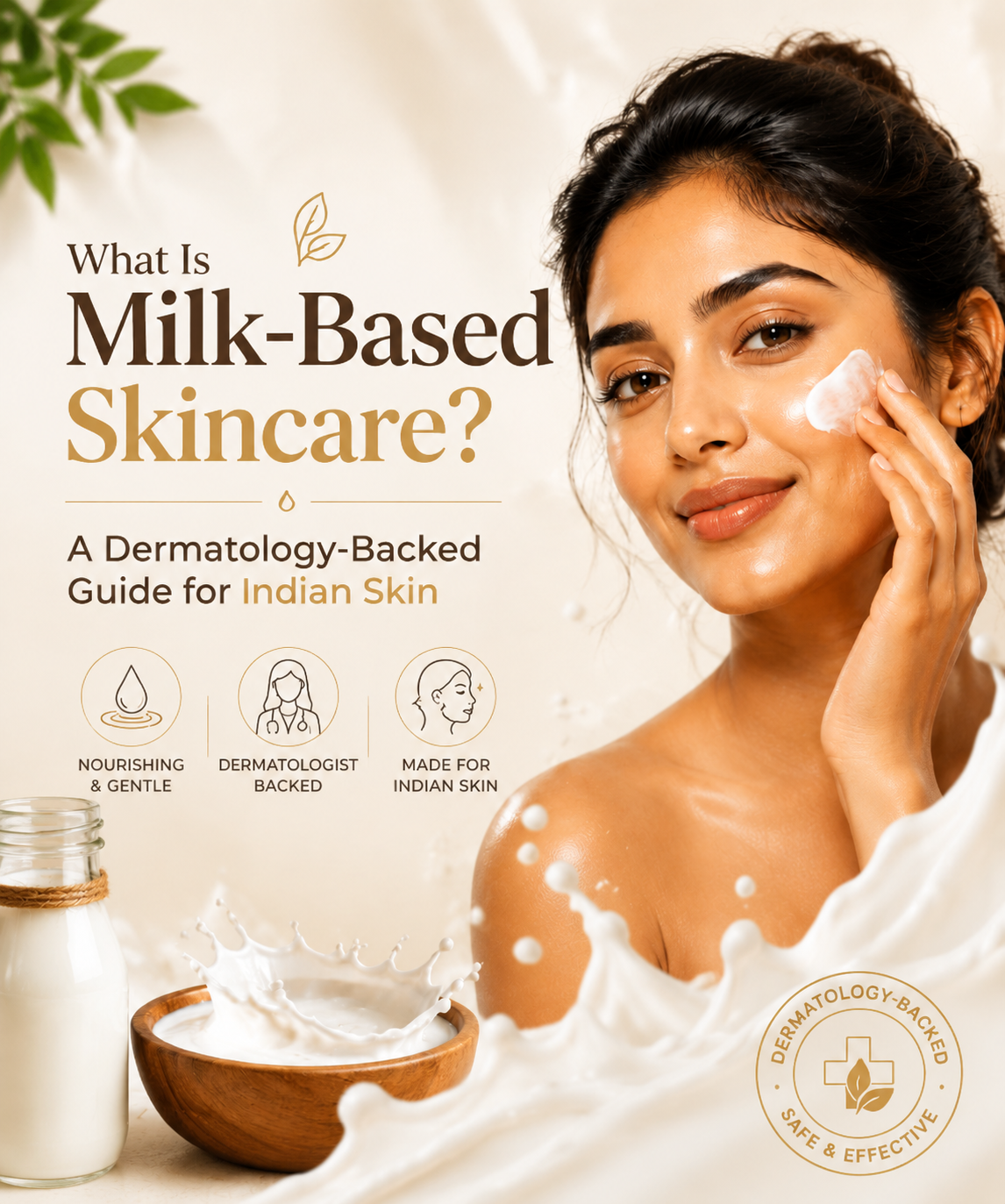
What Is Milk-Based Skincare, and Why Does It Suit Indian Skin?
Milk-based skincare delivers exfoliation, brightening, and barrier repair through milk actives instead of harsh synthetic agents. According to the Indian Journal of Dermatology, Venereology and Leprology (2008), the lactic acid in milk is an alpha hydroxy acid, the same exfoliating-acid family dermatologists use for melasma, post-inflammatory hyperpigmentation, and photoageing, and superficial alpha hydroxy acid treatments are safe for Indian skin.
Indian skin pigments reactively under strong sun. A 2026 pan-India survey of 409 dermatologists in the Journal of Dermatology Research named sun exposure as the leading cause of hyperpigmentation, cited by 59.2% of respondents. Milk actives work at gentle, low strengths, which matters because the same IJDVL guideline warns that deep, aggressive acid peels carry pigmentation risk on darker Indian skin.
Which Milks Power Vilvah's Milk Range, and What Does Each One Do?
Vilvah's Milk Range uses five milks, each chosen for a specific active and a specific concern. The table maps each milk to its key compound, its mechanism, and the Vilvah product that carries it.
|
Milk |
Key active |
What it does for skin |
Vilvah product |
|
Goat Milk |
Lactic acid (AHA), vitamins A, D, E |
Gently exfoliates, hydrates, calms sensitivity |
|
|
Rice Milk |
Ferulic acid, antioxidants |
Fades dark spots, brightens, evens tone |
|
|
Oat Milk |
Colloidal oatmeal, beta-glucan |
Calms redness, repairs the barrier |
|
|
Almond Milk |
Vitamin E, natural lipids |
Nourishes, conditions, softens |
Vilvah Almond Milk Range |
|
Soy Milk |
Isoflavones (phytoestrogens) |
Protects against UV radiation |
Each milk works through its named active, not through milk as one undivided ingredient. The sections below explain the mechanism behind each one.
How Goat Milk Brightens and Calms Sensitive Skin
Goat milk works because its lactic acid is a gentle alpha hydroxy acid that loosens dead surface cells and lifts cellular turnover, which reveals brighter, smoother skin. Its short-chain fatty acids, caprylic and capric acid, plus vitamins A, D, and E, penetrate the skin barrier to nourish and reduce irritation. Goat milk sits at a pH close to human skin, so it conditions without stripping the protective acid mantle, which suits dry, sensitive, and eczema-prone skin.
Goat milk protein also rebuilds hair. In Vilvah Goat Milk Shampoo, goat milk proteins coat and smooth the cuticle to tame frizz and strengthen weak roots, while Vilvah Classic Goat Milk Soap mildly exfoliates and hydrates the body.
How Rice Milk Fades Dark Spots and Tanning on Indian Skin
Rice milk fades pigmentation because it carries ferulic acid, an antioxidant that inhibits tyrosinase, the enzyme that drives melanin production. The 2026 Journal of Dermatology Research survey lists ferulic acid among the exfoliating agents Indian dermatologists accept for melasma. In a 2022 clinical study in Molecules, a ferulic acid cream sourced from rice bran reduced skin melanin content by 3.86% at two weeks and 5.69% at four weeks across 16 volunteers with Fitzpatrick III to IV skin, the tone range common across India.
Vilvah Milk Drops Brightening Serum pairs rice milk with Alpha Arbutin, a gentle active that blocks excess melanin transfer without irritating acne-prone skin. Vilvah states that consistent daily use shows early change in three to four weeks and visible dark-spot fading in six to eight weeks. For ageing concerns,
How Oat Milk Repairs the Barrier and Calms Sensitive Skin
Oat milk calms inflammation through colloidal oatmeal. Its avenanthramides reduce inflammation by inhibiting the NF-kB pathway and the cytokine IL-8, and the Skin Therapy Letter (2020) reports this anti-inflammatory effect reaches a level similar to topical 1% hydrocortisone. Oat beta-glucan forms a water-binding film that repairs the barrier, and the US FDA recognised colloidal oatmeal as an over-the-counter skin protectant in 2003.
Barrier repair matters in India, where the same Journal of Dermatology Research survey found 81.4% of dermatologists treat moisturisation as a mainstay of pigmentation care. In one 173-infant randomised controlled study cited in the Skin Therapy Letter review, a colloidal oatmeal emollient cut high-potency topical steroid use by 42%. Vilvah Milk Body Lotion uses oat milk to deliver this barrier repair across the body.
How Almond Milk Deeply Nourishes Dry Skin
Almond milk nourishes through vitamin E and natural lipids. Vitamin E is a fat-soluble antioxidant that defends skin cells against oxidative stress, and almond lipids act as a bio-compatible emollient that softens rough, dry patches and seals in moisture. This makes almond milk a strong fit for dry and mature skin that needs conditioning rather than exfoliation.
How Soy Milk Supports Firmer, Younger-Looking Skin
Soy milk supports firmness through isoflavones, the plant phytoestrogens daidzein and genistein. The Dermatology and Therapy (2025) review explains that these compounds bind estrogen receptor beta, which is abundant in the skin, and act as antioxidants that support collagen and slow visible aging. Soy milk suits skin that has started to lose elasticity, which the same review links to falling collagen from the early thirties onward.
How to Build a Milk-Based Skincare Routine for Indian Skin
A milk-based routine layers a gentle cleanser, a targeted serum, and daily sun protection, the structure 86.3% of Indian dermatologists follow per the 2026 Journal of Dermatology Research survey. Each step assigns one milk active to one job.
- Cleanse: Start with Vilvah Milk Powder Face Wash, a waterless cleanser that uses milk proteins to lift dirt without stripping moisture. Milk proteins bind to grime while keeping the skin's lipid layer intact, so skin stays soft rather than tight.
- Treat: Apply Vilvah Milk Drops Brightening Serum with rice milk ferulic acid and Alpha Arbutin to fade dark spots. Switch to Vilvah Better Ageing Serum with Bakuchiol at night, since Bakuchiol firms and smooths fine lines without the irritation of retinol.
- Detan weekly: Use Vilvah Milk Mud Mask to draw out tan and brighten. Clay binds excess oil and impurities while milk actives loosen the dull surface layer that builds up in Indian humidity.
- Protect: Finish every morning with Vilvah Skin Finish Sunscreen SPF 50 PA++++. The survey ranked broad-spectrum SPF 50+ PA++++ the most recommended sunscreen in India at 60.2%, and this formula adds Niacinamide, which inhibits melanosome transfer to control pigment and oil.
Milk-Based Skincare: Your Questions Answered
Is milk-based skincare good for Indian skin?
Yes, milk-based skincare suits Indian skin because its actives are gentle yet target the concerns Indian skin shows most. The 2026 Journal of Dermatology Research survey found that over 80% of the Indian population shows facial pigmentation heterogeneity, with sun exposure the top cause at 59.2%. Goat milk lactic acid and rice milk ferulic acid both fade pigmentation, and the IJDVL (2008) confirms that lactic acid, an alpha hydroxy acid, is safe on Indian skin at gentle strengths.
Does goat milk help with pigmentation?
Yes, goat milk supports pigmentation control through its natural lactic acid. Lactic acid is an alpha hydroxy acid that loosens dead surface cells and lifts cellular turnover, which fades dullness and evens tone over weeks of use. The IJDVL (2008) lists lactic acid among the alpha hydroxy acids dermatologists use for melasma and post-inflammatory hyperpigmentation. Because goat milk delivers this acid at a low, skin-friendly strength, it brightens without the sting of a clinical peel.
Which Vilvah product is best for dark spots?
Vilvah Milk Drops Brightening Serum is the Vilvah product built for dark spots. It combines rice milk ferulic acid, which inhibits the melanin enzyme tyrosinase, with Alpha Arbutin to fade post-acne marks and tanning on acne-prone skin. In a 2022 Molecules study, ferulic acid from rice bran reduced melanin content by 5.69% at four weeks. Vilvah states that consistent daily use shows visible dark-spot fading in six to eight weeks.
Is milk-based skincare safe for sensitive and acne-prone skin?
Yes, milk-based skincare is formulated for sensitive and acne-prone skin. Goat milk sits at a skin-friendly pH, and oat milk avenanthramides calm inflammation at a strength close to topical 1% hydrocortisone, per the Skin Therapy Letter (2020). Vilvah formulations skip artificial fragrance, a common irritant for reactive skin. Rice milk ferulic acid also brightens without the breakouts that harsh chemical lighteners trigger on acne-prone Indian skin.
How long does milk-based skincare take to fade dark spots?
Visible dark-spot fading takes about six to eight weeks of consistent daily use, by Vilvah's own timeline. Rice milk ferulic acid begins measurable work early: the 2022 Molecules study recorded a 3.86% melanin reduction by two weeks and 5.69% by four weeks.
Sources & References
- Khunger N. Standard Guidelines of Care for Chemical Peels. Indian Journal of Dermatology, Venereology and Leprology, 2008. https://ijdvl.com/standard-guidelines-of-care-for-chemical-peels/
- Choudhary S, et al. Hyperpigmentation Management Perspectives: A Nationwide Survey of Indian Dermatologists. Journal of Dermatology Research, 2026. https://athenaeumpub.com/hyperpigmentation-management-perspectives-a-nationwide-survey-of-indian-dermatologists/
- Pueknang J, Saewan N. Stability and Anti-Aging of Encapsulated Ferulic Acid in Phosphorylated Rice Starch. Molecules, 2022. https://www.mdpi.com/1420-3049/27/11/3463
- Lynde C. Colloidal Oatmeal use in Dermatology. Skin Therapy Letter, 2020. https://www.skintherapyletter.com/atopic-dermatitis/colloidal-oatmeal-dermatology/
- Lephart ED. Bioactives for Estrogen-Deficient Skin: Topical and Oral Supplement Clinical Studies. Dermatology and Therapy, 2025. https://link.springer.com/article/10.1007/s13555-025-01413-2
Related Stories
-

Fitzpatrick Skin Types: Where Most Indian Skin Actually Sits
-

Skin Tone vs Skin Undertone: Why the Difference Changes What You Buy
-

How to Find Your Skin Undertone at Home: Warm, Cool or Neutral
-

Dry Scalp: Causes, Remedies & How to Treat It Effectively
-

Vilvah: Brand, Ingredients and Product FAQs
-

Hair Serum v/s Hair Oil: Key Differences Explained With Benefits
-

Alfalfa for Hair Growth: Benefits, Uses & What You Need to Know
-

Face Wash vs Cleanser: What's Actually Different, and Which One Does Your Skin Need
-

Hair Serum Benefits: The Missing Step in Your Hair Care Routine
-

Premature Grey Hair: Why It Happens Young and How to Slow It Down


Leave a comment
All comments are moderated before being published.
This site is protected by hCaptcha and the hCaptcha Privacy Policy and Terms of Service apply.