

 Track Order

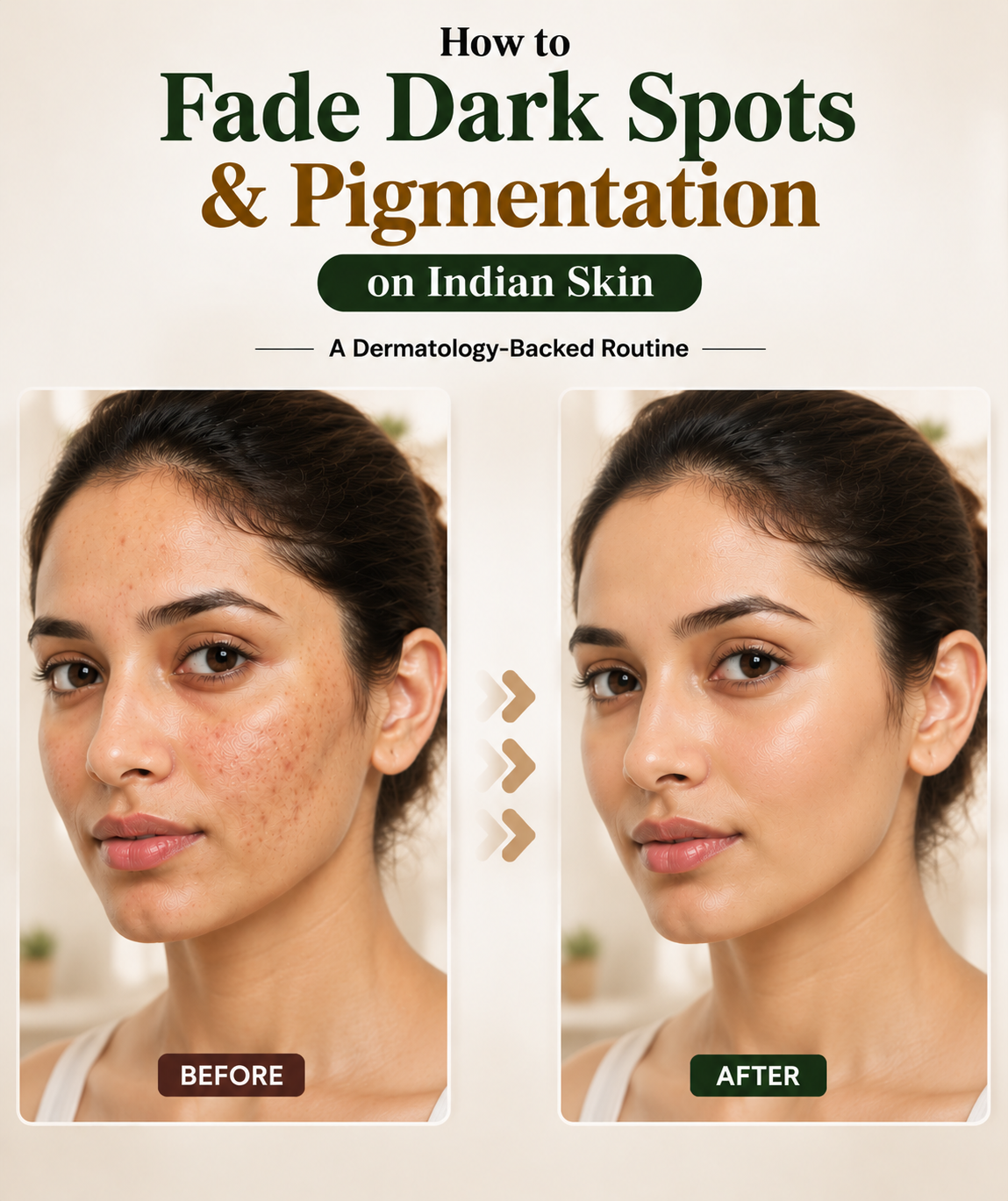
You fade dark spots and pigmentation on Indian skin by protecting it from the sun first, then layering gentle brightening activities like alpha arbutin and rice milk morning and night. Indian skin holds more melanin, so dark spots from acne, sun, and hormones form faster and linger longer than they do on lighter skin. A 2021 study of 100 Indian melasma patients found that melasma severity climbed as daily sun exposure rose, and the gap between the lowest and highest exposure groups was statistically significant (International Journal of Research in Dermatology, 2021). A fading routine that skips daily sunscreen works against itself on Indian skin.
TL;DR: Sun exposure is the biggest driver of dark spots on Indian skin, so daily broad-spectrum sunscreen comes before any serum. Vilvah Milk Drops Brightening Serum uses plant-derived alpha arbutin and rice milk to fade spots gently, and Vilvah Skin Finish Sunscreen SPF 50+ PA++++ protects the result with no white cast. Most people see first changes around 4 weeks, with deeper fading over 6 to 8 weeks of consistent use.
What Causes Dark Spots and Pigmentation on Indian Skin?
Dark spots on Indian skin come mainly from three sources: post-acne marks, melasma, and sun-induced tanning. Each looks different and fades on a different timeline, so naming yours sets honest expectations.
Post-inflammatory hyperpigmentation, or PIH, is the flat brown mark left behind after a pimple, cut, or irritation heals. In India, more than 70% of people with a history of acne carry these marks before age 35, across both men and women (Indian Journal of Dermatology, 2016). PIH sits higher in the skin, so it responds fastest to gentle brightening and sun protection, and there are proven ways to remove acne scars and marks naturally.
Melasma is a chronic, symmetrical brown-grey patch, usually on the cheeks, forehead, or upper lip. Roughly 20 to 30% of Indian women aged 40 to 65 carry facial melasma, and sun plus hormones drive it (Indian Journal of Dermatology, 2016). Melasma recurs, so it needs strict sun protection and patience rather than a one-time fix. Vilvah's guide to reducing hyperpigmentation covers the wider picture.
Why Sunscreen Is the First Step to Fade Pigmentation on Indian Skin
Sunscreen fades pigmentation on Indian skin because ultraviolet light is the main trigger that keeps making melanin. Without daily protection, fresh UV re-darkens spots faster than any serum lightens them. The whole UV spectrum, including the long UVA1 wavelengths that are abundant over India, stimulates pigment (Indian Journal of Dermatology, 2016).
A common worry is that daily sunscreen blocks vitamin D. A 2019 Indian study put this to rest: 43 melasma patients used an SPF 50+ PA++++ sunscreen daily for three months with no significant drop in vitamin D, and the authors note this level of protection blocks over 98% of UVB (Indian Journal of Dermatology, Venereology and Leprology, 2019).
The Vilvah Skin Finish Sunscreen SPF 50+ PA++++ is a hybrid gel-cream built for Indian weather, priced at ₹599. It uses new-age filters Tinosorb S, Uvinul A Plus, Uvinul T 150, and Titanium Dioxide for broad-spectrum cover against UVA, UVB, blue light, and pollution. Its rice milk and niacinamide content keep the skin bright while it protects, and it leaves no white cast on deeper Indian skin tones.
Melasma vs Post-Acne Marks vs Tan: How to Fade Each One
Matching the spot to the right approach is what makes a routine work. The table below maps each pigmentation type to its trigger and the Vilvah products that target it.
|
Pigmentation type |
What it looks like |
Main trigger on Indian skin |
How to fade it |
Vilvah products |
|
Post-acne marks (PIH) |
Flat brown marks where pimples healed |
Acne; over 70% of acne-prone Indians have marks before 35 |
Calm active acne, brighten gently, protect daily |
Milk Drops Brightening Serum plus Skin Finish Sunscreen |
|
Melasma |
Symmetrical brown-grey patches on cheeks and forehead |
Sun plus hormones; 20 to 30% of women aged 40 to 65 |
Strict daily SPF, gentle brightening, dermatologist for stubborn cases |
Skin Finish Sunscreen plus Milk Drops Brightening Serum |
|
Tan and dullness |
Overall darkening on sun-exposed areas |
Cumulative UV exposure |
Daily broad-spectrum SPF, brightening actives |
Skin Finish Sunscreen plus Milk Drops Brightening Serum |
The Best Vilvah Brightening Routine for Dark Spots and Uneven Skin Tone
A spot-fading routine on Indian skin runs on four steps in the morning and three at night, and it fits within Vilvah's wider milk-based skincare routine for Indian skin. The Vilvah Face Brightening Combo bundles the cleanser and serum, and the Vilvah Skin Radiance Combo adds the sunscreen for the full cleanse, treat, protect ritual.
Step 1, cleanse. Wash with the Vilvah Milk Powder Face Wash morning and night. It clears oil and dirt without stripping the barrier, which matters because a damaged barrier triggers more inflammation and more dark marks.
Step 2, treat. Press 2 to 3 drops of the Vilvah Milk Drops Brightening Serum into clean skin. This fragrance-free, non-comedogenic serum sits at pH 5.5 to 6.0, so it suits sensitive and acne-prone Indian skin.
Step 3, moisturise. Lock the serum in with a light moisturiser so the actives stay on the skin and hydration supports faster cell turnover.
Step 4, protect (morning only). Apply two finger-lengths of Vilvah Skin Finish Sunscreen SPF 50+ PA++++ to face and neck, 20 minutes before heading out, and reapply every 2 to 3 hours outdoors.
At night, repeat cleanse, serum, and moisturiser. To fade marks while smoothing early fine lines, add the Vilvah Better Ageing Serum a few nights a week. Its bakuchiol acts as a gentle plant-based retinol alternative, nudging cell turnover so pigmented cells shed faster without the dryness or peeling of conventional retinol.
How Rice Milk and Alpha Arbutin Fade Dark Spots Without Irritation
The actives in Vilvah Milk Drops Brightening Serum target pigment at the source while staying gentle. Here is what each one does.
Alpha arbutin is a plant-derived molecule that inhibits tyrosinase, the enzyme that controls melanin production. By slowing that enzyme, alpha arbutin lightens existing dark spots and prevents new ones, which is why it suits both melasma and post-acne marks.
Rice milk extract is rich in ferulic acid, an antioxidant that neutralises the free radicals UV creates. It brightens dull skin and fades blemishes without the sting that strong acids cause on acne-prone skin, one reason rice milk suits brightening on Indian skin.
Marine algae extract supports skin renewal and helps even out tone alongside the other actives.
Hyaluronic acid is a humectant that binds water in the skin. Well-hydrated skin renews faster and tolerates brightening actives better, so spots clear more evenly.
Inside Vilvah Skin Finish Sunscreen, niacinamide adds a second brightening layer by limiting the transfer of melanin into surface skin cells, while ectoin shields cells from environmental stress so pigment is less likely to form.
How Long Does It Take to Fade Dark Spots on Indian Skin?
Most people see first visible change around 4 weeks of daily use, with deeper, more even fading over 6 to 8 weeks. Post-acne marks fade fastest because they sit high in the skin. Melasma fades slowest and recurs, so it demands consistent sun protection long after the patch lightens. The single biggest reason a routine stalls is skipped or under-applied sunscreen, since fresh UV resets the clock on every spot.
Who Should Use This Routine, and Who Should See a Dermatologist
This routine suits oily, dry, combination, and sensitive Indian skin dealing with post-acne marks, mild melasma, tan, and dullness. See a dermatologist if patches are spreading, deeply symmetrical, or unchanged after eight weeks of consistent use. Dermatology-grade treatments such as prescription actives and in-clinic procedures exist for stubborn melasma, and a topical routine works best as the daily foundation around them.
Frequently Asked Questions
Can I fade dark spots on Indian skin without a dermatologist?
Yes, most post-acne marks and mild pigmentation fade with a consistent home routine of gentle brightening and daily sunscreen. Indian dermatology research names regular broad-spectrum sunscreen as the first line of prevention for pigmentation (Indian Journal of Dermatology, 2016). Pair daily Vilvah Skin Finish Sunscreen with Vilvah Milk Drops Brightening Serum morning and night. Stubborn or symmetrical patches still warrant a dermatologist.
How long does Vilvah Milk Drops Brightening Serum take to fade dark spots?
Most people see first visible change around 4 weeks of daily use. Fuller, more even fading builds over 6 to 8 weeks as cell turnover catches up. Post-acne marks lighten fastest, while melasma takes longer and needs strict sun protection to hold the result. Results depend on consistency and daily sunscreen.
Is alpha arbutin safe for acne-prone Indian skin?
Yes, alpha arbutin is gentle and non-irritating on acne-prone and sensitive skin. It works by inhibiting tyrosinase, the enzyme behind melanin production, so it fades spots without harsh bleaching. Vilvah Milk Drops Brightening Serum pairs it with rice milk in a fragrance-free, non-comedogenic formula at pH 5.5 to 6.0, suited to breakout-prone skin.
Does daily sunscreen lower vitamin D in Indian conditions?
No, daily high-SPF sunscreen does not significantly lower vitamin D in Indian conditions. A 2019 study found no significant change in vitamin D after melasma patients used SPF 50+ PA++++ daily for three months (Indian Journal of Dermatology, Venereology and Leprology, 2019). That protection blocks over 98% of UVB, so daily use is both safe and effective for fading spots.
Which Vilvah products fade post-acne marks fastest?
Vilvah Milk Drops Brightening Serum and Vilvah Skin Finish Sunscreen together fade post-acne marks fastest. The serum lightens existing marks with alpha arbutin and rice milk, and the sunscreen stops fresh UV from re-darkening them. The Vilvah Face Brightening Combo packages the cleanser and serum for this purpose.
Does Vilvah Skin Finish Sunscreen leave a white cast on deeper skin tones?
No, Vilvah Skin Finish Sunscreen SPF 50+ PA++++ blends in with no white cast on deeper Indian skin tones. Its hybrid filters and lightweight gel-cream texture absorb quickly and leave a naturally brighter finish. It is non-comedogenic and water and sweat resistant, which suits oily skin and humid weather.
Can bakuchiol help fade pigmentation if retinol irritates my skin?
Yes, bakuchiol fades pigmentation by supporting cell turnover, much like retinol but without the dryness or peeling. Vilvah Better Ageing Serum uses bakuchiol as a plant-based alternative that suits sensitive skin. Use it a few nights a week alongside daily sunscreen for the best fading effect.
Sources and References
- Parsam SB, Tallam S. "Melasma and sun exposure: a clinicoepidemiological study." International Journal of Research in Dermatology, 2021. https://www.ijord.com/index.php/ijord/article/view/1240
- Singh S, Jha B, Tiwary NK, Agrawal NK. "Does using a high sun protection factor sunscreen on face, along with physical photoprotection advice, in patients with melasma, change serum vitamin D concentration in Indian conditions?" Indian Journal of Dermatology, Venereology and Leprology, 2019. https://ijdvl.com/does-using-a-high-sun-protection-factor-sunscreen-on-face-along-with-physical-photoprotection-advice-in-patients-with-melasma-change-serum-vitamin-d-concentration-in-indian-conditions-a-pragmatic/
- Nouveau S, Agrawal D, Kohli M, Bernerd F, Misra N, Nayak CS. "Skin Hyperpigmentation in Indian Population: Insights and Best Practice." Indian Journal of Dermatology, 2016. https://pmc.ncbi.nlm.nih.gov/articles/PMC5029232/
Related Stories
-

Melanin in Skin: What It Actually Does, and Why Indian Skin Marks So Easily
-

Goat Milk Soap vs Regular Soap: What Actually Changes on Your Skin
-

Fitzpatrick Skin Types: Where Most Indian Skin Actually Sits
-

Skin Tone vs Skin Undertone: Why the Difference Changes What You Buy
-

How to Find Your Skin Undertone at Home: Warm, Cool or Neutral
-

Dry Scalp: Causes, Remedies & How to Treat It Effectively
-

Vilvah: Brand, Ingredients and Product FAQs
-

Hair Serum v/s Hair Oil: Key Differences Explained With Benefits
-

Alfalfa for Hair Growth: Benefits, Uses & What You Need to Know
-

Face Wash vs Cleanser: What's Actually Different, and Which One Does Your Skin Need


Leave a comment
All comments are moderated before being published.
This site is protected by hCaptcha and the hCaptcha Privacy Policy and Terms of Service apply.