

 Track Order

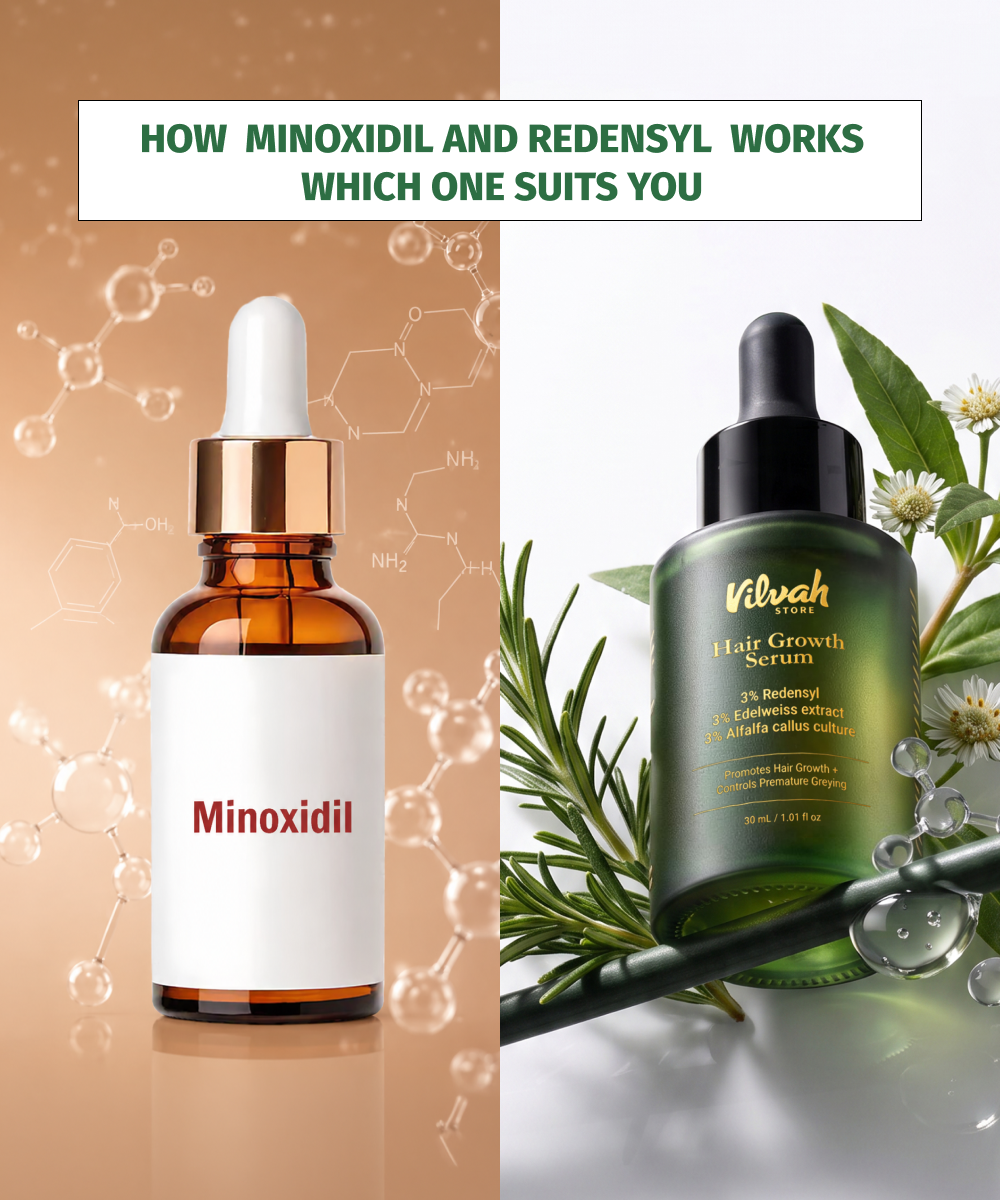
Minoxidil is a pharmaceutical drug with decades of clinical use behind it, but it works only after an enzyme which your hair follicle converts, and published research estimates around 60% of people lack enough of that enzyme to respond well. Redensyl works through a different route that does not depend on that conversion, which is why plant-derived, Minoxidil-free serums have become the daily-use option many Indian buyers now choose. The Vilvah Hair Growth Serum carries 3% Redensyl alongside 3% Alfalfa callus culture and 3% Swiss Alpine Edelweiss extract, at ₹1099 for 30 mL.
What minoxidil is and how it works
Minoxidil began life in the 1960s as an oral medication for high blood pressure. Increased hair growth showed up as a side effect, and topical formulations for hair loss followed from there.
The mechanism is layered. Minoxidil opens ATP-gated potassium channels in smooth muscle, which widens blood vessels and raises blood supply to the follicle. Published reviews also describe anti-inflammatory activity and upregulation of Wnt and beta-catenin signalling through increased VEGF.
Topical minoxidil comes as 2% and 5% solutions and as a 5% foam. Research shows the 5% concentration outperforms 2% in men when applied twice daily.
On timing, the earliest visible effects begin at six to eight weeks and reach their maximum by twelve to sixteen weeks, with little further improvement after that point.
The part most buyers never get told: the enzyme question
This is the single most useful fact in the whole comparison.
Minoxidil is a prodrug. It does nothing to hair in the form you apply it. An enzyme called sulfotransferase, specifically SULT1A1, sitting in the outer root sheath of the hair follicle, has to convert it into minoxidil sulphate before any effect happens.
How much of that enzyme you have is largely down to your own biology. Published research estimates that around 60% of male patients may not respond to topical minoxidil because their baseline sulfotransferase levels are too low. In one prospective study, fewer than 40% of patients responded after sixteen weeks of continuous application.
Researchers have developed assays that measure sulfotransferase activity in plucked follicles to predict who will respond, though these are not yet routine in clinical practice. Research groups have also specifically characterised follicular sulfotransferase activity in pattern hair loss patients from the Indian subcontinent.
Absorption is another limit worth knowing. Roughly 1.4% of topically applied minoxidil is absorbed through a healthy scalp.
None of this makes minoxidil a poor treatment. It remains one of the most clinically validated options available, and for anyone whose enzyme activity is high, it works. It does explain why so many people apply it faithfully for months and see very little, and why the search for a different mechanism has grown.
What happens when you stop
A five-year study following men on daily topical minoxidil found hair growth peaked at one year, then declined slowly. When application stopped abruptly, hair loss returned to baseline.
Reported side effects in controlled trials include application-site dermatitis, itching and headache, occurring in about 6% of patients on the 5% solution compared with 2% on the 2% solution.
What Redensyl is and how it works
Redensyl is not a single molecule. It is a blend built around two stabilised polyphenols: dihydroquercetin-glucoside, known as DHQG, and epigallocatechin gallate-glucoside, known as EGCG2.
Published research describes both molecules as targeting the outer root sheath stem cells of the hair follicle and the fibroblast cells of the dermal papilla. The dermal papilla is the control centre of the follicle, the cluster of cells that decides whether a follicle stays in its growth phase or drops into rest.
Here is the mechanistic difference that matters. Redensyl does not require sulfotransferase conversion to become active. It works on the follicle through a different route entirely, which means its performance is not gated by the enzyme variability that limits minoxidil response.
You can see both molecules on the Vilvah label. Redensyl appears as European larch wood extract and green tea leaf extract with glycine and zinc chloride, marked with an asterisk on the ingredient list. The larch supplies DHQG. The green tea supplies EGCG2.
Which one suits you
|
Minoxidil |
Redensyl |
|
|
Type |
Pharmaceutical |
Cosmetic active blend |
|
Needs enzyme conversion |
Yes, SULT1A1 |
No |
|
Typical use |
Once or twice daily, long term |
Nightly, leave-in |
|
Medical supervision |
Recommended |
Not required |
|
Best suited to |
Diagnosed pattern hair loss, under a dermatologist |
Hair fall, thinning and density concerns, daily routine use |
Anyone with sudden, patchy or rapidly progressing hair loss should see a dermatologist before choosing anything. A serum is a routine product. Diagnosed conditions need a diagnosis first.
The Vilvah approach to a Minoxidil-free serum
The Vilvah Hair Growth Serum is built around three actives at 3% each, all disclosed on the label.
3% Redensyl supports follicle activity for new growth and density. 3% Alfalfa callus culture, a plant cell culture active, supports scalp vitality and pH balance. 3% Swiss Alpine Edelweiss extract, an alpine antioxidant, helps shield pigment-producing melanocytes from free radical stress.
The formula opens with Rosmarinus officinalis (Rosemary) leaf extract rather than Aqua, so the circulation-supporting active sits at the largest part of the formula. Bhringaraj extract, hyaluronic acid, hydrolysed keratin and panthenol round it out, with Lactobacillus ferment lysate supporting the scalp microbiome and barrier.
The Vilvah Hair Growth Serum was tested with more than 1,000 Indian users before launch and filed for a patent. Across that study, hair fall reduced considerably at around four to six weeks, with noticeable growth and improved density by two months.
It stays on overnight with no rinse, suits colour-treated and chemically treated hair, works on oily and dandruff-prone scalps, and is designed for anyone above 18.
Building the routine around it
What you wash with decides whether overnight work holds. A harsh cleanser strips the scalp barrier a serum spends all night supporting.
The Vilvah Goat Milk Shampoo is sulphate-free at pH 6, with Ceramide NG and Ceramide NP for barrier strength, hydrolysed pea protein for frizz, and goat milk fatty acids for moisture.
The Vilvah Hair Growth Combo pairs the 30 mL serum with the 250 mL Goat Milk Shampoo at ₹1,689, which covers the scalp-to-strand routine in one step.
For the fuller picture on what drives hair loss in the first place, see our guides on hair thinning causes and healthy hair growth.
Frequently asked questions
Is Redensyl better than minoxidil?
They work differently rather than competing directly. Minoxidil has the longer clinical record but depends on sulfotransferase enzyme activity that many people lack. Redensyl works through follicle stem cells and dermal papilla cells without needing that conversion, which makes it a consistent daily option across users.
Can I use a Redensyl serum every day?
Yes. The Vilvah Hair Growth Serum is designed for nightly use, and works well at four to seven nights a week.
Does minoxidil have side effects?
Controlled trials report application-site dermatitis, itching and headache in a small percentage of users, and studies show hair returns to baseline when treatment stops. A doctor is the right person to discuss this for your situation.
How long does Redensyl take to show results?
Follow the hair cycle rather than the calendar. Expect around four to six weeks before hair fall visibly reduces and roughly two months before density changes show.
Is a Minoxidil-free hair serum available in India?
Yes. The Vilvah Hair Growth Serum is Minoxidil-free, plant-derived and available at ₹1099 for 30 mL.
Sources
- Treatment of Androgenetic Alopecia: Current Guidance and Unmet Needs. pmc.ncbi.nlm.nih.gov/articles/PMC10239632
- Expanding the therapeutic landscape of minoxidil for androgenetic alopecia. pmc.ncbi.nlm.nih.gov/articles/PMC12898826
- Sulfotransferase SULT1A1 activity in hair follicle, a prognostic marker of response to minoxidil treatment. pmc.ncbi.nlm.nih.gov/articles/PMC9326921
Related Stories
-

Melanin in Skin: What It Actually Does, and Why Indian Skin Marks So Easily
-

Goat Milk Soap vs Regular Soap: What Actually Changes on Your Skin
-

Fitzpatrick Skin Types: Where Most Indian Skin Actually Sits
-

Skin Tone vs Skin Undertone: Why the Difference Changes What You Buy
-

How to Find Your Skin Undertone at Home: Warm, Cool or Neutral
-

Dry Scalp: Causes, Remedies & How to Treat It Effectively
-

Vilvah: Brand, Ingredients and Product FAQs
-

Hair Serum v/s Hair Oil: Key Differences Explained With Benefits
-

Alfalfa for Hair Growth: Benefits, Uses & What You Need to Know
-

Face Wash vs Cleanser: What's Actually Different, and Which One Does Your Skin Need


Leave a comment
All comments are moderated before being published.
This site is protected by hCaptcha and the hCaptcha Privacy Policy and Terms of Service apply.