

 Track Order

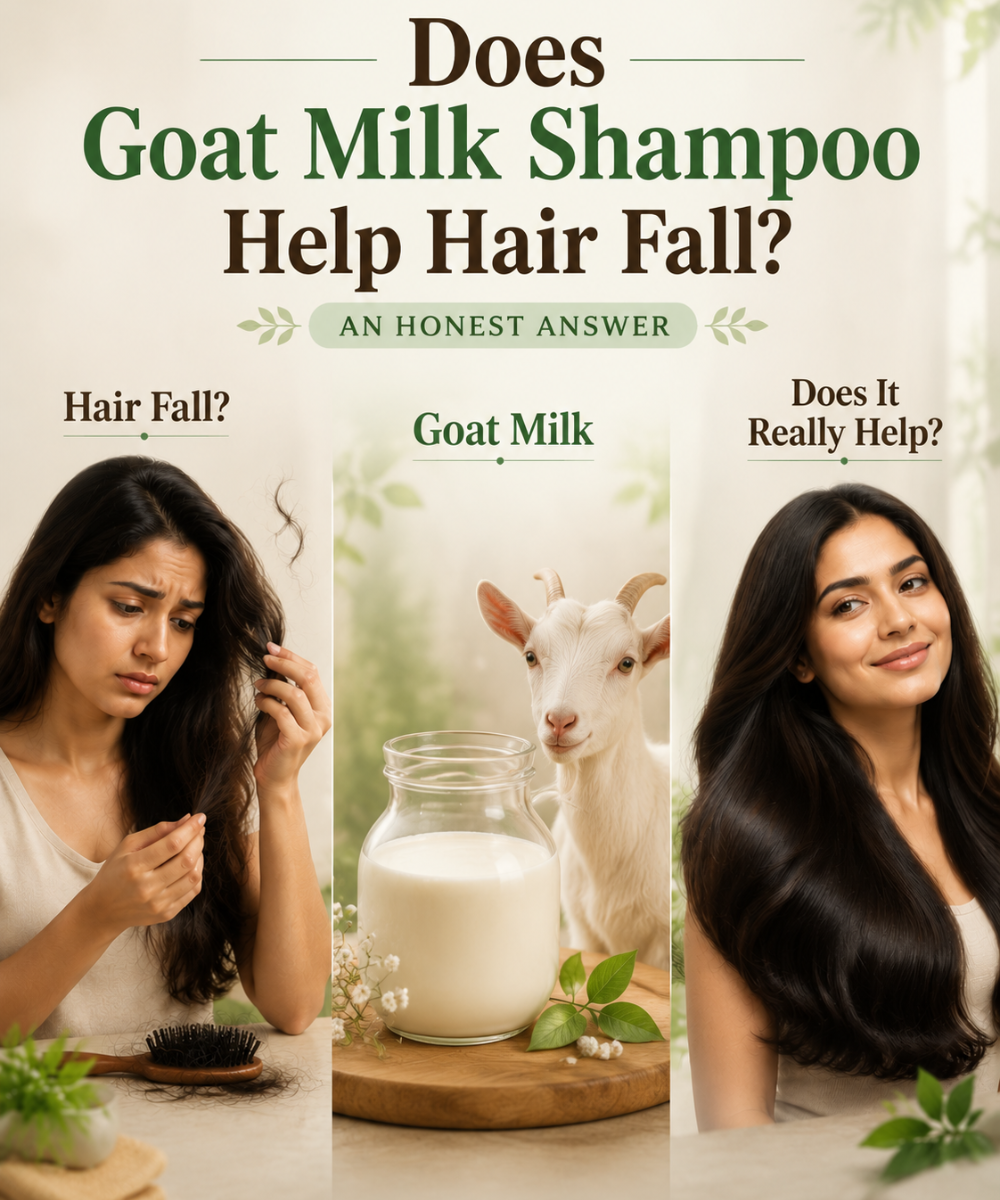
Vilvah Goat Milk Shampoo helps one kind of hair fall: the strands you lose to breakage. A 2014 analysis of 123 shampoos in the International Journal of Trichology found that alkaline, harsh cleansing raises the friction that snaps dry hair, while gentler, lower-pH washing reduces it. The Vilvah Goat Milk Shampoo cleans without sulfates, holds moisture in the shaft, and lowers that friction, so brittle strands break less. It does not regrow hair from a follicle that has stopped producing it, and it does not reverse pattern baldness.
What is breakage-driven hair fall, and why does Indian hair break?
Breakage-driven hair fall is hair that snaps along the shaft rather than shedding from the root. You see it as short broken pieces, split ends, and frizz, not as a widening part. The damage sits in the cuticle, the outer layer of the strand that a shampoo can reach.
Indian hair breaks for specific local reasons. Hard water deposits minerals that roughen the cuticle, shown by a 2016 study in the International Journal of Dermatology that used electron microscopy on hair treated in hard water. Heat styling, rough towel-drying, and alkaline shampoos add to that surface damage until strands fracture, which is covered in Vilvah's guide to what causes hair breakage and how to prevent it.
Breakage or hair loss: which kind of hair fall do you have?
Both breakage and follicular hair loss leave hair in your brush, so people treat them as one problem. They differ at the root, literally. Breakage is shaft damage you feel as roughness and see as frizz. Follicular hair loss is a medical or hormonal issue that thins hair from inside the scalp.
|
Feature |
Breakage-driven hair fall |
Follicular hair loss |
|---|---|---|
|
Where it starts |
Along the hair shaft |
Inside the follicle |
|
What you see |
Short broken pieces, split ends, frizz |
Thinning, widening part, bald patches |
|
Common Indian triggers |
Hard water, heat styling, rough drying, alkaline shampoo |
Genetics, hormones, thyroid, iron deficiency, post-illness shedding |
|
What reduces it |
Gentle sulfate-free cleansing, conditioning, less friction |
Dermatologist care, minoxidil, treating the cause |
|
Does Vilvah Goat Milk Shampoo address it |
Yes |
No |
Vilvah Goat Milk Shampoo works on breakage. It does not treat follicular hair loss, and no rinse-off shampoo does.
How Vilvah Goat Milk Shampoo reduces breakage-driven hair fall
Vilvah Goat Milk Shampoo fights breakage through three parts that each act on the hair shaft:
Goat milk delivers short-chain fatty acids and natural lactic acid that coat the shaft and hold moisture inside it. Moisturised hair bends instead of snapping. Vilvah, India's first milk-based skin and hair care brand since 2017, built this shampoo around farm-sourced goat milk, now reinforced with ceramides that lock moisture into the shaft and strengthen it against breakage.
Hydrolysed pea protein binds to the cuticle and fills the roughened spots where strands fracture. Vilvah cites clinical data showing this pea protein reduces frizz and flyaways, the visible signs of a weak shaft. Smoother cuticles slide past each other instead of catching and tearing.
Sulfate-free, amino-acid-based cleansers such as disodium cocoyl glutamate and sodium lauroyl sarcosinate clean without stripping the shaft's protective lipids. Sulfate shampoos remove those lipids and raise the friction that breaks hair. Vilvah Goat Milk Shampoo keeps the fibre lubricated, which matters most for the dry, chemically treated hair it is built for.
Why shampoo pH and India's hard water decide how much hair you break
Shampoo pH controls how far the cuticle lifts, and a lifted cuticle breaks. In a 2014 study of 123 shampoos in the International Journal of Trichology, the official journal of the Hair Research Society of India, measured pH ranged from 3.5 to 9.0, and about 62 percent sat above 5.5. The scalp surface holds a pH near 5.5 and the hair shaft near 3.67.
Gavazzoni Dias and colleagues reported in 2014 that an alkaline pH raises the negative charge on the hair surface, increasing friction between strands until the cuticle damages and the fibre breaks. A 2015 dermatology guide by D'Souza and Rathi in the Indian Journal of Dermatology shows that conditioning reverses that charge and cuts combing breakage. Pairing Vilvah Goat Milk Shampoo with the Vilvah Cream Conditioner applies both steps, which matters in hard-water Indian cities where the cuticle takes daily mineral damage.
When Vilvah Goat Milk Shampoo will not help your hair fall
No shampoo regrows hair from a follicle that has shrunk or stopped working, and Vilvah Goat Milk Shampoo is no exception. Androgenetic alopecia, the genetic and hormonal pattern hair loss common in Indian men and women, miniaturises follicles until they stop producing hair. Telogen effluvium pushes many follicles into shedding at once after illness, childbirth, crash dieting, or severe stress.
A 2024 review in the IP Indian Journal of Clinical and Experimental Dermatology lists the treatments that work on these conditions: minoxidil, finasteride, platelet-rich plasma, and transplantation. The same review notes that mild shampoo and gentle combing reduce breakage, the exact supporting role Vilvah Goat Milk Shampoo plays. Vilvah draws this line on its own website, routing hair fall to its Hair Regrowth Oil and hair-fall control range, separate from this shampoo. If your part is widening or your hairline is receding, see a dermatologist first.
How to use Vilvah Goat Milk Shampoo to lose less hair to breakage
Technique decides how much breakage you prevent. Follow these steps:
- Lather on the scalp, not the lengths. Work Vilvah Goat Milk Shampoo into your scalp and let the runoff clean the rest. Scrubbing long hair directly creates the friction that snaps it.
- Condition mid-length to ends every wash. Apply Vilvah Cream Conditioner where hair is oldest and most fragile, which restores the surface charge and cuts combing breakage.
- Rinse cool and pat dry. Hot water and rough towel-drying lift the cuticle and tear wet hair, which is at its weakest. Press water out with a soft towel.
- Add a weekly mask for dry, frizzy hair. The Vilvah Goat Milk Hair Mask deposits extra moisture and protein for hair stressed by hard water or heat styling.
Vilvah sells the shampoo and conditioner together in the Bestseller Hair Combo, which covers the two core steps. Vilvah states hair feels softer and less frizzy from the first wash and stronger over three to four weeks of regular use. That timeline reflects a healthier shaft, not new growth.
Frequently asked questions
Does goat milk shampoo regrow hair?
No, goat milk shampoo does not regrow hair, because growth happens inside the follicle and a rinse-off product reaches only the shaft and scalp surface. Vilvah Goat Milk Shampoo strengthens and moisturises the hair you already have so less of it breaks off during washing and combing. Regrowing hair from inactive follicles needs medical treatment such as minoxidil, confirmed by a 2024 review in the IP Indian Journal of Clinical and Experimental Dermatology. Treat Vilvah Goat Milk Shampoo as protection for existing hair, and see a dermatologist for regrowth options.
Is goat milk shampoo good for hair fall?
Goat milk shampoo is good for breakage-driven hair fall and not for medical hair loss. If your strands snap because they are dry, frizzy, or roughened by hard water, Vilvah Goat Milk Shampoo reduces that loss through goat milk, clinically cited pea protein, and sulfate-free amino-acid cleansers. If your hair thins from the root, the shampoo will not change that, and a dermatologist should assess the cause. Matching the product to the right type of hair fall is what makes it effective, which is why Vilvah separates the two concerns on its own site.
Is Vilvah Goat Milk Shampoo safe for daily use and for children?
Yes, Vilvah formulates this shampoo as a mild, sulfate-free everyday cleanser suitable for everyone aged five and above. Its gentle surfactants clean without stripping moisture, so daily washing does not dry out the shaft the way harsh sulfate shampoos do. This makes it a practical single product for families with dry, sensitive, or frizz-prone hair across different ages. Goat milk proteins and natural lipids add moisture back with every wash, which keeps frequent use from causing the dryness that leads to breakage.
Does goat milk shampoo work better than regular shampoo for breakage?
Yes, for breakage specifically, because most mass-market shampoos use sulfates and sit above pH 5.5. A 2014 analysis of 123 shampoos in the International Journal of Trichology found that this alkaline range lifts the cuticle and raises the friction that breaks hair. Vilvah Goat Milk Shampoo avoids sulfates and adds shaft-strengthening pea protein, so less hair fractures during washing and combing. For follicular hair loss, neither a regular nor a goat milk shampoo helps, since that problem sits below the surface a shampoo can reach.
Will goat milk shampoo help hair fall caused by hard water?
Yes, it reduces hard-water breakage when you pair it with conditioner. A 2016 study in the International Journal of Dermatology used electron microscopy to show that hard water roughens the cuticle and weakens hair. Vilvah Goat Milk Shampoo cleans gently and Vilvah Cream Conditioner smooths the cuticle back down, so together they cut the breakage hard water causes. It does not soften the water itself, so a shower filter adds protection in very hard-water areas.
What should I use if my hair fall starts at the root?
See a dermatologist first, because root-level hair fall points to a follicular or medical cause rather than shaft damage. Vilvah routes this concern to its Hair Regrowth Oil and hair-fall control range rather than to Goat Milk Shampoo, which matches the 2024 evidence that shampoos do not treat alopecia. A doctor can identify whether genetics, hormones, thyroid problems, or iron deficiency drives your loss. The right diagnosis decides the right treatment, and a shampoo stays useful only for protecting the hair you keep.
Sources and references
- Gavazzoni Dias MF, de Almeida AM, Cecato PM, Adriano AR, Pichler J. The Shampoo pH can Affect the Hair: Myth or Reality? International Journal of Trichology, 2014. PMID 25210332. https://pmc.ncbi.nlm.nih.gov/articles/PMC4158629/
- D'Souza P, Rathi SK. Shampoo and Conditioners: What a Dermatologist Should Know? Indian Journal of Dermatology, 2015. PMID 26120149. https://journals.lww.com/ijd/fulltext/2015/60030/shampoo_and_conditioners__what_a_dermatologist.5.aspx
- Srinivasan G, Chakravarthy Rangachari S. Scanning Electron Microscopy of Hair Treated in Hard Water. International Journal of Dermatology, 2016. PMID 26711619. https://pubmed.ncbi.nlm.nih.gov/26711619/
- Rathi K, Pingat P, Bhole R, Mishra S, Singh S. Breaking Bald: Unraveling the Mysteries of Hair Loss and Modern Treatments. IP Indian Journal of Clinical and Experimental Dermatology, 2024. https://ijced.org/archive/volume/10/issue/2/article/7924
Related Stories
-

Lactic Acid for Skin: What It Does That Glycolic Acid Does Not
-

Telogen Effluvium: How to Tell Sudden Shedding From Ongoing Hair Fall
-

Wheatish Skin Tone: What It Means, and How to Tell If Yours Is One
-

Skincare Ingredients That Underperform on Indian Skin, and What Works Instead
-

Dandruff v/s Dry Scalp: Understand the Real Difference
-

Melanin in Skin: What It Actually Does, and Why Indian Skin Marks So Easily
-

Goat Milk Soap vs Regular Soap: What Actually Changes on Your Skin
-

Fitzpatrick Skin Types: Where Most Indian Skin Actually Sits
-

Skin Tone vs Skin Undertone: Why the Difference Changes What You Buy
-

How to Find Your Skin Undertone at Home: Warm, Cool or Neutral


Leave a comment
All comments are moderated before being published.
This site is protected by hCaptcha and the hCaptcha Privacy Policy and Terms of Service apply.