

 Track Order

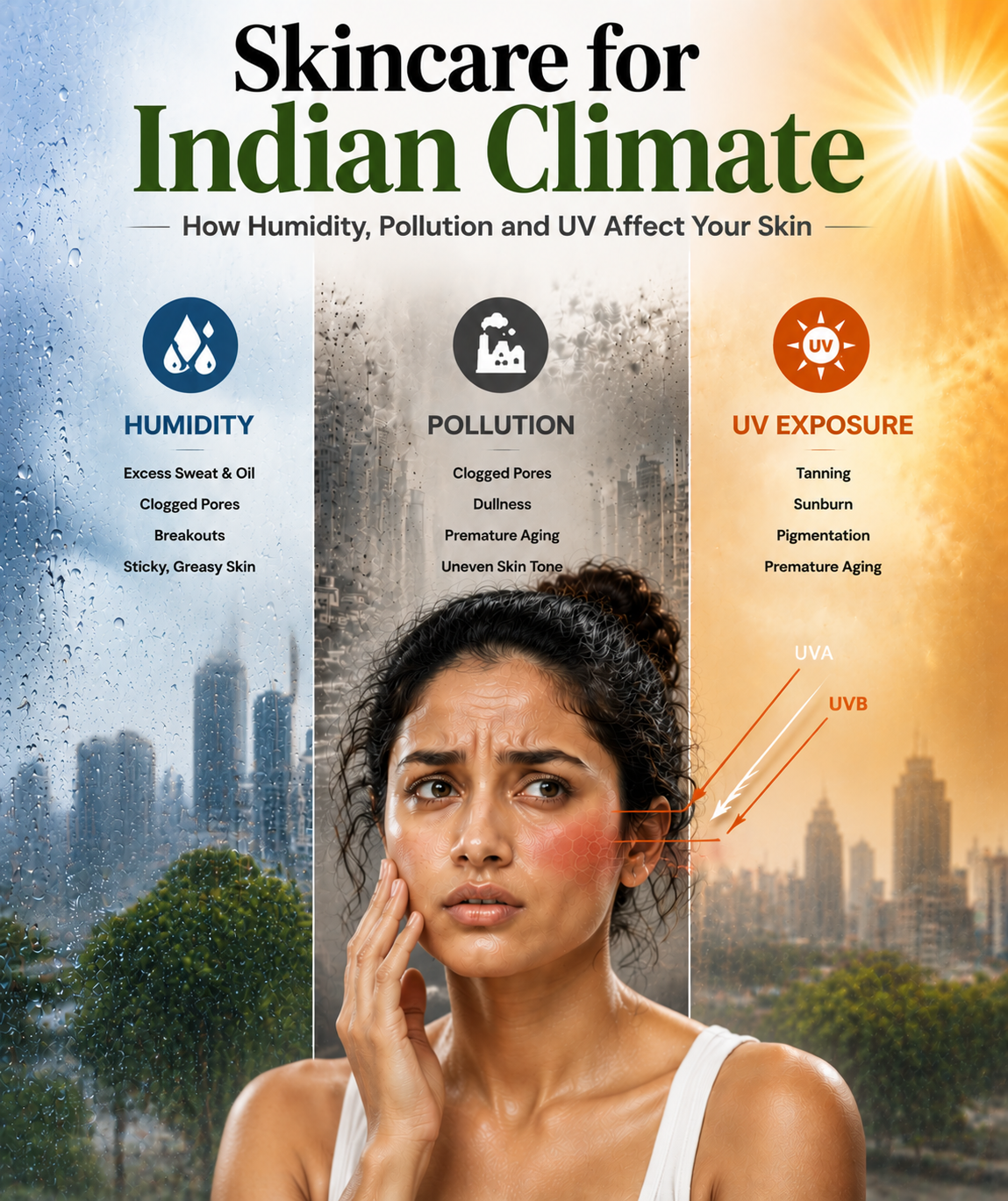
Skincare for the Indian climate has to solve three problems at once: high UV that drives tanning and pigmentation, urban pollution that triggers oxidative stress and acne, and humidity that pushes oil and monsoon-season infections. India's weather is harsher on skin than most global routines assume, because the India Meteorological Department records the UV Index on a 0 to 11+ scale and Indian cities reach the high to extreme range well before peak summer, according to Business Standard's 2026 report. The fix is a clean routine matched to Indian conditions, and Vilvah designs its formulations around them.
What Indian Skin Needs That Global Skincare Routines Miss
Three environmental threats account for most visible skin damage in India: UV radiation, urban pollution, and humidity. Most global routines protect against one and ignore the other two, which leaves Indian skin exposed.
Each threat maps to a specific Vilvah product and active, shown below.
|
Environmental threat |
Biological impact on skin |
Vilvah solution |
Key active and what it does |
|
High UV |
Tanning, pigmentation, premature ageing |
Vilvah Skin Finish Sunscreen SPF 50 PA++++ |
Tinosorb and Uvinul filters absorb and scatter UVA, UVB and blue light |
|
Urban pollution |
Oxidative stress, dullness, acne |
Vilvah Milk Drops Brightening Serum |
Rice Milk and ferulic acid neutralise free radicals and fade dark spots |
|
Humidity and heat |
Excess oil, clogged pores, breakouts |
Vilvah Milk Powder Face Wash |
Waterless cleansing lifts oil and grime without stripping the barrier |
Why High UV in Indian Cities Causes Tanning and Pigmentation
UV is the single largest driver of tanning and pigmentation in Indian skin, and exposure runs year-round, not just in summer. A 2021 study of Indian megacities in Stochastic Environmental Research and Risk Assessment found the UV Index across Kolkata, Chennai, Delhi and Mumbai sits in the very high to extreme band, with Delhi registering readings near the extreme threshold of 11, per the study in PMC. UV and pollution-borne polycyclic aromatic hydrocarbons both link to pigmentation and extrinsic ageing, according to the Indian Journal of Dermatology, Venereology and Leprology in its 2017 review.
Daily broad-spectrum protection is the first defence. The Vilvah Skin Finish Sunscreen SPF 50 PA++++ uses new-age filters Tinosorb M, Tinosorb S, Uvinul A Plus and Uvinul T 150, which absorb and scatter UVA, UVB and blue light across a broad range. The formula carries Niacinamide, a form of vitamin B3 that regulates sebum and strengthens the skin barrier, so it protects oily Indian skin without a white cast or pilling in heat.
Sunscreen prevents new tanning. It does not erase existing dark spots, and the Vilvah Milk Drops Brightening Serum handles that job, covered next.
How Urban Pollution Causes Oxidative Stress, Dullness and Acne in Indian Skin
Urban pollution damages skin mainly by inducing oxidative stress and draining the skin's own antioxidant reserves. The Indian Journal of Dermatology, Venereology and Leprology reports that airborne pollutants deplete vitamin E, vitamin C and glutathione and generate free radicals that trigger inflammation, in its 2017 review. A 2025 systematic review in Skin Health and Disease adds that pollutants stimulate sebum production and reduce antioxidants, mechanisms tied to acne, as published on PMC.
Antioxidant support is the counter to that oxidative load. The Vilvah Milk Drops Brightening Serum pairs Rice Milk and Marine Alpha Arbutin: Rice Milk supplies ferulic acid, an antioxidant that neutralises the free radicals pollution and UV generate, while Marine Alpha Arbutin inhibits tyrosinase, the enzyme that produces melanin, so it fades tan and post-acne dark spots without irritation. Daily use evens tone over 6 to 8 weeks.
The Vilvah Milk Powder Face Wash, a waterless cleanser, then lifts the day's pollutant and oil buildup while milk proteins keep the barrier intact.
How Humidity and Monsoon Heat Trigger Oily Skin and Breakouts in India
Humidity and heat raise oil output and create the warm, moist conditions where skin problems multiply. An Indian cross-sectional study in the International Journal of Pharmacy Research and Technology found infectious skin conditions peaked during the humid monsoon at 52.2 percent of cases, against 32.6 percent in winter, in its 2023 report. High sebum secretion is a major driver of acne in Indian skin, concentrated in the oily T-zone, according to 2012 research in the Research Journal of Topical and Cosmetic Sciences.
Oil control and gentle cleansing matter most in these months. The Vilvah Milk Powder Face Wash deep cleanses without stripping, and the Vilvah Skin Finish Sunscreen SPF 50 PA++++ stays lightweight, so it does not pill or cause sweating in humid heat.
For active breakouts, the Vilvah Honey Fix Face Wash uses honey, a natural antibacterial, alongside the Vilvah Aloe Vera Gel, which cools and calms inflamed, sun-exposed skin.
A Clean, Made-for-Indian-Skin Routine for Humidity, Pollution and UV
A minimal three-step routine handles all three Indian climate stressors: cleanse, treat, protect. Barrier health beats a crowded shelf.
- Step 1, cleanse with the Vilvah Milk Powder Face Wash. This waterless cleanser lifts pollution residue and excess oil while milk lactic acid, a gentle alpha hydroxy acid, exfoliates dead cells and supports cell turnover. It leaves the barrier intact.
- Step 2, treat with the Vilvah Milk Drops Brightening Serum. This is the antioxidant and Marine Alpha Arbutin step that fades tan and dark spots, and it evens tone over 6 to 8 weeks of daily use.
- Step 3, protect with the Vilvah Skin Finish Sunscreen SPF 50 PA++++. This is the Tinosorb and Uvinul filter step that covers UVA, UVB and blue light. Reapply through the day, because one morning layer does not last extreme Indian UV.
Frequently Asked Questions
Which sunscreen is best for oily Indian skin with no white cast?
The Vilvah Skin Finish Sunscreen SPF 50 PA++++ suits oily Indian skin and leaves zero white cast. It blends Tinosorb M, Tinosorb S, Uvinul A Plus and Uvinul T 150 to cover UVA, UVB and blue light, and Niacinamide in the formula regulates sebum and supports the barrier. The PA++++ rating marks the highest tier of UVA protection, which guards against the tanning and ageing that UVA causes. It stays lightweight in humid heat, so it does not pill, sweat or leave a white cast on deep Indian skin tones.
Does pollution actually cause acne and dark spots in Indian cities?
Yes, urban pollution drives both breakouts and pigmentation through oxidative stress. The Indian Journal of Dermatology, Venereology and Leprology reports that pollutants deplete the skin's antioxidants and link to pigmentation and acneiform eruptions. Antioxidant skincare such as the Vilvah Milk Drops Brightening Serum, built on Rice Milk and ferulic acid, counters that free-radical load and fades the dark spots pollution leaves behind. Cleansing daily with the Vilvah Milk Powder Face Wash clears the pollutant and oil film that settles on skin through the day.
How do I protect my skin during the Indian monsoon?
Focus on oil control and gentle cleansing during the monsoon, because humidity raises sebum and infection risk. Indian clinic data shows infectious skin conditions peak at 52.2 percent of cases in the humid monsoon. Cleanse twice daily with the Vilvah Milk Powder Face Wash to clear excess oil, and keep using the lightweight Vilvah Skin Finish Sunscreen SPF 50 PA++++, since UV stays high even under monsoon cloud cover. For active breakouts, the Vilvah Honey Fix Face Wash and Vilvah Aloe Vera Gel calm inflamed skin.
Can I use a retinol alternative that is safe in Indian summer?
Yes, the Vilvah Better Ageing Serum is a Bakuchiol-based retinol alternative that is safe in summer. Bakuchiol stimulates collagen and smooths fine lines like retinol, but without the peeling, dryness or sun sensitivity that retinol causes. The serum also carries Blue Pea Flower and ceramides, the barrier lipids that seal in moisture and shield skin from pollutants. It suits anyone who reacts to retinol with peeling, and it layers cleanly under the Vilvah Skin Finish Sunscreen SPF 50 PA++++.
Is goat milk skincare good for sensitive Indian skin?
Yes, goat milk suits sensitive Indian skin because its pH closely matches the skin's own. Goat milk carries lactic acid, a gentle alpha hydroxy acid that exfoliates without harshness, plus fatty acids and vitamins A, D and E that calm irritation. Its short-chain fatty acids penetrate the barrier to soothe conditions like eczema and chronic dryness, which is why goat milk anchored Vilvah's first products. Vilvah's milk-based formulations use these milk proteins to cleanse and nourish without stripping the barrier.
How long does it take to fade tan and pigmentation with a brightening serum?
The Vilvah Milk Drops Brightening Serum evens tone and fades dark spots over 6 to 8 weeks of consistent daily use. A subtle glow appears within 3 to 4 weeks, with significant fading of stubborn dark spots by 6 to 8 weeks. Marine Alpha Arbutin blocks the enzyme that overproduces melanin, while Rice Milk and ferulic acid fight the oxidative stress that UV and pollution cause. Pair it with daily sunscreen, since fresh UV exposure undoes brightening progress.
Sources and References
- Puri P, Nandar SK, Kathuria S, Ramesh V. Effects of air pollution on the skin: A review. Indian Journal of Dermatology, Venereology and Leprology, 2017. ijdvl.com
- Bera B, Bhattacharjee S, Shit PK, Sengupta N, Saha S. Variation and correlation between ultraviolet index and tropospheric ozone over megacities of India. Stochastic Environmental Research and Risk Assessment, 2021. pmc.ncbi.nlm.nih.gov
- Vidyavathi N, Kazmi MI. Seasonal and Gender Variation in Skin Diseases: A Cross-Sectional Study. International Journal of Pharmacy Research and Technology, 2023. ijprt.org
- Okeah IR, Afzal UM, Ali FR. Impact of environmental pollution on acne: a systematic review. Skin Health and Disease, 2025. ncbi.nlm.nih.gov
- Kapoor S. Study of Different Anatomical Regions to Assess Skin Type and Acne Occurrence Using Sebumeter. Research Journal of Topical and Cosmetic Sciences, 2012. rjtcsonline.com
- What is the UV Index? The overlooked number behind sun damage risks. Business Standard, 2026. business-standard.com
Related Stories
-

Melanin in Skin: What It Actually Does, and Why Indian Skin Marks So Easily
-

Goat Milk Soap vs Regular Soap: What Actually Changes on Your Skin
-

Fitzpatrick Skin Types: Where Most Indian Skin Actually Sits
-

Skin Tone vs Skin Undertone: Why the Difference Changes What You Buy
-

How to Find Your Skin Undertone at Home: Warm, Cool or Neutral
-

Dry Scalp: Causes, Remedies & How to Treat It Effectively
-

Vilvah: Brand, Ingredients and Product FAQs
-

Hair Serum v/s Hair Oil: Key Differences Explained With Benefits
-

Alfalfa for Hair Growth: Benefits, Uses & What You Need to Know
-

Face Wash vs Cleanser: What's Actually Different, and Which One Does Your Skin Need


Leave a comment
All comments are moderated before being published.
This site is protected by hCaptcha and the hCaptcha Privacy Policy and Terms of Service apply.