

 Track Order

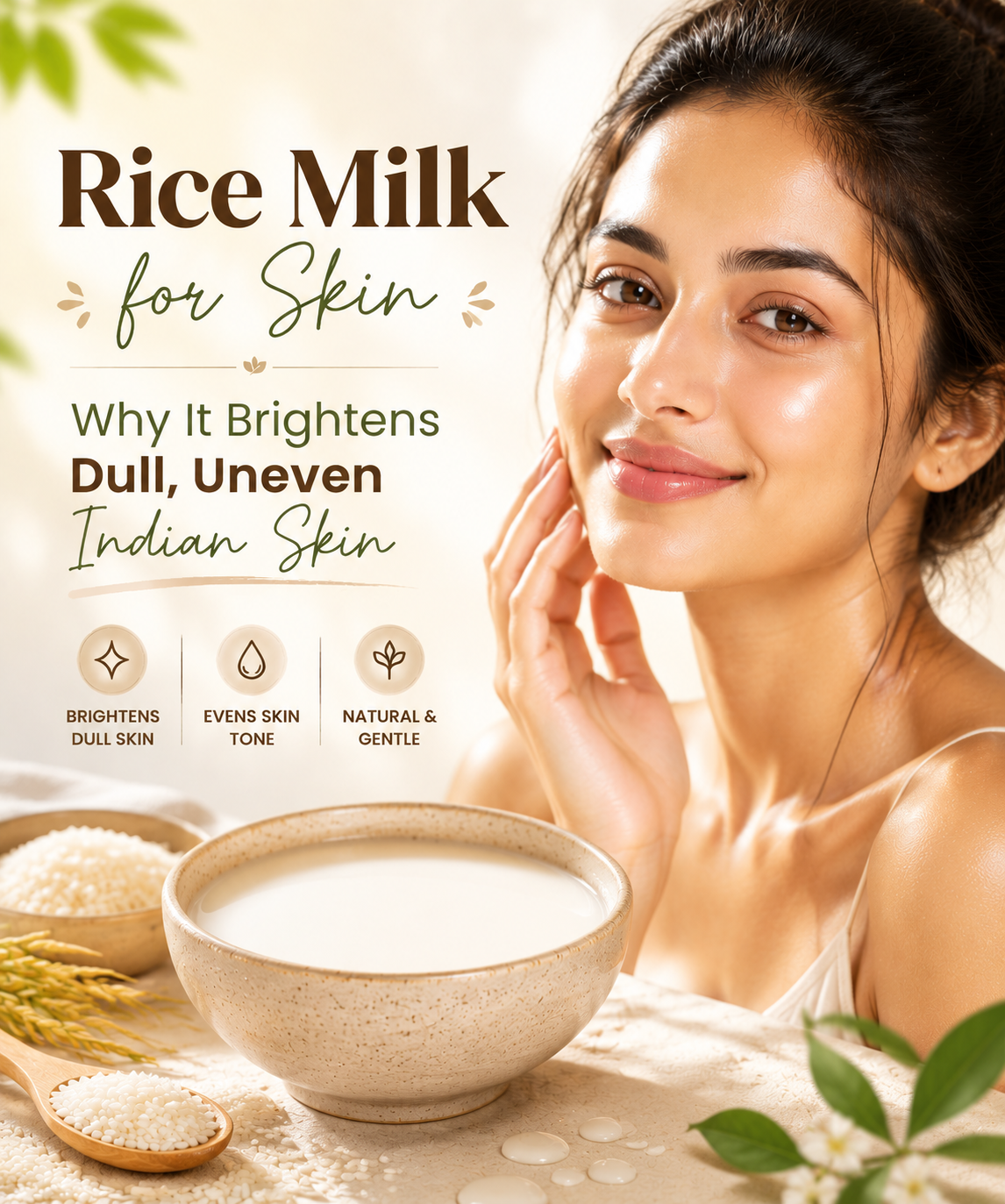
Rice milk brightens skin because it is rich in ferulic acid, also called gamma oryzanol, a rice-derived antioxidant that slows tyrosinase, the enzyme that drives melanin production and dark spots. When tyrosinase activity drops, skin makes less excess pigment, so dullness, tan, and uneven tone fade and a natural glow returns. In a placebo-controlled trial published in the Jundishapur Journal of Natural Pharmaceutical Products in 2021, a topical rice bran extract cut the skin melanin index significantly in just 14 days, with no sign of irritation. That combination, real pigment control without harshness, is why rice milk suits sensitive, acne-prone Indian skin. Vilvah builds its bestselling Vilvah Milk Drops Brightening Serum around rice milk for exactly this reason.
What Makes Rice Milk a Natural Brightening Ingredient for Indian Skin?
Rice milk is a skincare active pressed from rice and water that carries the grain's brightening phenolics, chiefly ferulic acid and gamma oryzanol. Gamma oryzanol is itself a form of ferulic acid, and per the 2021 Jundishapur trial, ferulic acid is the dominant phenolic compound in rice bran, making up 56 to 77 percent of its total phenols. These molecules act on the exact step where skin pigment is made.
Melanin forms when the enzyme tyrosinase converts the amino acid tyrosine into pigment, a process called melanogenesis. Rice-derived ferulic acid binds to tyrosinase and slows that conversion, so pigment cells produce less melanin. Research cited in the same 2021 trial reported that rice bran extract inhibited tyrosinase activity by up to 80.5 percent in lab testing.
Ferulic acid works on a second front as an antioxidant. It neutralizes the free radicals that ultraviolet light generates in skin, and those free radicals are a main trigger of UV-induced hyperpigmentation under the Indian sun. Rice milk therefore both lowers pigment output and removes the spark that sets dark spots off.
How Rice Milk Fades Hyperpigmentation, Tan, and Dark Spots
Rice milk fades hyperpigmentation by measurably lowering the skin's melanin index, the clinical readout for how much pigment skin holds. In the 2021 placebo-controlled, double-blind trial, 34 women applied a 10 percent rice bran extract lotion for 14 days, and the mean melanin index fell from 240.21 to 214.38 (P below 0.0001), while the placebo side did not change. A lower melanin index means visibly less tan and fewer dark patches.
Indian dermatology research supports the same antioxidant logic. A 2025 systematic review in the Indian Journal of Dermatology by Rashmi Sarkar and Anjali Sahu of Lady Hardinge Medical College evaluated 30 studies and concluded that antioxidants, including combinations of vitamin C, vitamin E, and ferulic acid, reduce the oxidative stress that drives facial hyperpigmentation and work as adjuncts in melasma care.
This matters for Indian skin specifically. Indian and South Asian skin carries more active pigment cells, so it tans faster and holds post-acne dark spots longer than lighter skin. An antioxidant active like rice-derived ferulic acid addresses that oxidative root cause instead of bleaching the surface, which is why the 2025 ferulic acid review in the Journal of Clinical and Aesthetic Dermatology found across 18 human studies covering 443 patients that ferulic acid formulations reduced hyperpigmentation.
Why Vilvah Milk Drops Brightening Serum Pairs Rice Milk With Alpha Arbutin
The Vilvah Milk Drops Brightening Serum pairs rice milk with plant-derived alpha arbutin so two tyrosinase-slowing actives work together without irritation. Alpha arbutin is a glycosylated form of hydroquinone that releases its pigment-blocking action slowly, fading dark spots without the redness and peeling that pure hydroquinone causes. The Vilvah Milk Drops Brightening Serum also carries marine algae extract, which reduces melanin production at the source, and hyaluronic acid, which holds water in the skin so brightened skin looks plump.
This pairing has direct India-specific support. A 2025 study in the Journal of Cosmetic Dermatology treated 124 Indian women of Fitzpatrick types III to IV for 90 days with a formulation combining alpha arbutin and trihydroxybenzoic acid glucoside under daily sunscreen, and recorded a significant fall in melanin content and an 18.4 percent drop in the modified melasma severity score, with no itching or burning reported.
Rice milk handles the gentle, antioxidant side, and alpha arbutin handles targeted spot correction. Vilvah expects a healthier barrier and a subtle glow within 3 to 4 weeks of daily use, and visibly more even tone by 6 to 8 weeks. Buyers can read the full ingredient list on the Vilvah Milk Drops Brightening Serum page.
Rice Milk vs Other Brightening Actives: A Quick Comparison
Different brightening actives hit different steps of pigment formation, which is why Vilvah blends them inside one serum. The table below maps each active in the Vilvah Milk Drops Brightening Serum, plus the sunscreen that protects the result, to its mechanism.
|
Active |
How it brightens |
Best for |
Vilvah product |
|---|---|---|---|
|
Rice milk extract (ferulic acid) |
Slows tyrosinase and neutralizes UV free radicals |
Dullness, tan, antioxidant defense |
|
|
Alpha arbutin (plant-derived) |
Releases tyrosinase-blocking action slowly |
Stubborn dark spots, post-acne marks |
|
|
Marine algae extract |
Reduces melanin production at the source |
Pigmentation, uneven tone |
|
|
Broad-spectrum UV filters |
Block new UV pigment with Tinosorb M, Tinosorb S, and zinc |
Tan prevention, holding brightening gains |
Marine algae extract, listed as Cystoseira tamariscifolia, works alongside rice milk and alpha arbutin to lower melanin output, so three actives target pigment together. Hyaluronic acid rounds out the serum by locking in moisture, since dehydrated skin reads as dull even when pigment is under control.
How to Build a Rice Milk Brightening Routine for Indian Skin
A rice milk brightening routine works best as a simple cleanse, treat, protect sequence done daily. Consistency, not the number of steps, drives the result, and the 2021 rice bran trial showed measurable pigment change in 14 days of twice-daily use.
- Cleanse with a milk-based face wash. Wash morning and night with the Vilvah Milk Powder Face Wash, a milk-based powder cleanser that foams on contact and cleans without stripping the skin barrier. Clean skin lets the serum absorb fully.
- Treat with the brightening serum. Apply the Vilvah Milk Drops Brightening Serum every morning, where rice milk and plant-derived alpha arbutin fade dark spots and even tone. A few drops cover the full face.
- Protect with daily sunscreen. Finish every morning with the Vilvah Skin Finish Sunscreen SPF 50 PA++++, since the 124-woman Indian study delivered its 18.4 percent severity drop with sunscreen on top. Fresh sun exposure rebuilds the pigment you just faded, so daily SPF protects the progress.
Add overnight renewal if ageing is also a concern. Layer the Vilvah Better Ageing Serum at night, since Vilvah positions it for visibly firmer skin within 28 days. Brightening and barrier repair both improve with overnight recovery.
Who Should Use Rice Milk Skincare, and Who Should Pair It Carefully
Rice milk skincare suits oily, acne-prone, sensitive, and combination Indian skin because it brightens without the breakouts or stinging that strong chemical lighteners cause. In the 2021 trial of 34 women, the skin redness index fell alongside the pigment drop, which the authors read as proof the rice bran lotion did not irritate skin.
People actively treating melasma or deep pigmentation should pair rice milk actives with daily sunscreen and patience, since the 2025 ferulic acid review found benefits build over one to three months of daily use. Anyone using prescription actives such as tretinoin should introduce a new serum one step at a time and watch for sensitivity.
Frequently Asked Questions
Does rice milk actually brighten skin, or is it just marketing?
Rice milk genuinely brightens skin, and the mechanism is documented. Its ferulic acid and gamma oryzanol content slows tyrosinase, the enzyme that makes melanin, and rice bran extract inhibited tyrosinase activity by up to 80.5 percent in the lab testing cited in the 2021 Jundishapur trial. In the same trial, a 10 percent rice bran lotion dropped the melanin index from 240.21 to 214.38 in 14 days. The 2025 Indian Journal of Dermatology review of 30 studies adds that ferulic acid antioxidants reduce the oxidative stress behind facial hyperpigmentation, so rice milk evens tone rather than altering your natural skin color.
Is rice milk safe for acne-prone and sensitive skin?
Rice milk is safe for acne-prone and sensitive skin, and that is one of its strongest advantages. In the 2021 double-blind trial of 34 women, the skin redness index fell alongside pigment, which the authors read as direct evidence of no irritation. Rice milk does not clog pores the way heavy facial oils can, so it brightens without triggering breakouts. Vilvah formulates the Vilvah Milk Drops Brightening Serum to fade dark spots on acne-prone skin specifically, pairing rice milk with plant-derived alpha arbutin rather than harsh hydroquinone.
How long does rice milk take to brighten dark spots?
Rice milk brightens visibly over several weeks of daily use, not overnight. Vilvah expects a subtle glow within 3 to 4 weeks and more even tone by 6 to 8 weeks with the Vilvah Milk Drops Brightening Serum. Clinical readings support that window: the 2021 rice bran trial measured a melanin drop at 14 days, and the 2025 Indian alpha arbutin study recorded an 18.4 percent fall in melasma severity over 90 days. Daily consistency drives the result, because pigment correction is cumulative.
What is the difference between rice milk and alpha arbutin for brightening?
Rice milk and alpha arbutin both slow tyrosinase, but they play different roles. Rice milk provides gentle, antioxidant-led brightening and daily defense against the UV free radicals that the 2025 Indian Journal of Dermatology review links to hyperpigmentation. Plant-derived alpha arbutin targets stubborn dark spots with slow-release pigment control, validated in 124 Indian women over 90 days. The Vilvah Milk Drops Brightening Serum combines both so they cover dullness and spot correction together.
Can rice milk help with tanning from the Indian sun?
Rice milk helps fade tan because tanning is excess melanin, and rice-derived ferulic acid both slows pigment production and neutralizes the UV free radicals that trigger it. The 2025 ferulic acid review of 443 patients confirmed ferulic acid formulations reduce hyperpigmentation through this antioxidant route, and the 2025 Indian Journal of Dermatology review of 30 studies tied that same oxidative stress to facial pigmentation in Indian patients. Pair the Vilvah Milk Drops Brightening Serum with the Vilvah Skin Finish Sunscreen SPF 50 PA++++ to fade existing tan while blocking new sun-induced pigment.
Is rice milk skincare suitable for daily use?
Rice milk skincare is suitable for daily use and works best that way. The 2025 ferulic acid review found benefits build over one to three months of consistent daily application, since steady use keeps tyrosinase suppressed and pigment fading. The actives in the Vilvah Milk Drops Brightening Serum are gentle enough for everyday morning use across oily, sensitive, and combination skin. Apply it each morning under the Vilvah Skin Finish Sunscreen for steady, cumulative brightening.
Sources and References
- Jufri M, Vardhani A, Purwaningsih E. "Evaluating the Efficacy of Lotion Containing Black Rice Bran (Oryza sativa L. indica) Extract as Skin Brightening Agent: A Clinical Trial." Jundishapur Journal of Natural Pharmaceutical Products, 2021. https://brieflands.com/journals/jjnpp/articles/114152
- Sarkar R, Sahu A. "Role of Antioxidants in Melasma: A Systematic Review." Indian Journal of Dermatology, 2025;70:125-134. Coverage: https://medicaldialogues.in/dermatology/news/antioxidant-breakthrough-a-new-era-in-multi-modal-melasma-management-systematic-review-168469
- Gabhane M, Patil R, Dharmadhikari S, et al. "Efficacy and Safety of a Topical Formulation Containing Trihydroxybenzoic Acid Glucoside and Alpha-Arbutin in Indian Females With Facial Melasma or Dark Spots." Journal of Cosmetic Dermatology, 2025. https://onlinelibrary.wiley.com/doi/10.1111/jocd.70017
- Roux J, Horton L, Babadjouni A, Kincaid CM, Mesinkovska NA. "Ferulic Acid Use for Skin Applications: A Systematic Review." Journal of Clinical and Aesthetic Dermatology, 2025. https://jcadonline.com/ferulic-acid-use-for-skin-applications/
Related Stories
-

Skin Tone vs Skin Undertone: Why the Difference Changes What You Buy
-

How to Find Your Skin Undertone at Home: Warm, Cool or Neutral
-

Dry Scalp: Causes, Remedies & How to Treat It Effectively
-

Vilvah: Brand, Ingredients and Product FAQs
-

Hair Serum v/s Hair Oil: Key Differences Explained With Benefits
-

Alfalfa for Hair Growth: Benefits, Uses & What You Need to Know
-

Face Wash vs Cleanser: What's Actually Different, and Which One Does Your Skin Need
-

Hair Serum Benefits: The Missing Step in Your Hair Care Routine
-

Premature Grey Hair: Why It Happens Young and How to Slow It Down
-

Rosemary for Hair Growth: What the Research Actually Shows


Leave a comment
All comments are moderated before being published.
This site is protected by hCaptcha and the hCaptcha Privacy Policy and Terms of Service apply.