

 Track Order

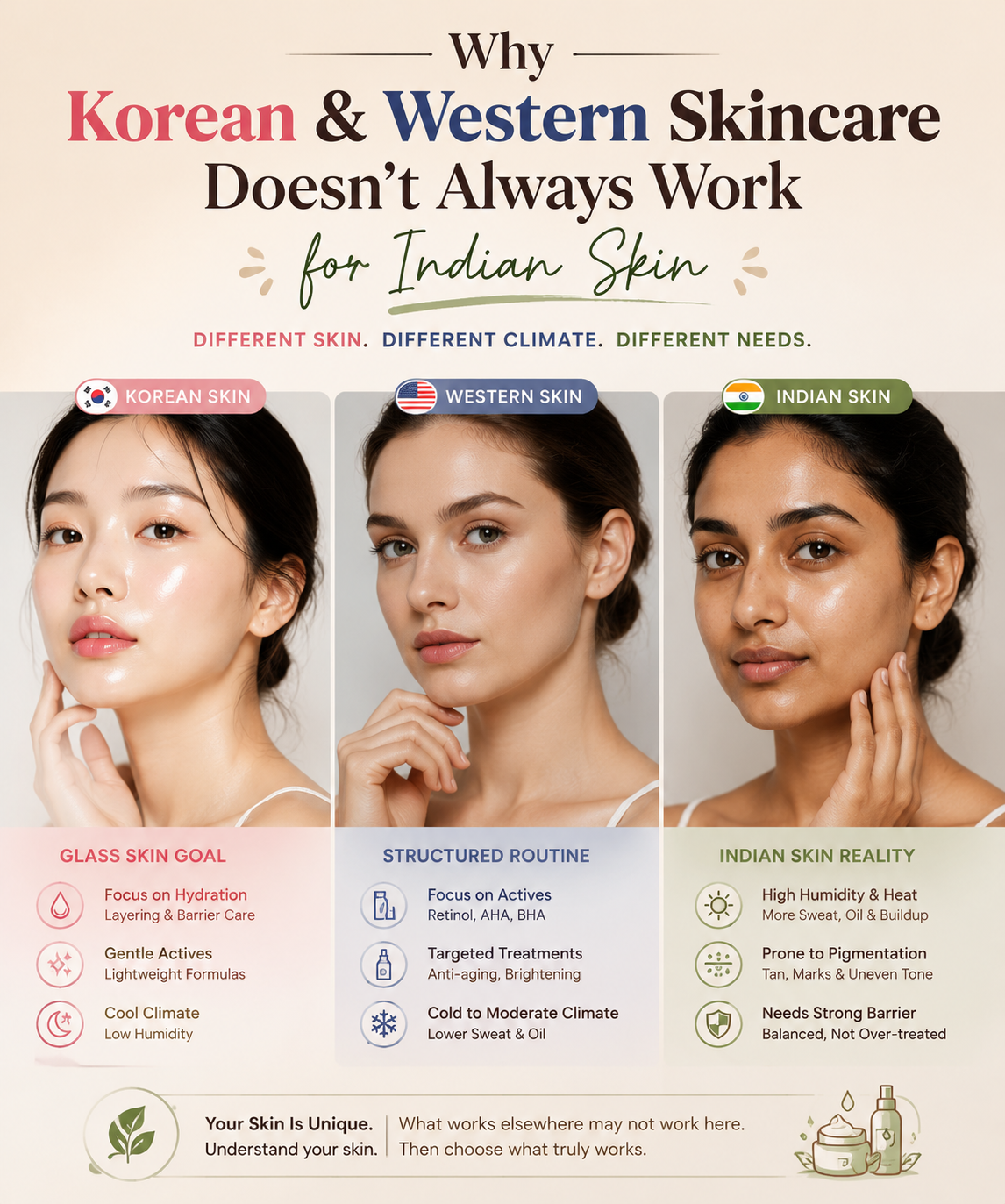
Korean and Western skincare often underperforms on Indian skin because it is built for a different skin type, a different set of concerns, and a different climate. Most Indian skin sits at Fitzpatrick type IV to V, the deeper end of a scale that began with fair, sun-sensitive skin, and its first problems are pigmentation, tanning, and dark marks rather than fine lines (Indian Journal of Dermatology, Venereology and Leprology, 2009). India is also hot, humid, and high in UV, so a routine designed for cool, dry Europe or cool, humid Korea solves a different problem. Vilvah formulates plant-based, milk-infused skincare around the Indian concern profile and Indian climate instead.
What Makes Indian Skin Different from Korean and Western Skin?
Fitzpatrick skin type is a dermatology scale that classifies skin by how it reacts to sun, from type I (very fair, always burns) to type VI (deeply pigmented, rarely burns). The most common Indian skin type is V, followed by IV, on a scale that began with fair Western skin before types V and VI were added for brown and dark skin (Indian Journal of Dermatology, Venereology and Leprology, 2009). The defaults of global skincare were calibrated on skin unlike most Indian skin.
Higher melanin is real sun protection. Eumelanin, the brown-black pigment that dominates Indian skin, dissipates more than 99.9% of the UV and visible light it absorbs (Indian Journal of Dermatology, 2016).
The difference is not that Indian skin is a separate organ. Melanocyte numbers stay roughly constant across every skin colour, and what changes is how much melanin those cells make and how strongly the skin reacts to triggers (Indian Journal of Dermatology, 2016). The right question is not whether Indian skin is different biology, but which concerns and which climate it faces.
Why Pigmentation Is the Number One Skin Concern for Indian Skin
Pigmentation is the leading skincare concern in India, and it shows up early. Post-inflammatory hyperpigmentation (PIH) is the dark mark left after acne or irritation heals, and it is more frequent and longer-lasting in deeper skin tones. More than 70% of Indians with a history of acne carry these post-acne marks before age 35 (Indian Journal of Dermatology, 2016).
A study of 1,204 women across Chennai, Mumbai, Kolkata, and Delhi mapped the concern profile in detail. Melasma, a pigmentation disorder of symmetrical brown facial patches driven by UV and hormones, peaked at about 30% in women aged 40 to 65 (Indian Journal of Dermatology, Venereology and Leprology, 2014).
The same study found dark circles in most women, with moderate to severe under-eye pigmentation rising from 50% to 85% with age. Over 70% of women past 30 carried more than ten dark spots on the face, most of them post-acne marks before 40. This is a pigmentation-first concern map, not a wrinkle-first one.
Skin tone also varies sharply across the country, with lighter complexions recorded in Delhi and significantly darker complexions in Chennai (Indian Journal of Dermatology, Venereology and Leprology, 2014). A single global formula cannot assume one Indian skin tone.
How India's Climate Changes What Your Skincare Needs to Do
India's climate stresses the skin barrier in ways a cool, dry climate does not. Heat alone raises water loss through the skin and pushes skin pH up, both signs of a stressed barrier, and in a controlled study hot exposure raised transepidermal water loss from 25.75 to 58.58 grams per hour per square metre (Journal of Clinical Medicine, 2022). In a hot, humid country, a routine designed for cold weather targets the wrong problem.
UV load is the other half of the climate gap. India receives high annual doses of long-wave UVA1, the most abundant UV reaching the ground, which drives pigmentation and photoageing (Indian Journal of Dermatology, 2016). Sunscreen built for fair skin leaves a white cast on deeper Indian tones, so people skip it, and skipping sunscreen makes pigmentation worse.
This is why Indian skincare prioritises lightweight, non-greasy textures and high broad-spectrum protection that disappears on deep skin. Rich occlusive creams built for dry European winters feel heavy and clog pores in Indian heat.
Korean vs Western vs Indian Skincare: What Each Routine Is Built For
Each tradition optimises for the skin and weather it grew up around. The table below shows what each routine centres and what it underweights for Indian skin.
|
Routine origin |
Concern it centres |
Climate it assumes |
Texture priority |
What it underweights for Indian skin |
|
Korean (K-beauty) |
Hydration and glass-skin glow through layers |
Cool and humid, lower UV |
Many lightweight essences and layers |
Deep-tone sun protection and pigmentation actives |
|
Western |
Anti-ageing, fine lines, and wrinkles |
Cool and dry, lower UV |
Rich creams and occlusives |
Pigmentation, tanning, and heat-friendly textures |
|
Indian (Vilvah) |
Pigmentation, tanning, dark circles, barrier in heat |
Hot and humid, high UV |
Lightweight, non-greasy, zero white cast |
Built for this profile directly |
None of these routines is wrong. A Korean or Western routine is optimised for a different job, not a worse one. For Indian skin, the job is pigmentation control, deep-tone sun protection, and barrier care in heat.
Which Vilvah Products Are Made for Indian Skin and Climate
Vilvah builds each formula around the Indian concern profile, with milk and plant actives chosen for specific jobs. Here is how the core Vilvah range maps to the concerns above.
- The Milk Drops Brightening Serum targets dark spots and uneven tone using rice milk and alpha arbutin. Rice milk carries ferulic acid and antioxidants that brighten dull skin, while alpha arbutin slows tyrosinase, the enzyme that produces melanin, so spots fade without harsh bleaching.
- The Skin Finish Sunscreen SPF 50 PA++++ gives broad-spectrum UVA and UVB protection through new-age UV filters and melts into deep Indian skin tones with zero white cast. It stays lightweight in heat, so daily reapplication becomes realistic, which is the biggest gap in Indian sun care.
- The Better Ageing Serum uses bakuchiol, a plant-derived active that signals skin to firm and smooth like retinol without the peeling or added sun sensitivity.
- The Milk Powder Face Wash cleanses with milk proteins that lift dirt and oil without stripping the barrier. Goat milk sits close to skin pH and carries lactic acid, a mild exfoliating acid that clears dead cells and supports glow.
- The Aloe Vera Gel cools and calms heat-stressed, irritated, and acne-prone skin, which suits Indian summers and sensitive skin.
- The Milk Body Lotion uses oat milk, whose beta-glucans calm redness and reinforce the barrier, for light full-body hydration that does not feel heavy in humidity.
- The Goat Milk Shampoo repairs dry, frizzy hair with goat milk proteins and lipids that smooth the cuticle without harsh silicones.
Niacinamide, found across the Vilvah range, regulates oil and reinforces the barrier, and dermatology reviews list it among effective topical agents for hyperpigmentation (Indian Journal of Dermatology, 2016). For pigmentation, pairing the Milk Drops Brightening Serum with the Skin Finish Sunscreen addresses the marks and the cause at once.
How to Build a Skincare Routine for Indian Skin
A minimal, barrier-first routine beats a long imported one for Indian skin. Cleanse, treat pigmentation, hydrate lightly, and protect from UV, keeping every texture light for heat.
- Cleanse with the Milk Powder Face Wash to remove sweat, oil, and pollution without stripping the barrier. Non-stripping cleansing matters most in heat, where over-cleansing triggers more oil.
- Hydrate lightly with the Milk Face Toner to balance skin without heavy layers that feel sticky in humidity.
- Treat with the Milk Drops Brightening Serum in the morning for dark spots, and the Better Ageing Serum at night for firmness without retinol irritation.
- Protect every morning with the Skin Finish Sunscreen SPF 50 PA++++, the step that decides whether pigmentation improves or returns.
Frequently Asked Questions
Does Korean skincare work for Indian skin?
Korean skincare works well for hydration but is not built for India's main concerns. K-beauty routines prioritise glass-skin glow and many lightweight layers suited to a cool, humid, lower-UV climate. Indian skin needs pigmentation-first actives and high broad-spectrum sun protection that disappears on deep tones, which is what Vilvah formulates around. A Korean essence fits inside an Indian routine, but it does not replace pigmentation care and a no-white-cast sunscreen like the Vilvah Skin Finish Sunscreen SPF 50 PA++++.
Why does my skin tan and pigment so easily in India?
Your skin tans and pigments easily because most Indian skin is Fitzpatrick type IV to V, which makes more melanin in response to UV. India also receives high annual UVA1 doses that drive pigmentation and photoageing (Indian Journal of Dermatology, 2016). The same melanin that guards against burning reacts strongly to sun and inflammation, leaving dark marks and uneven tone. Daily broad-spectrum protection with the Vilvah Skin Finish Sunscreen SPF 50 PA++++ is the most effective control.
What is the best sunscreen for Indian skin with no white cast?
The Vilvah Skin Finish Sunscreen SPF 50 PA++++ is formulated for Indian skin with zero white cast on deep tones. It uses new-age UV filters for broad-spectrum UVA and UVB protection and stays lightweight and non-greasy in heat. Because Indian skin carries a high UVA1 load (Indian Journal of Dermatology, 2016), a sunscreen people actually reapply protects pigmentation better than a high number on a formula they avoid.
Which Vilvah serum is best for dark spots and pigmentation?
The Vilvah Milk Drops Brightening Serum is the pick for dark spots and uneven tone. It pairs rice milk, rich in brightening ferulic acid, with alpha arbutin, which slows the melanin-producing enzyme tyrosinase. Pigmentation appears early and ranks as the leading concern for Indian skin (Indian Journal of Dermatology, Venereology and Leprology, 2014), so a daily brightening serum plus sunscreen targets the marks and the cause together.
Is bakuchiol better than retinol for Indian skin?
Bakuchiol is a gentler choice than retinol for many people on Indian skin. It signals skin to firm and smooth like retinol, without the peeling, dryness, or added sun sensitivity that retinol causes. The Vilvah Better Ageing Serum uses bakuchiol so anti-ageing care does not trigger the irritation or fresh pigmentation that deeper skin develops after inflammation.
Do I need a different skincare routine for Indian weather?
Yes, Indian weather calls for lighter textures and stronger sun protection. Heat raises water loss and skin pH and stresses the barrier (Journal of Clinical Medicine, 2022), and rich winter creams clog pores in humidity. A barrier-friendly cleanser, a brightening serum, light hydration, and a daily no-white-cast sunscreen from Vilvah suit Indian conditions better than a heavy imported routine.
Sources and References
- Sachdeva S. Fitzpatrick skin typing: Applications in dermatology. Indian Journal of Dermatology, Venereology and Leprology, 2009. ijdvl.com
- Nouveau S, Agrawal D, Kohli M, Bernerd F, Misra N, Nayak CS. Skin Hyperpigmentation in Indian Population: Insights and Best Practice. Indian Journal of Dermatology, 2016. pmc.ncbi.nlm.nih.gov
- Hourblin V, Nouveau S, Roy N, de Lacharriere O. Skin complexion and pigmentary disorders in facial skin of 1204 women in 4 Indian cities. Indian Journal of Dermatology, Venereology and Leprology, 2014. ijdvl.com
- Herrero-Fernandez M, Montero-Vilchez T, et al. Impact of Water Exposure and Temperature Changes on Skin Barrier Function. Journal of Clinical Medicine, 2022. digibug.ugr.es
Related Stories
-

Fitzpatrick Skin Types: Where Most Indian Skin Actually Sits
-

Skin Tone vs Skin Undertone: Why the Difference Changes What You Buy
-

How to Find Your Skin Undertone at Home: Warm, Cool or Neutral
-

Dry Scalp: Causes, Remedies & How to Treat It Effectively
-

Vilvah: Brand, Ingredients and Product FAQs
-

Hair Serum v/s Hair Oil: Key Differences Explained With Benefits
-

Alfalfa for Hair Growth: Benefits, Uses & What You Need to Know
-

Face Wash vs Cleanser: What's Actually Different, and Which One Does Your Skin Need
-

Hair Serum Benefits: The Missing Step in Your Hair Care Routine
-

Premature Grey Hair: Why It Happens Young and How to Slow It Down


Leave a comment
All comments are moderated before being published.
This site is protected by hCaptcha and the hCaptcha Privacy Policy and Terms of Service apply.