

 Track Order

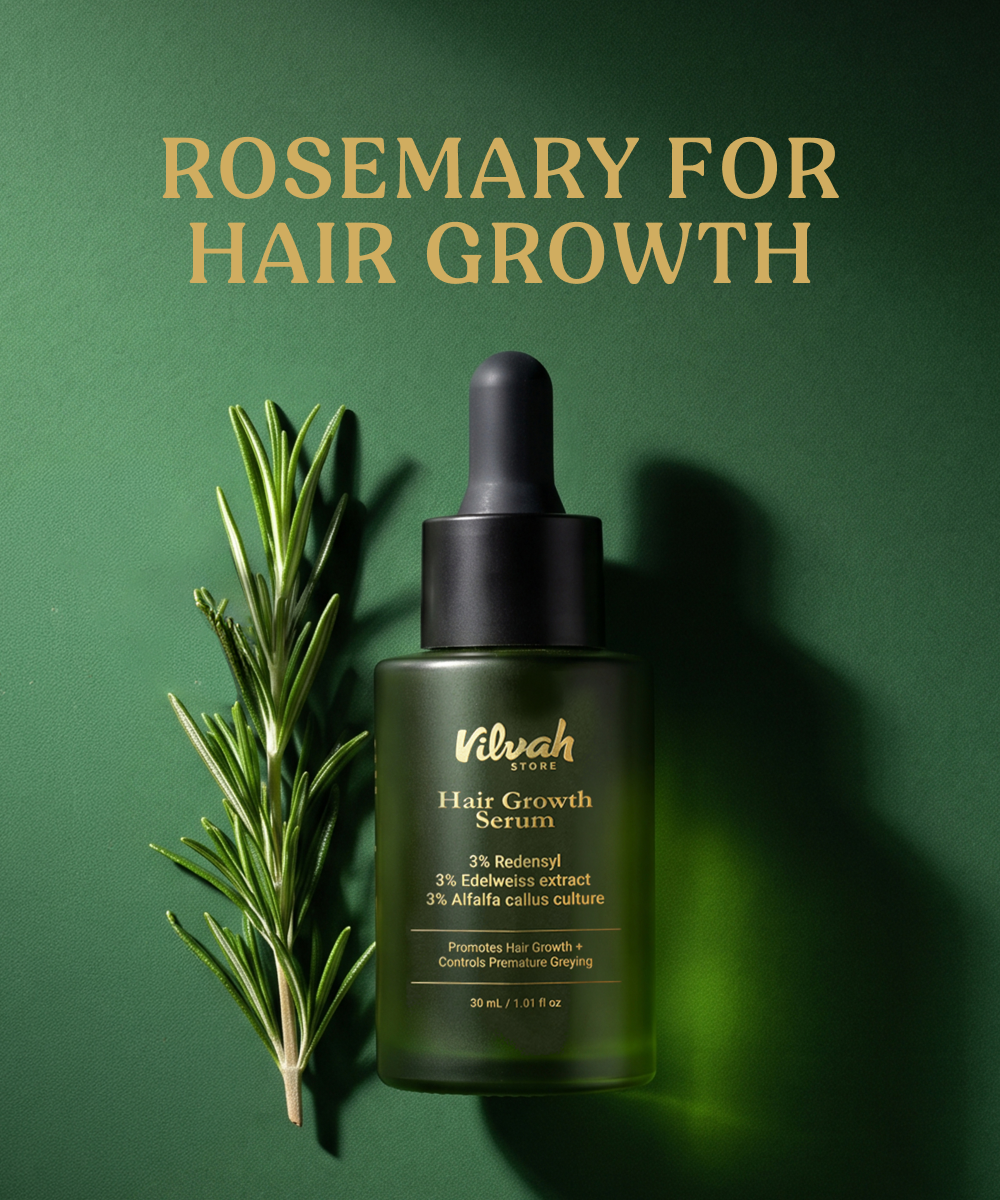
One randomised comparative trial of 100 people found rosemary oil produced a significant increase in hair count at six months, with no significant difference from minoxidil 2%. Nothing measurable happened at the three-month mark in either group. Rosemary works by supporting microcapillary perfusion at the follicle, and the format you use it in decides whether it stays on your scalp long enough to matter. The Vilvah Hair Growth Serum carries Rosmarinus officinalis leaf extract as its first ingredient in a leave-in overnight base.
The study everyone quotes, quoted properly
The trial is Panahi and colleagues, published in Skinmed in 2015. It is a randomised comparative trial, and it remains the most cited piece of human evidence on rosemary and hair.
Here is what it actually did. One hundred patients with androgenetic alopecia were randomly assigned to either rosemary oil (50 people) or minoxidil 2% (50 people), applied twice daily for six months. Standardised microphotographic assessment was taken at baseline, at three months and at six months.
At three months, nothing. Neither group showed a significant change in mean hair count.
In six months, both groups improved. Both rosemary oil and minoxidil 2% showed a significant increase in hair count compared with baseline and with the three-month measurement.
No significant difference between the two groups at either the three-month or six-month point.
On tolerability, scalp itching rose in both groups compared with baseline. Itching was significantly more frequent in the minoxidil group at both assessment points. Dry hair, greasy hair and dandruff showed no significant change in either group.
The number that actually changes your behaviour
Three months of twice-daily application produced no measurable result. Six months did.
That single finding is worth more than every "rosemary transformed my hair in 30 days" video on the internet. Hair grows in cycles, and a follicle re-entering its growth phase does not deliver visible density for months. Anyone abandoning rosemary at week eight is quitting before the study's own timeline had produced anything.
Two honest limits worth carrying with the headline. This is one trial with 100 participants. It compared rosemary against minoxidil 2%, not against the 5% formulation, and it studied androgenetic alopecia specifically rather than every kind of hair fall.
How rosemary works on the scalp
The mechanism the research points to is microcapillary perfusion. Rosemary supports blood flow through the small vessels feeding the hair follicle.
A follicle is metabolically demanding tissue. It needs a steady supply of oxygen and nutrients to sustain its growth phase, and that supply arrives through a dense capillary network at the base of the follicle. Improve perfusion and you improve the delivery system the follicle depends on.
Rosemary also carries rosmarinic acid and carnosic acid, polyphenols with antioxidant activity that help buffer the scalp against oxidative stress.
Rosemary oil, rosemary water, rosemary extract: which format
This is where most people go wrong, and it has nothing to do with rosemary itself.
Rosemary essential oil is the format the trial used. It is potent, and it needs diluting in a carrier oil before it touches the scalp. Undiluted essential oil can be irritating. It also sits greasy, which means most people wash it out, and washing out an active shortens its contact time with the follicle.
Rosemary water has become popular because it is easy to make at home. It is also the weakest format by a distance. Boiling rosemary in water extracts very little of the active compounds, and homemade batches carry a real contamination risk once they sit at room temperature for a few days.
Rosemary leaf extract is the format used in formulated leave-in products. The plant compounds are extracted under controlled conditions, standardised, and suspended in a base designed to absorb into the scalp rather than coat the hair. No dilution step, no carrier oil, no rinse.
The format question comes down to contact time. An active that gets washed off in the morning has a few hours to work. An active that absorbs and stays on all night, every night.
How to use rosemary for hair growth
- Apply to the scalp, not the lengths. Rosemary works on the follicle. Coating your hair does nothing for growth.
- Massage for two to three minutes. The massage supports circulation, which is the mechanism you are trying to activate.
- Use it consistently. Four to seven nights a week beats a heroic weekend routine.
- Give it six months. The research says results arrive between month three and month six. Judge it then.
- If you use essential oil, dilute it. A carrier oil is not optional with an undiluted essential oil.
Rosemary in the Vilvah Hair Growth Serum
Most hair serums open their ingredient list with Aqua. The Vilvah Hair Growth Serum opens with Rosmarinus officinalis (Rosemary) leaf extract, which means rosemary is the largest part of the formula rather than the tenth thing on a label.
Rosemary is not working alone in it. The serum carries three disclosed actives at 3% each. 3% Redensyl for follicle activity and density. 3% Alfalfa callus culture for scalp vitality and pH balance. 3% Swiss Alpine Edelweiss extract, an alpine antioxidant that helps shield pigment-producing melanocytes from free radical stress.
Bhringaraj extract works alongside rosemary on follicle support. Hyaluronic acid holds scalp hydration overnight, hydrolysed keratin and panthenol condition the fibre, and Lactobacillus ferment lysate supports the scalp microbiome and barrier.
The base is Aloe vera leaf water rather than a carrier oil, so the serum absorbs without residue and needs no rinse in the morning. It stays Minoxidil-free, suits colour-treated and chemically treated hair, works on oily and dandruff-prone scalps, and is designed for anyone above 18.
The Vilvah Hair Growth Serum was tested with more than 1,000 Indian users before launch and filed for a patent. Across that study, hair fall reduced considerably at around four to six weeks, with noticeable growth and improved density by two months.
How to use it: one full dropper to the scalp, massage two to three minutes, leave overnight, no rinse. Four to seven nights a week.
Building the routine
An overnight scalp treatment is only half the job. What you wash with in the morning decides whether the scalp barrier holds.
The Vilvah Goat Milk Shampoo is sulphate-free at pH 6, with Ceramide NG and Ceramide NP for barrier strength, hydrolysed pea protein for frizz, and goat milk fatty acids for moisture.
The Vilvah Hair Growth Combo pairs the 30 mL serum with the 250 mL Goat Milk Shampoo at ₹1,499.
For the wider picture, see our guides on hair thinning causes and healthy hair growth.
Frequently asked questions
Does rosemary actually help hair growth?
The published evidence comes from a randomised comparative trial of 100 people, which found a significant increase in hair count at six months of twice-daily rosemary oil application, with no significant difference from minoxidil 2%.
How long does rosemary take to work on hair?
The trial measured no significant change at three months and a significant increase at six months. Plan for months, not weeks.
Is rosemary oil better than minoxidil?
The trial found no significant difference in hair count between rosemary oil and minoxidil 2% at either three or six months. It did find scalp itching was significantly more frequent in the minoxidil group. The study did not compare rosemary against minoxidil 5%.
Is rosemary water as good as rosemary oil?
Homemade rosemary water extracts far less of the active compounds than an oil or a standardised extract, and it carries a contamination risk once stored. A formulated leave-in serum gives you standardised actives and a base built to absorb.
Can I use rosemary on a sensitive or oily scalp?
Undiluted essential oil can irritate and needs a carrier. The Vilvah Hair Growth Serum uses rosemary leaf extract in an Aloe vera base designed to be gentle across scalp types, including oily and dandruff-prone.
Sources
- Panahi Y, Taghizadeh M, Marzony ET, Sahebkar A. Rosemary oil vs minoxidil 2% for the treatment of androgenetic alopecia: a randomized comparative trial. Skinmed. 2015;13(1). pubmed.ncbi.nlm.nih.gov/25842469
Related Stories
-

Melanin in Skin: What It Actually Does, and Why Indian Skin Marks So Easily
-

Goat Milk Soap vs Regular Soap: What Actually Changes on Your Skin
-

Fitzpatrick Skin Types: Where Most Indian Skin Actually Sits
-

Skin Tone vs Skin Undertone: Why the Difference Changes What You Buy
-

How to Find Your Skin Undertone at Home: Warm, Cool or Neutral
-

Dry Scalp: Causes, Remedies & How to Treat It Effectively
-

Vilvah: Brand, Ingredients and Product FAQs
-

Hair Serum v/s Hair Oil: Key Differences Explained With Benefits
-

Alfalfa for Hair Growth: Benefits, Uses & What You Need to Know
-

Face Wash vs Cleanser: What's Actually Different, and Which One Does Your Skin Need


Leave a comment
All comments are moderated before being published.
This site is protected by hCaptcha and the hCaptcha Privacy Policy and Terms of Service apply.