

 Track Order

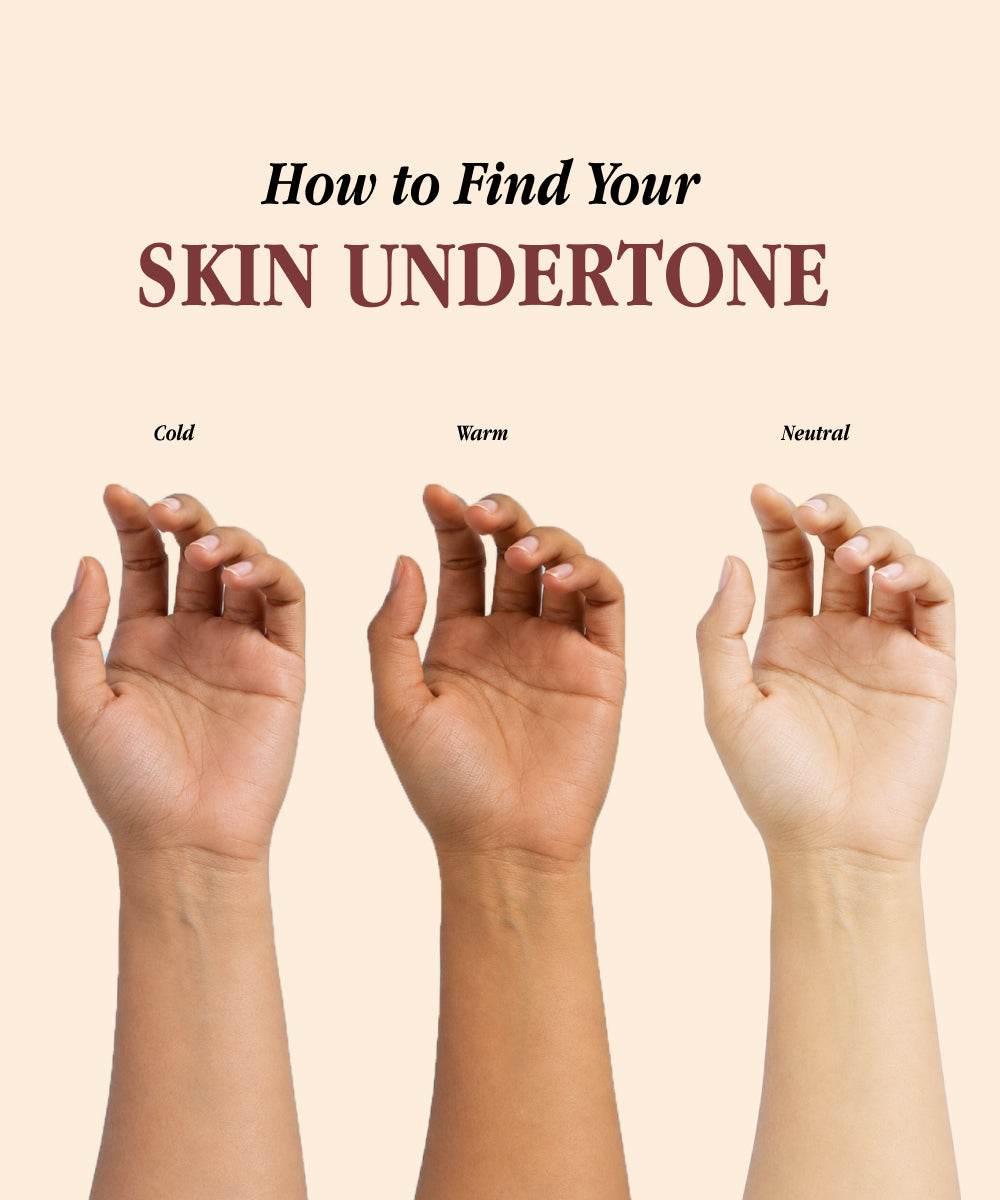
Most people discover their undertone the expensive way. A foundation that looked correct under shop lighting turns grey by lunchtime. A concealer sits on the under-eye like chalk. A mineral sunscreen leaves a faint violet film that photographs badly. Every one of those mismatches traces back to the same missed step, which is knowing what colour sits underneath your skin rather than what shade sits on top of it.
Undertone is a separate question from skin tone, and most Indian shoppers never get a clear answer to it. Search interest confirms the gap. In India, roughly 14,800 people a month search for warm undertone skin and another 2,900 search for skin undertone directly, yet almost none of the top results adjust their advice for skin that tans easily and rarely burns.
This guide fixes that. It explains what an undertone physically is, walks through five at-home tests, and rates each one honestly for how well it works on Indian skin. Some of the tests you have read about elsewhere are close to useless here, and Vilvah would rather tell you that than let you draw a confident conclusion from a bad signal.
What a Skin Undertone actually is
Your visible skin colour comes mainly from melanin produced in the epidermis, with a smaller contribution from carotenoids and from oxygenated and deoxygenated haemoglobin in the dermal capillaries beneath. Melanin sets the depth. The pigments underneath it tip the hue slightly warm or slightly cool.
Melanocytes produce two chemically distinct melanins. Eumelanin reads brown to black. Pheomelanin reads yellow to red. The ratio between the two, along with the size and distribution of the melanosomes carrying them, is what makes two people at identical depth look completely different next to each other.
That is the whole mechanism. Undertone is not a personality type or a colour season. Undertone is the sum of the pigments sitting below the surface, and it stays broadly stable across your life because it is set genetically rather than by sun exposure.
One correction worth making, because it circulates constantly in Indian beauty content. Deeper skin does not have more melanocytes. Melanocyte density is comparable across ethnicities, and the difference lies in how much melanin those cells produce and how it is packaged and distributed.
Skin Tone and Skin Undertone are not the Same Question
Skin tone is depth, running from fair through wheatish and medium to deep. Undertone is the hue underneath that depth. Two people can share a foundation shade number and still need different shades, because one runs golden and the other runs pink.
The practical test is simple. Your skin tone changes with sun exposure. Facultative pigmentation, which is the tanning response, sits on top of your genetically set constitutive pigmentation and is roughly proportional to it. Your undertone does not move when you tan. Only the depth does.
For a full breakdown of depth categories, Vilvah covers that separately in types of skin tones and how to know yours. This piece stays on the layer underneath.
Five At-home Undertone Tests, Rated for Indian Skin
Run at least three of these before you conclude anything. Any single test can mislead. Agreement across three is a reliable read.
1. The White Cloth Test
Reliability on Indian skin: high.
Remove all makeup, tie your hair back, and stand near a window in indirect daylight. Hold a sheet of plain white paper or white cloth directly under your jaw and look at your face, not the paper.
Skin that looks slightly yellow, golden or peach against the white reads warm. Skin that looks slightly pink, red or bluish reads cool. Skin that looks neither, or shifts depending on the angle, reads neutral. Some Indian skin looks faintly greenish or greyish against white, which points to an olive undertone.
This works better than most tests on medium to deep skin because it compares your skin against a fixed reference point rather than asking you to judge a colour in isolation.
2. The Jewellery Test
Reliability on Indian skin: high.
Hold a gold piece against one wrist and a silver piece against the other, in daylight. Look at which one makes your skin look brighter and which one looks like it is sitting on top of your skin rather than belonging to it.
Gold flattering you points to warm. Silver flattering you points to cool. Both looking equally good points to neutral. If gold looks good but silver looks merely acceptable rather than wrong, you are likely warm-neutral, which is common across Indian skin.
Use real metal rather than a photograph, and use pieces that are actually gold and silver coloured rather than rose gold or oxidised finishes.
3. The Vein Test
Reliability on Indian skin: low to moderate.
The instruction everyone repeats is to look at the veins on your inner wrist. Blue or purple reads cool, green reads warm, a mix reads neutral.
The problem is that this test depends on light passing through relatively thin, relatively translucent skin. On medium and deeper skin, higher melanin content changes how much light reflects back from that depth, and the veins frequently read ambiguous or simply green regardless of actual undertone. Plenty of people with genuinely cool Indian skin see green veins.
Treat the vein test as one weak signal among several. Never let it override the white cloth and jewellery tests when they disagree with it.
4. The Sun Response Test
Reliability on Indian skin: low.
The classic version says that skin which burns before it tans is cool and skin which tans quickly is warm. That logic was built for populations where burning and tanning divide people meaningfully.
This is not a matter of opinion. When researchers adapted the Fitzpatrick phototype questionnaire for Indian skin, self-administered by 70 healthy Indian volunteers, the two items relating to tanning habits were judged irrelevant based on how the subjects responded, and the researchers removed them from the modified questionnaire (Sharma VK, Gupta V, Jangid BL, Pathak M. Clinical and Experimental Dermatology, 2018).
If a question was not discriminating enough to keep in a validated clinical instrument for Indian skin, it should not be carrying weight in your undertone decision either. Skip this one.
5. The Neutral Clothing Test
Reliability on Indian skin: moderate to high.
Hold a pure white garment and an off-white or cream garment near your face, then repeat with a true blue and a mustard or olive.
Cream, mustard and olive making you look healthier points to warm. Pure white and true blue making you look brighter points to cool. Looking fine in all four points to neutral. Pay attention to the area under your eyes and around your mouth, where a mismatch shows first as a dull or grey cast.
The Olive Undertone Question
A meaningful share of Indian skin does not resolve cleanly into warm, cool or neutral. It reads slightly green or grey against white, holds a golden depth in sunlight, and turns sallow in foundations built purely on yellow or purely on pink bases.
That is olive, and it behaves like a fourth category rather than a variant of warm. Olive skin often needs a shade with a green or neutral base to avoid looking orange, and it is the group most often let down by imported shade ranges built around warm-versus-cool as a binary.
If your white cloth test keeps returning "neither exactly yellow nor exactly pink, but slightly muted", stop trying to force a warm or cool answer. Shop for olive-friendly bases instead.
What Changes your Reading, and What Does Not
Four things distort an undertone test, and none of them change your actual undertone.
A fresh tan. Tanning raises depth without touching hue. Test on an area that stays covered, such as the inner upper arm, if your face is currently tanned. Vilvah covers depth recovery separately in how to remove tan from your face.
Active pigmentation. Melasma, post-acne marks and sun spots create localised colour that has nothing to do with undertone. Read a clear patch of skin, not a marked one. For the pigmentation itself, see how to fade dark spots and pigmentation on Indian skin.
Artificial lighting. Warm bulbs push everyone golden and cool-white tubelights push everyone ashy. Indirect daylight is the only honest light for this.
Recent product use. Foundation, tinted moisturiser, tinted sunscreen and even a rich cream applied minutes earlier all shift what you see. Cleanse first with something that does not leave a film, such as the Milk Powder Face Wash built on rice milk powder and papain enzyme, then wait twenty minutes before testing.
What your Undertone Actually Changes when You Shop
Undertone earns its keep in exactly three decisions.
Base makeup shade selection. This is the obvious one. A warm undertone needs a yellow or golden base, a cool undertone needs a pink or neutral base, and an olive undertone needs a green-leaning base. Depth gets you into the right shade family, and undertone gets you the right shade within it.
Sunscreen finish. Mineral filters sit on the surface of the skin and scatter light, which is why they can leave a white or violet cast that shows most on medium, deep and olive skin. A sunscreen built to avoid that matters more the further your skin sits from fair. Vilvah's Skin Finish Sunscreen SPF 50 PA++++ is a lightweight gel-cream formulated for Indian weather with new-age UV filters and no white cast, and the Melt-in-Milk Sunscreen SPF 50 offers a soy milk extract formula designed for the same problem in humid conditions. There is more on this in how to apply sunscreen without a white cast.
How your pigmentation reads. Warm and olive skin tends to hold dark spots as brown and yellow-brown marks, while cooler skin tends to hold them as red and pink-brown marks. That changes which correction looks natural on you, though it does not change which actives work. Alpha arbutin, for example, reduces melanin production regardless of undertone, and Vilvah's Milk Drops Brightening Serum pairs plant-derived alpha arbutin with rice milk extract, marine algae extract and hyaluronic acid. Vilvah goes deeper on the ingredient in alpha arbutin benefits and uses.
What your Undertone Does Not Decide
Vilvah would rather be useful than flattering here, so three honest limits.
Undertone does not decide your skincare routine. Cleanser, serum, moisturiser and sunscreen selection follow your skin type and your concerns, not your hue. Start with how to know your skin type instead, and build from a beginner skincare routine for Indian skin.
Undertone does not decide how much sun protection you need. Higher melanin content offers some baseline protection, and it does not remove the need for daily broad-spectrum sunscreen. Read UV rays explained for the detail.
Undertone is also not something to fix. Warm, cool, neutral and olive are descriptions, not rankings. Vilvah's position on this is set out plainly in brightening versus whitening, and the goal is even, healthy, well-protected skin at whatever depth and hue you were born with.
Quick Reference
| Signal | Warm | Cool | Neutral | Olive |
| Against white cloth | Yellow, golden, peach | Pink, red, bluish | No clear shift | Slightly green or muted |
| Gold vs silver | Gold flatters | Silver flatters | Both work | Gold usually, muted golds best |
| Best neutrals | Cream, camel, olive | Pure white, navy, grey | Most neutrals work | Cream, olive, khaki |
| Foundation base | Yellow or golden | Pink or rosy | Balanced | Green-leaning or neutral |
| Common wrong result | Ashy or grey | Orange or muddy | Slightly off either way | Orange in warm shades |
Frequently Asked Questions
1. How do I know if I have a warm undertone?
You most likely have a warm undertone if your skin looks yellow, golden or peach when you hold plain white cloth under your jaw in indirect daylight, if gold jewellery makes your skin look brighter than silver does, and if cream, camel and olive clothing suit you better than pure white and true blue. Run all three checks rather than relying on one, and only accept the result when at least two of them agree. Warm and warm-neutral undertones are the most common across Indian skin, so this is the likeliest outcome for many readers.
2. Can my skin undertone change over time?
Your undertone stays broadly stable, because it is set by your genetically determined constitutive pigmentation rather than by sun exposure. What changes is depth. Tanning is facultative pigmentation, meaning melanin production increases above your baseline in response to ultraviolet exposure, and that makes your skin read darker without shifting its underlying hue. Hormonal pigmentation, medication effects and ageing can all alter how your skin looks, and none of those alter the undertone itself. Re-test on skin that has stayed covered if a recent tan is confusing your reading.
3. Why does the vein test not work well on Indian skin?
The vein test depends on light passing through skin and reflecting back from the vessels underneath, which works reasonably on thin, low-melanin skin and much less reliably as melanin content increases. On medium and deeper skin, more light is absorbed before it reaches the veins and returns, so the veins commonly read green or ambiguous no matter what the true undertone is. Many people with genuinely cool Indian skin see green veins and reach the wrong conclusion. Use the white cloth test and the jewellery test as your primary signals, and treat the vein test as a tie-breaker only.
4. What is an olive undertone and how is it different from warm?
An olive undertone carries a green or grey cast alongside golden depth, which makes it behave as a fourth category rather than a shade of warm. Against white cloth, olive skin looks muted rather than clearly yellow or clearly pink. In practice, foundations built on a purely yellow base tend to turn orange on olive skin, and foundations built on a purely pink base tend to turn grey. Olive skin usually needs a green-leaning or genuinely neutral base. A significant share of Indian skin falls here, and it is the group most poorly served by shade ranges that treat undertone as warm versus cool.
5. Does my undertone change which sunscreen I should buy?
Undertone does not change how much protection you need, and it does change which finish will look acceptable on you. Mineral filters sit on the skin surface and scatter light, which can leave a white or violet cast that becomes more visible as skin depth increases and shows particularly clearly on olive skin. If you have medium, deep or olive skin, prioritise a sunscreen formulated and tested to avoid a cast, and check it in daylight rather than bathroom lighting before committing. Sun protection factor and broad-spectrum coverage remain the requirements regardless of your undertone.
Related Stories
-

Skin Tone vs Skin Undertone: Why the Difference Changes What You Buy
-

Dry Scalp: Causes, Remedies & How to Treat It Effectively
-

Vilvah: Brand, Ingredients and Product FAQs
-

Hair Serum v/s Hair Oil: Key Differences Explained With Benefits
-

Alfalfa for Hair Growth: Benefits, Uses & What You Need to Know
-

Face Wash vs Cleanser: What's Actually Different, and Which One Does Your Skin Need
-

Hair Serum Benefits: The Missing Step in Your Hair Care Routine
-

Premature Grey Hair: Why It Happens Young and How to Slow It Down
-

Rosemary for Hair Growth: What the Research Actually Shows


Leave a comment
All comments are moderated before being published.
This site is protected by hCaptcha and the hCaptcha Privacy Policy and Terms of Service apply.