

 Track Order

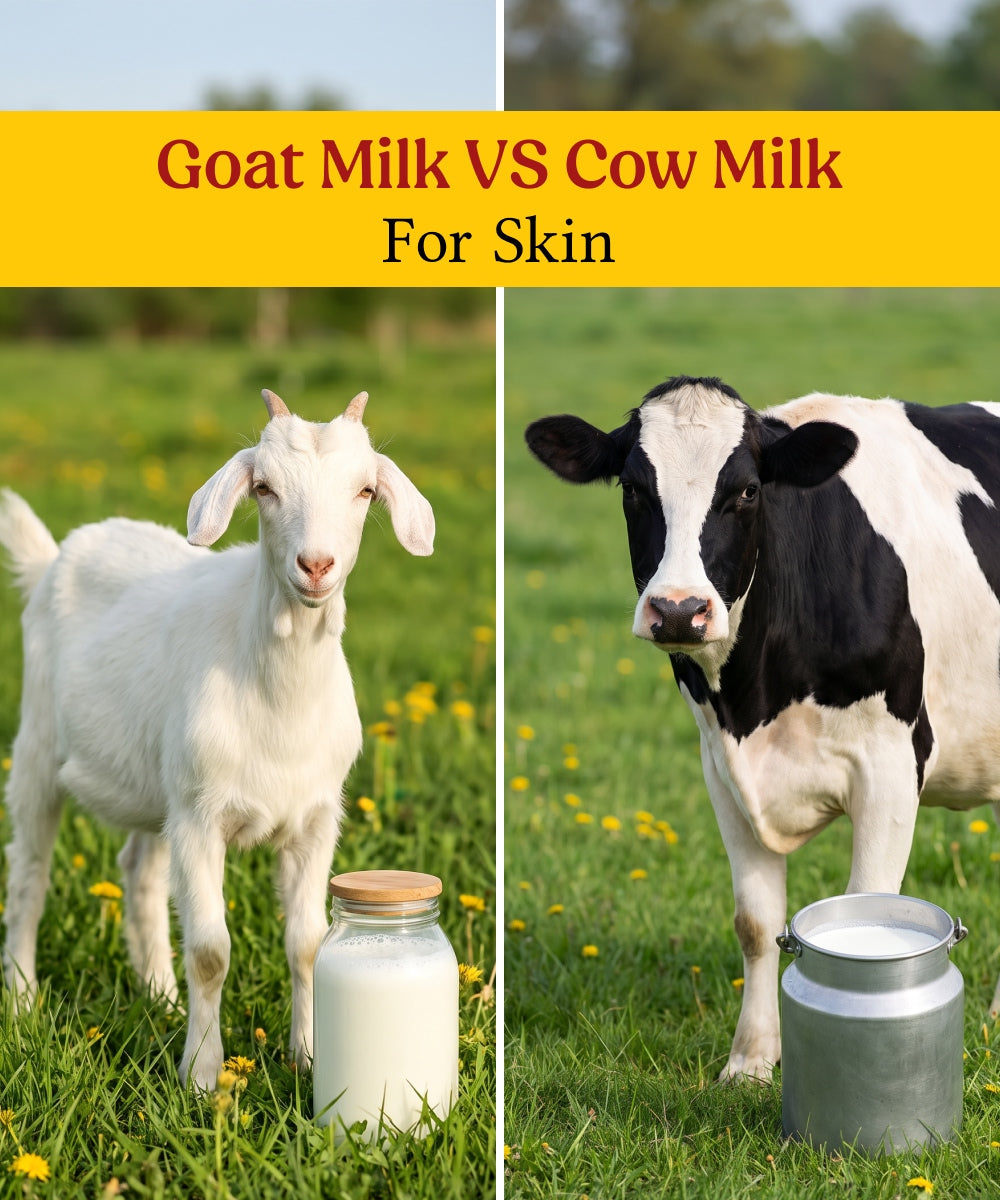
Ask this question online in India and you get answered by hospitals and dairies. Both are competent sources on milk. Neither is answering the question you asked, which is about your skin.
So here is a straight answer from a brand that formulates with both categories. The compositional differences between goat milk and cow milk are real, well documented and largely irrelevant to what happens on your face. The thing that decides how your skin responds is not which animal the milk came from. It is what survives into the finished product and how long that product stays on your skin.
This piece covers the actual differences, the honest limits of what they prove, and how to choose between milk-based products without falling for the wrong argument.
The Compositional Differences are Real
Start with what is genuinely established, because it is not nothing.
Fat structure. Goat milk carries smaller fat globules than cow milk, along with higher proportions of short-chain fatty acids and medium-chain fatty acids including caprylic, capric and caproic acid. Triacylglycerols account for around 98 percent of the total fat.
Protein structure. Goat milk contains relatively fewer caseins linked with αS1-casein, which is the main reason it is described as less allergenic than cow milk. Goat milk protein breaks down as roughly 70 percent water-insoluble casein, 25 percent water-soluble whey protein and 5 percent milk fat globule membrane protein.
Lactose and digestibility. Goat milk contains a lower concentration of lactose than cow milk, is more digestible, and has a greater buffering capacity.
Vitamin A. Goat milk contains a considerably higher concentration of vitamin A than cow milk, because goats convert all their carotenes into vitamin A. That conversion is also why goat milk is typically whiter in colour than cow milk.
Oligosaccharides. Goat milk contains more sialyloligosaccharides and fucosylated oligosaccharides than milk from other ruminants.
Every one of those points is documented. Hold on to the next section before you act on any of them.
The Honest Problem with all of it
Read the source material for those findings and you notice something. It is all about eating.
Fat globule size matters because smaller globules present more surface area to gut lipases. Lower αS1-casein matters because it reduces allergenicity in people drinking the milk. Buffering capacity matters in the stomach. Vitamin A concentration matters to blood serum levels in children fed goat milk instead of cow milk.
None of that establishes anything about what happens when a formulation containing milk is applied to your skin and rinsed off. Nobody has run a head-to-head trial of goat milk versus cow milk in a topical product on human skin, and until somebody does, quoting digestion research as skincare evidence is a stretch.
Vilvah manufactures goat milk products and could easily lean on those studies. It is more useful to say plainly that the digestion literature does not transfer, and then talk about what does.
What Actually Reaches your Skin
Three things from milk of any species have plausible topical relevance, and the amount that reaches you depends entirely on the formulation.
Lactic acid. An alpha hydroxy acid present naturally in milk. Alpha hydroxy acids appear in dermatology literature among the cosmetic agents used in anti-pigmentation formulations, so this one is real. What matters is concentration and contact time, neither of which is set by the animal.
Fats and lipids. Milk fat contributes to the emollient feel of a product. In a cold-process soap, a share of that fat survives saponification and stays in the bar. In a rinse-off cleanser, most of it leaves with the water.
Proteins and peptides. Milk proteins can behave as film-formers and humectants in a formulation. Their effect is a function of how they are processed and stabilised, not of the species.
Notice the pattern. In each case the variable that decides the outcome is formulation, not source animal.
So Why Does Vilvah use Goat Milk
Two honest reasons, neither of them a claim of biological superiority over cow milk.
Supply and consistency. Vilvah sources goat milk directly from its own farm in Coimbatore, which means control over freshness and handling that a bought-in commodity ingredient does not offer. In a product where a perishable input goes into the batch, that control is the difference between a consistent formulation and an unreliable one.
Sensory result. Goat milk's fat and protein profile behaves well in cold-process soap and in emulsions, producing the creamy feel the range is built around. That is a formulation reason, and it is a legitimate one.
Vilvah's wider thinking on the category is in goat milk for skin and hair and milk-based skincare for Indian skin.
The better question: which milk for which job
Milk is not one ingredient. Different milks suit different formats, and Vilvah's own range answers the question by using four of them for four different purposes.
|
Milk |
Where Vilvah uses it |
Why that format |
|
Goat milk |
Soaps, shampoo, hair mask, body wash |
Fat and protein profile suits cold-process bars and rich rinse-off formats |
|
Rice milk |
Milk Powder Face Wash, Milk Drops serum, Milk Face Toner |
Lighter, suits facial formats and leave-on serums |
|
Oat milk |
Milk Body Lotion, with ceramides and olive squalane |
Suits a lightweight body emulsion for dry skin |
|
Soy milk |
Melt-in-Milk Sunscreen SPF 50 |
Works in a lightweight sunscreen base for humid conditions |
That table is the real answer to "which milk is better for skin". It depends entirely on what you need the product to do. The Classic Goat Milk Soap and the Goat Milk Shampoo with ceramides and pea protein are rinse-off products where richness helps. The Milk Drops Brightening Serum, built on rice milk extract with plant-derived alpha arbutin, marine algae extract and hyaluronic acid, is a leave-on where a lighter base and an active matter more.
Vilvah has written separately about the rice milk side in rice milk for skin and the benefits of rice milk face toner.
One correction worth making, since it comes up. Vilvah's Milk Body Lotion is built on oat milk, not goat milk, alongside ceramides and olive squalane. The word milk on a label does not tell you which milk.
Do not put Raw Milk on your Face
Around 1,600 people a month in India search for putting raw milk on the face, and it deserves a direct answer.
Raw milk of any species is an unpreserved perishable. Applied straight to skin it carries no antimicrobial system, no stabiliser and no control over what has grown in it between the fridge and your face. Warm Indian conditions make that worse, not better.
There is also nothing gained. Whatever benefit lactic acid or milk lipids offer is available in a formulation that has been preserved, pH-controlled and stability-tested, at a known concentration. Vilvah makes the same argument about raw plant material in how safe is raw aloe vera on skin.
If you want the exfoliating effect, use a formulated product and follow the guidance in how to exfoliate your skin.
What Neither Milk will do
Three limits, stated plainly.
Neither changes your skin colour. Milk-based products can clean gently, hydrate and mildly exfoliate. They do not alter the melanin your genetics set. Vilvah's full answer on that is in does goat milk soap lighten skin and brightening versus whitening.
Neither treats a skin condition. The goat milk literature contains an anecdotal tradition of use in various allergic conditions, and the review that records it labels it exactly that, anecdotal. If you have a diagnosed skin condition, that is a dermatologist's territory rather than a soap's.
Neither settles the dairy and acne question for you. Whether drinking milk affects your breakouts is a separate question from what you wash with, and it varies between people. Track your own response rather than assuming. Vilvah covers the causes in what causes acne and how to prevent it.
How to Choose, in Three Steps
Start with format and skin type, not with the animal. Establish whether you need a bar, a body wash, a cleanser or a leave-on, and check your skin type using how to know your skin type.
Read where the milk sits in the ingredient list. Milk listed near the top is a formulation input. Milk listed after the preservatives is a label decoration. This applies equally to goat, cow, rice and oat.
Judge the finished product, not the ingredient story. A well-made cow milk cleanser will outperform a badly made goat milk one every time. The animal is the least important variable in the decision.
Browse the full milk range or the goat milk collection if you want to compare formats side by side.
Frequently Asked Questions
Is goat milk better than cow milk for skin?
There is no head-to-head evidence in topical products, so the honest answer is that nobody knows. The documented differences between the two are real but were established in the context of eating rather than applying. Goat milk has smaller fat globules, relatively less αS1-casein, lower lactose, greater buffering capacity and more vitamin A than cow milk. None of those findings has been tested as a skincare variable. What decides how your skin responds is the formulation, the concentration and the contact time, not the source animal.
What is the main difference between goat milk and cow milk?
The differences sit in fat, protein, sugar and vitamin content. Goat milk has smaller fat globules and higher proportions of short-chain and medium-chain fatty acids including caprylic, capric and caproic acid. It contains relatively fewer caseins linked with αS1-casein, which is the main reason it is considered less allergenic than cow milk. It has a lower lactose concentration and a greater buffering capacity. Goat milk also carries considerably more vitamin A, because goats convert all their carotenes into vitamin A, which is also why goat milk looks whiter.
Can I put raw goat milk or raw cow milk on my face?
It is not a good idea. Raw milk of any species is an unpreserved perishable with no antimicrobial system, no stabiliser and no control over microbial growth between storage and application. Indian ambient conditions accelerate that problem. There is also no benefit you cannot get more safely from a formulated product, where lactic acid concentration is known, the pH is controlled and the formula has been stability-tested. Use a preserved milk-based cleanser or soap instead, and keep raw dairy for the kitchen.
Which milk is best for dry skin?
Format matters more than species here. For dry body skin, a fat-rich cold-process bar such as a goat milk soap tends to leave less tightness than a stripped commercial bar, because it retains oils and glycerin. For a leave-on body product, an emulsion built for lightweight hydration is usually the better tool, and Vilvah's Milk Body Lotion uses oat milk with ceramides and olive squalane rather than goat milk. Choose on what the product is designed to do rather than on which milk appears on the front label.
Does milk in skincare cause acne?
Milk applied topically in a formulated product is a different question from milk consumed as food, and the two get conflated constantly. The dietary dairy and acne relationship varies considerably between individuals and is worth tracking in your own case rather than assuming. Topically, what tends to matter for breakout-prone skin is whether a product is non-comedogenic and how well it rinses, not whether milk is on the ingredient list. If a specific product causes breakouts for you, stop that product rather than the whole category.
Sources
- Kumar H, Yadav D, Kumar N, et al. Nutritional Profile, Processing and Potential Products: A Comparative Review of Goat Milk. Dairy, 2022;3(3):44. https://www.mdpi.com/2624-862X/3/3/44
- Mukhopadhyay P. Cleansers and Their Role in Various Dermatological Disorders. Indian Journal of Dermatology, 2011;56(1):2-6. https://pmc.ncbi.nlm.nih.gov/articles/PMC3088928/
- Auffret N, Leccia MT, Ballanger F, Claudel JP, Dahan S, Dréno B. Acne-induced Post-inflammatory Hyperpigmentation: From Grading to Treatment. Acta Dermato-Venereologica, 2025;105:42925. https://pmc.ncbi.nlm.nih.gov/articles/PMC12041799/
- Del Bino S, Duval C, Bernerd F. Clinical and Biological Characterization of Skin Pigmentation Diversity and Its Consequences on UV Impact. International Journal of Molecular Sciences, 2018;19(9):2668. https://pmc.ncbi.nlm.nih.gov/articles/PMC6163216/
Related Stories
-

Lactic Acid for Skin: What It Does That Glycolic Acid Does Not
-

Telogen Effluvium: How to Tell Sudden Shedding From Ongoing Hair Fall
-

Wheatish Skin Tone: What It Means, and How to Tell If Yours Is One
-

Skincare Ingredients That Underperform on Indian Skin, and What Works Instead
-

Dandruff v/s Dry Scalp: Understand the Real Difference
-

Melanin in Skin: What It Actually Does, and Why Indian Skin Marks So Easily
-

Goat Milk Soap vs Regular Soap: What Actually Changes on Your Skin
-

Fitzpatrick Skin Types: Where Most Indian Skin Actually Sits
-

Skin Tone vs Skin Undertone: Why the Difference Changes What You Buy


Leave a comment
All comments are moderated before being published.
This site is protected by hCaptcha and the hCaptcha Privacy Policy and Terms of Service apply.