

 Track Order

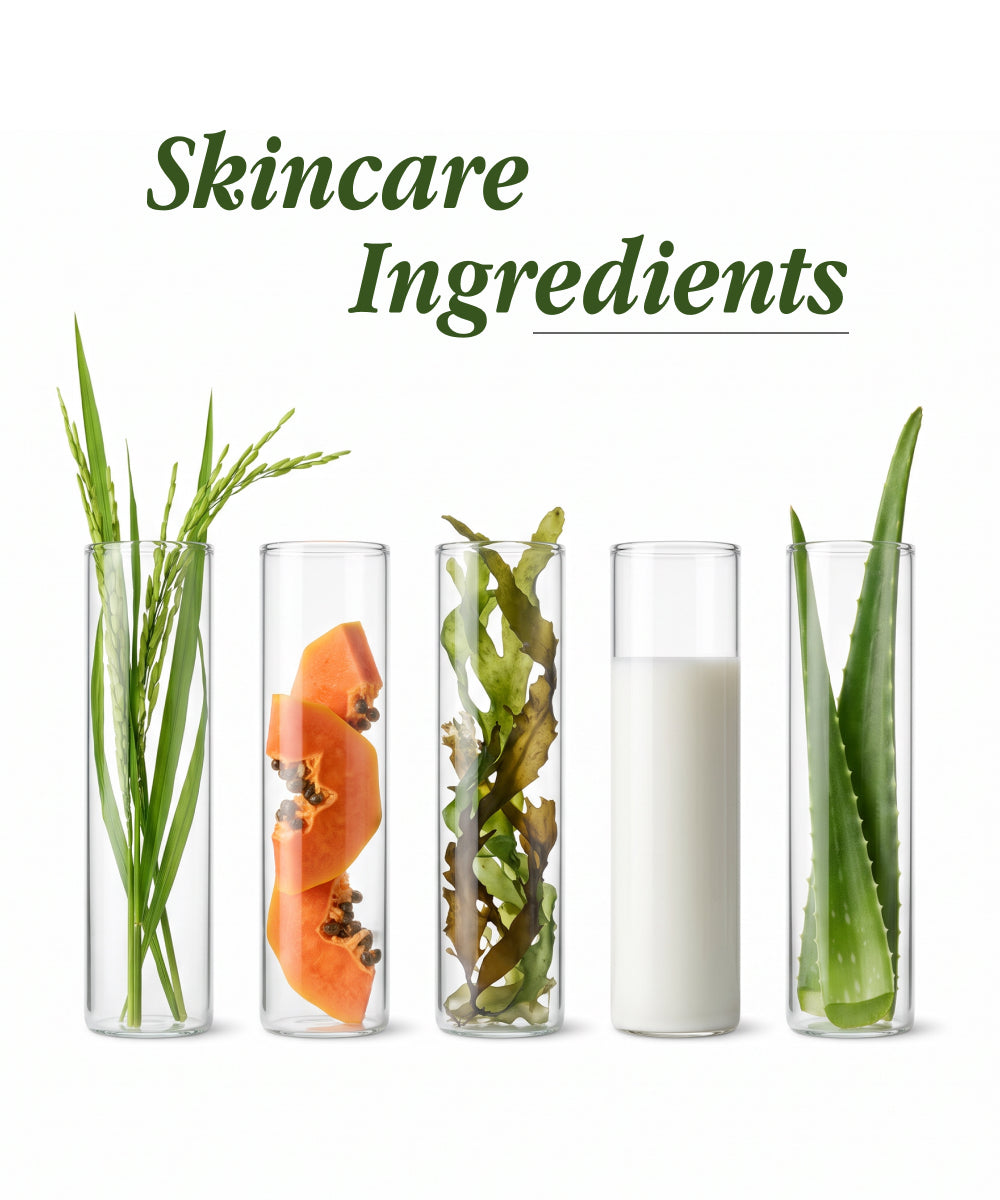
Several of the most heavily marketed pigmentation ingredients in India work less well on Indian skin than the packaging implies, and a few of them make the problem worse. Hydroquinone can cause exogenous ochronosis, a paradoxical blue-black darkening, and an Indian case series published in Cureus in 2023 documented it after as little as three months of use at 2% strength. High-strength vitamin C, physical scrubs, aggressive retinoid starts and routine chemical peels all carry a specific risk in melanin-rich skin that they do not carry in paler skin, which is that the irritation itself triggers pigment.
Indian skin is not paler skin that needs a stronger product. It is reactive skin in which inflammation reliably produces pigment, so any ingredient that irritates is working against the outcome you want. Hydroquinone carries a documented ochronosis risk that appears earlier in Indian patients than the international literature predicts. The ingredients that hold up are the ones that slow pigment production or transfer without provoking the skin, including alpha arbutin, niacinamide, azelaic acid and mild AHAs, plus daily broad-spectrum sunscreen, which every clinical pathway treats as the base layer rather than an extra.
Which skincare ingredients underperform on Indian skin?
The short answer, before the detail:
- Hydroquinone at 2% and above, used unsupervised or beyond a few months, risks exogenous ochronosis, a paradoxical darkening that is clinically refractory.
- Triple combination creams sold over the counter in India, combining a corticosteroid, tretinoin and hydroquinone, carry the ochronosis risk plus steroid-related skin changes.
- High-strength, low-pH vitamin C, where the irritation cost often exceeds the brightening benefit in reactive skin.
- Physical scrubs and over-exfoliation, because mechanical trauma is a direct trigger for post-inflammatory hyperpigmentation.
- Retinoids started at too high a concentration, where retinoid dermatitis can worsen the pigmentation the retinoid was bought to treat.
- Routine chemical peels, which a 2024 systematic review found should not be a first-line option in skin of colour.
The common thread is not that these ingredients are ineffective. It is that Indian skin converts irritation into pigment, so the side-effect profile matters more here than the active does.
Hydroquinone: the ingredient that can darken the skin it was bought to lighten
Hydroquinone remains the most prescribed topical for pigmentation worldwide, and StatPearls still lists it as the mainstay topical lightening agent for post-inflammatory hyperpigmentation. Roughly 33,100 people a month in India search for hydroquinone cream. The problem is what happens with prolonged or unsupervised use.
Exogenous ochronosis is a paradoxical hyperpigmentation caused by long-term application of hydroquinone and other phenolic bleaching agents, presenting as blue-black or slate-grey pigmentation with coarse, stippled skin. It is a separate, treatment-resistant condition that looks like melasma getting worse, which is exactly why patients respond by applying more cream.
Divyalakshmi and colleagues at Render Skin and Hair in Chennai reported six confirmed cases of exogenous ochronosis in a single year, published in Cureus in 2023. Five of the six had used 2% hydroquinone. The shortest duration before pigmentation deepened was three months. Two patients had used it for six months, two for about a year. Almost all had continued over the counter, beyond the prescribed period.
The international benchmark is far longer. The same paper notes that an earlier United States series reported an average of 9.2 years of hydroquinone use before ochronosis developed. The Chennai series found it at one year at most, and the authors suggest the high regional ultraviolet index may be accelerating onset. Their conclusion is that the combination of increasing incidence and faster time to clinical presentation could produce a much larger caseload of exogenous ochronosis in India than anticipated.
The triple combination cream problem
The Cureus paper identifies the specific format driving this. Triple combination creams sold in India, containing a topical corticosteroid, tretinoin and hydroquinone, carry between 2% and 4% hydroquinone. The authors describe their use for skin bleaching and fairness in certain regions of India as rampant.
Two risks stack in that tube. The hydroquinone carries the ochronosis risk. The corticosteroid carries its own: StatPearls specifies that within the standard triple combination of hydroquinone 4%, tretinoin 0.05% and fluocinolone acetonide 0.01%, the steroid should only be used for up to 8 weeks to minimise the likelihood of steroid-induced skin changes. A cream bought repeatedly at a chemist without review has no 8-week stop date attached to it.
If you are using any fairness or pigmentation cream bought without a prescription, the single most useful thing you can do is find out whether it contains hydroquinone or a steroid, and for how long you have been using it.
High-strength vitamin C: the irritation cost is higher here
Vitamin C is not a bad ingredient. It is an ingredient whose failure mode is badly matched to Indian skin.
L-ascorbic acid needs a low pH to remain active and penetrate, and it oxidises readily. In practice that means two problems. The formula degrades, which is why a serum that has turned orange is doing less than it did on day one. And the low pH that keeps it working is also what stings, and stinging is the early signal of the irritation that produces pigment in melanin-rich skin.
StatPearls is explicit on the principle: overly aggressive treatment can lead to skin irritation and further hyperpigmentation. That applies to concentration choices as much as to procedures. A stable, lower-irritation active used daily for months will usually outperform a high-strength vitamin C abandoned in week two for burning.
Physical scrubs and over-exfoliation: the trauma route to pigment
Post-inflammatory hyperpigmentation does not need acne to start. It needs inflammation, and mechanical injury supplies it.
In the 2024 systematic review published in the Journal of Cutaneous Medicine and Surgery, which pooled 46 studies and 1,356 people with skin of colour, trauma accounted for 11% of all post-inflammatory hyperpigmentation cases. Within that group, laser therapy caused 27%, hair removal techniques 26%, light therapy 23% and chemical peels 20%. Every one of those is a procedure someone chose in order to improve their skin.
Home scrubbing sits on the same spectrum with a lower ceiling and a higher frequency. A walnut-shell scrub used twice a week for a year is a repeated low-grade inflammatory stimulus applied to skin that answers inflammation with pigment. Vilvah's Milk Powder Face Wash at ₹499 is built as a waterless powder cleanser rather than a grit scrub for that reason.
Retinoids started at the wrong strength
Topical retinoids are genuinely useful here. In the 2024 systematic review they were the most investigated intervention, used by 294 participants, and produced partial pigment reduction in 64% of the 118 patients assessed. No participant achieved complete resolution.
The caveat in that same review is the part that gets skipped. The authors advise caution regarding retinoid dermatitis, which may potentially exacerbate post-inflammatory hyperpigmentation in dark skin, and recommend risk mitigation by starting at lower dosages and slowly increasing the concentration.
The failure is rarely the molecule. It is the starting point. A 0.1% retinol bought because it sounded stronger, applied nightly from day one, produces peeling, then redness, then new marks where the redness was.
Chemical peels are not a first-line option in melanin-rich skin
The 2024 systematic review concluded that people with skin of colour have a well-documented elevated risk of developing post-inflammatory hyperpigmentation transiently after peels compared with the general population, and that chemical peels should therefore not be routinely recommended as a first-line treatment in this group, though they may have merit in refractory cases.
The adverse-event numbers back it. In one study of salicylic acid peels at 20% to 30% in dark skin, side effects after two weeks included itching in 70%, redness in 40%, crusting in 40%, hyperpigmentation in 40% and hypopigmentation in 10%. The review also found glycolic acid peels outperformed salicylic acid ones, with one glycolic protocol reducing a hyperpigmentation severity score by 50% after 22 weeks. Peels can work. They are a supervised second-line option in Indian skin, not a monthly habit.
What works instead, and why
The ingredients that hold up in melanin-rich skin share one property. They interrupt pigment production or transfer without provoking the skin into making more.
- Alpha arbutin. It works by interfering with tyrosinase, the enzyme that starts melanin synthesis, which StatPearls describes as the mechanism behind tyrosinase inhibitors generally. Because it slows production rather than stripping existing pigment, it is well tolerated over the long courses this problem actually requires. Vilvah's Milk Drops Brightening Serum at ₹640 is formulated at pH 5.50 to 6.00 with plant-derived alpha arbutin, rice milk extract, Cystoseira tamariscifolia marine algae extract and hyaluronic acid, and is fragrance free and non-comedogenic.
- Niacinamide. It works at a completely different point in the chain. In a study by Hakozaki and colleagues published in the British Journal of Dermatology in 2002, niacinamide had no effect on tyrosinase activity at all, but produced 35% to 68% inhibition of melanosome transfer from melanocytes to keratinocytes in a coculture model. In the accompanying clinical work, niacinamide significantly decreased hyperpigmentation and increased skin lightness against vehicle after four weeks. Because it acts downstream of production, niacinamide pairs rather than competes with a tyrosinase-targeting active.
- Azelaic acid. StatPearls notes it can treat both acne and post-inflammatory hyperpigmentation, which matters because acne is the upstream cause in the overwhelming majority of Indian pigmentation cases. Treating the trigger and the mark with one ingredient removes a step.
- Mild AHAs over physical abrasion. Lactic acid and glycolic acid deliver exfoliation chemically, at a controlled concentration, without the mechanical trauma of grit. The systematic review's own peel data showed glycolic acid outperforming salicylic acid in skin of colour, which points the same direction at cosmetic strengths.
- Broad-spectrum sunscreen, daily, as the base layer. StatPearls describes daily broad-spectrum sunscreen use as a foundational part of treatment and notes that recurrences are common particularly without adequate photoprotection. Vilvah's Skin Finish Sunscreen SPF 50 PA++++ at ₹599 uses Diethylamino Hydroxybenzoyl Hexyl Benzoate, Ethylhexyl Triazone and Bis-Ethylhexyloxyphenol Methoxyphenyl Triazine alongside Titanium Dioxide, with Niacinamide and ceramides in the base.
What none of these ingredients will do
No topical changes your baseline skin colour, and none of the ingredients above is trying to. They reduce the excess pigment laid down after a trigger. That is the entire achievable goal, and any product implying otherwise is describing something that does not happen.
Nothing here clears a mark outright, either. In that 2024 systematic review, laser therapy was the only modality that produced complete clearance in any subgroup, at 26% of 165 patients, while also carrying documented cases of worsening pigmentation. Topical retinoids, the most studied topical, cleared nobody completely.
And time does some of the work regardless. Among 346 participants in the same review who received no treatment at all, 62% still achieved partial pigment reduction on their own. The review's overall conclusion was that there is a lack of robust efficacy across all treatment modalities studied in skin of colour. Any brand claiming a decisive result is claiming more than the evidence currently supports.
Vilvah, founded in 2017 in Coimbatore by Kruthika Kumaran as India's first milk-based skin and hair care brand, formulates for Fitzpatrick type IV and V skin as the default case. Practically, that means choosing the tolerable active over the aggressive one, because in this skin the aggressive one creates the next problem.
Frequently asked questions
Is hydroquinone safe for Indian skin?
Hydroquinone is effective at reducing pigmentation and is still listed by StatPearls as the mainstay topical lightening agent, but it carries a specific risk in melanin-rich skin called exogenous ochronosis, a paradoxical blue-black darkening that is difficult to treat. An Indian case series published in Cureus in 2023 by Divyalakshmi and colleagues in Chennai documented six cases in one year. Five of the six had used 2% hydroquinone, and the shortest duration before pigmentation deepened was three months. That is dramatically faster than the average of 9.2 years reported in an earlier United States series, and the authors suggest the high regional ultraviolet index may be contributing. The practical position is that hydroquinone belongs under dermatologist supervision with a defined stop date, and not in an over-the-counter cream used indefinitely.
What is exogenous ochronosis and how do I know if I have it?
Exogenous ochronosis is a paradoxical hyperpigmentation of the skin caused by prolonged use of bleaching agents containing hydroquinone or other phenolic compounds. It appears as blue-black or slate-grey pigmentation, often with coarse skin texture and stippled macules, most commonly on the cheeks, forehead and chin. The dangerous part is that it looks like the original pigmentation is worsening, so people respond by applying more of the cream causing it. Warning signs worth acting on are darkening that has a grey or blue-black cast rather than warm brown, pigmentation that deepens after months on a lightening cream, and skin that has become coarse or thinned. Diagnosis requires a dermatologist, using dermoscopy and usually a biopsy. If you suspect it, stop the cream and get assessed rather than switching to a stronger product.
Why does vitamin C serum irritate Indian skin?
L-ascorbic acid, the most studied form of vitamin C, requires a low pH to stay stable and penetrate the skin. That acidity is what causes the stinging many people report, and it oxidises over time, which is why a serum that has turned yellow or orange has lost potency. In melanin-rich skin the irritation is not just uncomfortable, it is counterproductive, because inflammation is itself a trigger for post-inflammatory hyperpigmentation. StatPearls notes directly that overly aggressive treatment can lead to skin irritation and further hyperpigmentation. Vitamin C is not unusable on Indian skin, but a lower concentration, a more stable derivative, or a gentler alternative active used consistently will usually deliver more over six months than a high-strength serum that gets abandoned in week two.
Are chemical peels bad for Indian skin?
Not bad, but not first-line. The 2024 systematic review in the Journal of Cutaneous Medicine and Surgery found that people with skin of colour have a well-documented elevated risk of developing post-inflammatory hyperpigmentation transiently after peels compared with the general population, and concluded that peels should not be routinely recommended as a first-line treatment in this group, while retaining merit in cases that have not responded to other options. The adverse-event data explains the caution. In one study of salicylic acid peels in dark skin, side effects at two weeks included itching in 70% of patients, redness in 40%, crusting in 40% and hyperpigmentation in 40%. The review also found glycolic acid peels performed better than salicylic acid ones in this population. If you do have peels, they belong with an experienced clinician, at conservative concentrations, with strict sun protection afterwards.
Which brightening ingredient is best for pigmentation on Indian skin?
There is no single best one, and the more useful framing is which mechanism you are targeting. Alpha arbutin and other tyrosinase inhibitors slow melanin production at the enzyme. Niacinamide works further downstream: research by Hakozaki and colleagues published in the British Journal of Dermatology in 2002 found it had no effect on tyrosinase but inhibited melanosome transfer from melanocytes to keratinocytes by 35% to 68% in a coculture model. Azelaic acid is useful where acne is the underlying trigger, because it addresses both. Because these act at different points, they combine rather than compete. What none of them replaces is daily broad-spectrum sunscreen, which every clinical pathway for pigmentation in skin of colour treats as the base layer rather than an optional addition.
How long should I give a pigmentation product before deciding it does not work?
Months, not weeks. The 2024 systematic review found the average duration of post-inflammatory hyperpigmentation before treatment began was 21 months, and follow-up periods in the pooled studies ran to three, four and eight months depending on the intervention. Judging a serum at four weeks is judging it before the skin has cycled enough to show a result. There is a complication worth knowing about when you do assess it: among participants in that review who received no treatment at all, 62% still showed partial pigment reduction over time. Some of what any product appears to achieve is spontaneous improvement running in the background. That is an argument for consistency over switching, and for photographs in consistent lighting rather than memory.
Should I stop using my fairness cream?
If it contains hydroquinone or a corticosteroid and you bought it without a prescription, the honest answer is that you should have it reviewed by a dermatologist rather than continue indefinitely. The Cureus case series from Chennai found that almost all six ochronosis patients had continued using their creams over the counter, beyond the prescribed period. StatPearls specifies that in the standard triple combination formula, the corticosteroid component should be used for a maximum of 8 weeks to limit steroid-induced skin changes, which is a limit that no over-the-counter purchase enforces. Stopping abruptly can cause rebound issues with some steroid-containing products, which is another reason to do it with clinical guidance rather than alone.
Sources
- Divyalakshmi C, Selvadurairaj S, Sukumaran P, Ganesh S, Lourdhurajan R. Exogenous Ochronosis: Clinicopathological Correlation in Indian Patients and the Practical Applicability of the Dogliotti and Phillips Classification Systems. Cureus, 29 November 2023;15(11):e49620. https://pmc.ncbi.nlm.nih.gov/articles/PMC10755631/
- Mar K, Khalid B, Maazi M, Ahmed R, Wang OJ, Khosravi-Hafshejani T. Treatment of Post-Inflammatory Hyperpigmentation in Skin of Colour: A Systematic Review. Journal of Cutaneous Medicine and Surgery, 2024;28(5):473-480. https://pmc.ncbi.nlm.nih.gov/articles/PMC11514325/
- Lawrence E, Syed HA, Al Aboud KM. Postinflammatory Hyperpigmentation. StatPearls, NCBI Bookshelf, updated 25 November 2024. https://www.ncbi.nlm.nih.gov/books/NBK559150/
- Hakozaki T, Minwalla L, Zhuang J, Chhoa M, Matsubara A, Miyamoto K, Greatens A, Hillebrand GG, Bissett DL, Boissy RE. The effect of niacinamide on reducing cutaneous pigmentation and suppression of melanosome transfer. British Journal of Dermatology, July 2002;147(1):20-31. https://pubmed.ncbi.nlm.nih.gov/12100180/
Related Stories
-

Dandruff v/s Dry Scalp: Understand the Real Difference
-

Melanin in Skin: What It Actually Does, and Why Indian Skin Marks So Easily
-

Goat Milk Soap vs Regular Soap: What Actually Changes on Your Skin
-

Fitzpatrick Skin Types: Where Most Indian Skin Actually Sits
-

Skin Tone vs Skin Undertone: Why the Difference Changes What You Buy
-

How to Find Your Skin Undertone at Home: Warm, Cool or Neutral
-

Dry Scalp: Causes, Remedies & How to Treat It Effectively
-

Vilvah: Brand, Ingredients and Product FAQs
-

Hair Serum v/s Hair Oil: Key Differences Explained With Benefits


Leave a comment
All comments are moderated before being published.
This site is protected by hCaptcha and the hCaptcha Privacy Policy and Terms of Service apply.