

 Track Order

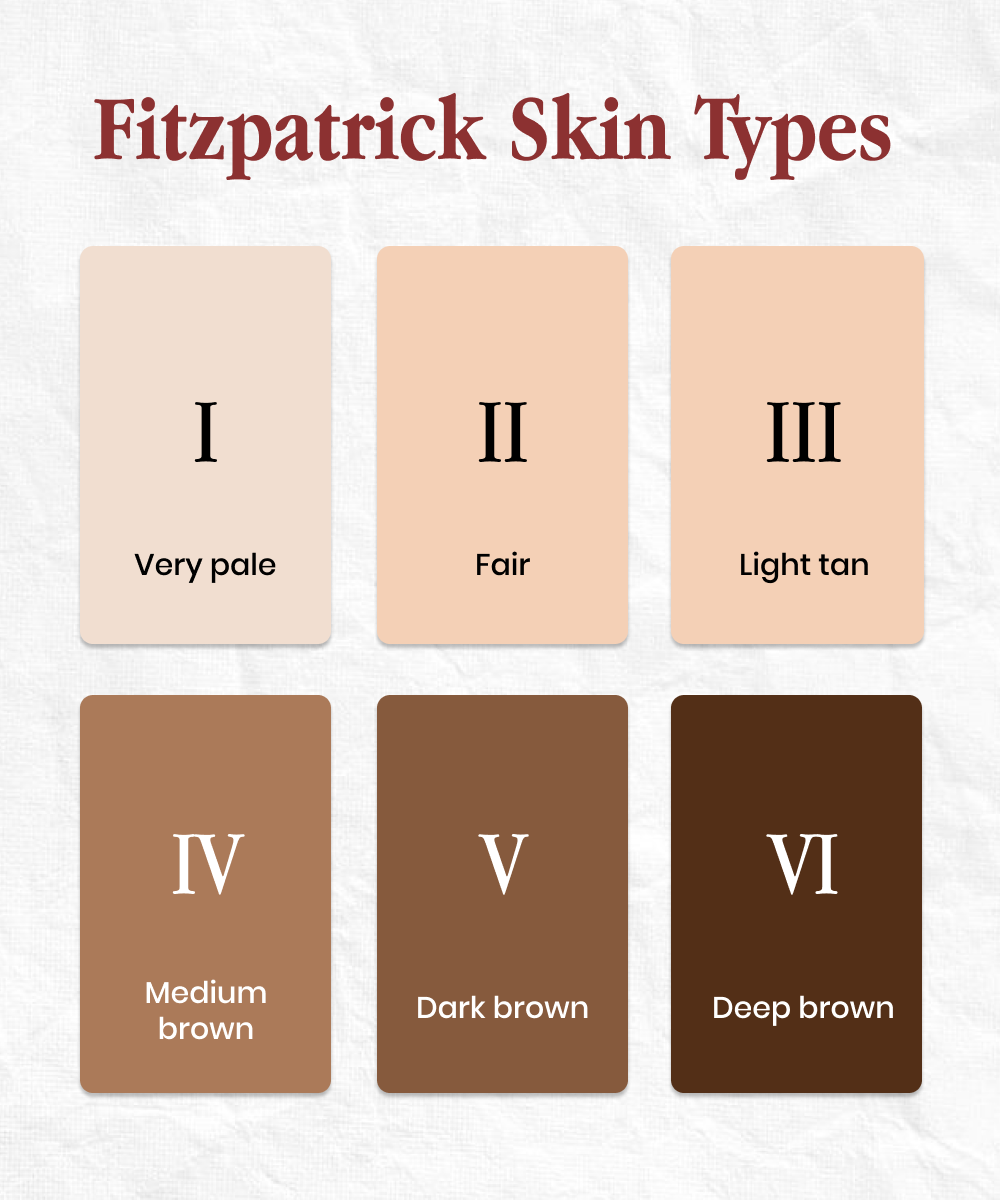
Search "Fitzpatrick skin type" from India and you will get a chart. Six rows, each with a burn-and-tan description, and somewhere near the bottom a line telling you that type V rarely burns and type VI never does. Almost every one of those charts is written for a Western reader and copied without adjustment.
The scale itself is real, useful and worth understanding. Around 4,400 people a month in India search for it, at a competition index of 1, which tells you how little serious Indian-facing content exists on the topic. What almost none of that content explains is where the scale came from, what it was built to do, and the specific ways it misfires on Indian skin.
This guide covers all three. It will tell you where most Indian skin sits, and it will also tell you where the scale stops being trustworthy, because the second part is the part that actually protects your skin.
What is Fitzpatrick Scale
Thomas Fitzpatrick described the classification in the early 1970s, and its original job was narrow. He developed it to classify people with white skin so clinicians could select the correct dose of ultraviolet A, measured in joules per square centimetre, for PUVA photochemotherapy in psoriasis.
The scoring method reflects that origin. Classification rested on a patient's self-reported answers about how their skin reacted to a 45 to 60 minute noon sun exposure in early summer at northern latitudes between 20 and 45 degrees. Two questions carried it: how painful the sunburn was, and how much tan developed in a week.
Note what that means geographically. The calibration window sits between 20 and 45 degrees north. Delhi at roughly 28 degrees north falls inside it. Bengaluru at about 13, Coimbatore at about 11 and Chennai at about 13 sit well below the southern edge of the band the scale was designed around.
The Six Types, and the Two That were Added Later
The scale was first written with four types, I through IV, all of them describing people with white unexposed skin. Types V and VI were added afterwards to account for people with brown and black skin.
Here is the standard chart, which is accurate as far as it goes.
| Type | Description | Sun response as written |
| I | Very fair, often freckled | Always burns, never tans |
| II | Fair | Usually burns, tans minimally |
| III | Light to medium | Sometimes burns, tans gradually |
| IV | Medium, olive or light brown | Rarely burns, tans easily |
| V | Brown | Very rarely burns, tans very easily |
| VI | Deeply pigmented brown to black | Never burns, always tans |
Hold on to that final column. It is where the trouble starts.
Where most Indian skin actually sits
Indian skin spans roughly types III to VI, and the bulk of it lands in IV and V. Wheatish and medium-brown skin, which is the most common description across the country, generally corresponds to type IV. Deeper brown skin, more common in southern and coastal regions, generally corresponds to type V.
The most useful Indian-specific work on this is a 2018 study that modified the Fitzpatrick questionnaire for the Indian population. Researchers had 70 healthy Indian volunteers self-administer both the original and modified versions, then measured melanin and erythema indices from photoexposed and photoprotected sites using a narrowband reflectance spectrophotometer. They found a melanin index of 42 or above marked the cut-off between phototypes I to III and IV, and 47 or above marked the cut-off between IV and V to VI.
That study also produced the single most important finding for anyone in India trying to type themselves. The two questionnaire items about tanning habits were judged irrelevant based on how the volunteers responded, and the researchers removed them from the modified version entirely.
Three Things the Scale Gets Wrong for Indian Skin
1. The Tanning Questions do not Discriminate
If you are Indian and you have ever tried to answer "how much tan do you develop in a week", you probably found the question meaningless. So did the volunteers in that 2018 study, which is why the items were cut.
The reason is structural. Those two questions were written to separate people who burn from people who tan, a distinction that does real work across Fitzpatrick I to IV and very little work across IV to VI, where almost everyone tans. A question that returns the same answer from most of your population is not measuring anything.
2. "Never Burns" is not True
The scale states that type V and VI skin usually or always tans and never or rarely burns. A 2021 review in Skin Health and Disease called these categorisations wholly inaccurate and traced them to attitudes prevalent among dermatologists in the 1960s and 1970s who came predominantly from Europe and North America. Studies show sunburn in darker skin is considerably more common than previously assumed.
There is a measured version of the baseline protection that deeper skin does provide. Kaidbey and colleagues found that black skin filtered roughly five times as much ultraviolet radiation as Caucasian skin, giving an estimated intrinsic sun protection factor of 13.4 against 3.3 for light skin.
Read that number carefully, because it is the whole argument. An intrinsic SPF of 13.4 is real protection and it is well below the SPF 30 to 50 range recommended for daily use. Deeper skin starts further ahead and still needs sunscreen. Research on ultraviolet-induced DNA damage across ethnic groups found that damage was appreciable in all skin types, even at low levels of exposure. Vilvah covers the mechanism in UV rays explained and the habit in sunscreen benefits for face.
3. It was Never a Pigmentation-Risk Scale
Fitzpatrick built the scale to dose phototherapy and predict sunburn. It was not designed to predict the concern that actually brings most Indian customers to a dermatologist, which is pigmentation.
That gap matters because phototype does predict pigmentation risk, just through a different mechanism. Post-inflammatory hyperpigmentation is observed more frequently in phototypes III to VI, driven by increased size and quantity of melanosomes. A 2025 expert panel building a severity grading tool for acne-induced pigmentation weighted phototype as its single most important parameter, scoring types IV to VI at two points against zero for types I and II.
So your Fitzpatrick number is genuinely informative about your dark-spot risk. It just tells you that by accident rather than by design. Vilvah covers the practical side in how to reduce hyperpigmentation and how to fade dark spots and pigmentation on Indian skin.
The Self-Reporting Problem
Even setting the questions aside, self-typing is unreliable in a way that is specific to where you live.
Self-reporting of skin colour is influenced by the community a person lives in. The 2021 review notes that people living in parts of Asia or North Africa may consider the local population to be mainly type III or IV, while an observer from elsewhere would classify the same people differently. An Indian reader comparing themselves against friends and family will type themselves relative to that group rather than against a global scale.
Self-report is also less accurate than a trained dermatologist's assessment. If you want an objective number rather than an approximate one, reflectance spectrophotometry is the tool that does it, and it can distinguish all six types across the 450 to 615 nanometre range. That is a clinic instrument rather than a home one.
What your Fitzpatrick Type Does Usefully Predict
Three things, reliably.
Procedure safety. This is the scale's strongest surviving use. Melanin in the epidermis absorbs laser energy, so higher phototypes carry a higher risk of epidermal injury during laser and light-based treatments, and a higher risk of post-procedural hyperpigmentation or hypopigmentation. If you are booking laser hair removal, resurfacing or a peel, your phototype is the number the practitioner needs.
Pigmentation risk after inflammation. Covered above, and it is the reason to treat acne early rather than waiting. Picking at a spot at phototype V costs you a mark that can outlast the spot by a year. See what causes acne and how to prevent it and how to remove acne scars naturally.
Photoageing timeline. Higher melanin content is associated with less pronounced and delayed signs of photoageing, which is a genuine advantage of deeper skin that rarely gets stated plainly.
What It does not Predict
Your undertone. Phototype measures depth and sun reactivity. It says nothing about whether your skin reads warm, cool, neutral or olive, and two people at identical phototype can need different foundation bases. The method for that is in how to find your skin undertone at home, and the distinction is unpacked in skin tone versus skin undertone.
Your skin type. Oily, dry, combination and sensitive are separate axes entirely. A phototype V reader with dry skin and a phototype III reader with dry skin need the same routine. Start at how to know your skin type.
Your sunscreen quantity. Everyone needs daily broad-spectrum coverage. What changes with phototype is which formula wears acceptably, since mineral filters scatter light and leave a cast that grows more visible with depth. See how to apply sunscreen without a white cast.
What to do With Your Number
Treat your Fitzpatrick type as a rough band rather than a precise reading, then act on the two things it genuinely governs.
For daily protection, use a broad-spectrum SPF 50 formulation and reapply it. Vilvah's Skin Finish Sunscreen SPF 50 PA++++ is a lightweight gel-cream built for Indian weather with new-age UV filters and no white cast, and the Melt-in-Milk Sunscreen SPF 50 uses soy milk extract for humid conditions. Technique matters as much as choice, so read how to apply sunscreen on your face.
For pigmentation, treat inflammation early and support the fade with a tyrosinase-inhibiting active. Vilvah's Milk Drops Brightening Serum pairs plant-derived alpha arbutin with rice milk extract, marine algae extract and hyaluronic acid. Keep the rest of the routine gentle, since irritation is itself a pigmentation trigger, and the Milk Powder Face Wash is built around rice milk powder and papain enzyme rather than aggressive scrubbing.
For everything else, ignore the number. Vilvah's broader position on building for Indian skin is set out in milk-based skincare for Indian skin and why Korean and Western skincare does not always work for Indian skin.
Frequently Asked Questions
1. What Fitzpatrick skin type is Indian skin?
Indian skin spans roughly Fitzpatrick types III to VI, with the majority sitting in types IV and V. Wheatish and medium-brown skin, the most common description across India, generally corresponds to type IV. Deeper brown skin, more common in southern and coastal regions, generally corresponds to type V. A 2018 study that adapted the Fitzpatrick questionnaire for Indian volunteers used melanin index measurements to set the boundaries, placing the cut-off between types I to III and IV at a melanin index of 42, and the cut-off between IV and V to VI at 47.
2. Is the Fitzpatrick scale accurate for Indian skin?
Partially. The scale reliably predicts procedure risk and correlates with pigmentation tendency, and it is unreliable on the two questions it was built around. Researchers adapting it for Indian volunteers removed both tanning-habit items after finding them irrelevant to how Indian subjects answered. A 2021 review also called the "never burns" descriptions for types V and VI wholly inaccurate and traced them to assumptions held by Western dermatologists in the 1960s and 1970s. Use the scale for laser safety and pigmentation risk, and do not use it to decide whether you need sun protection.
3. Does type V or VI skin need sunscreen?
Yes. Deeper skin does carry more baseline photoprotection, and the measured amount is far below what daily protection requires. Research comparing photoprotection by melanin estimated black skin at an intrinsic sun protection factor of about 13.4 against roughly 3.3 for light skin, which leaves a substantial gap to the SPF 30 to 50 range recommended for daily use. Separate work on ultraviolet-induced DNA damage across ethnic groups found appreciable damage in all skin types, even at low exposure levels. Higher phototypes also carry greater risk of pigmentation after any inflammation.
4. How do I find my Fitzpatrick skin type at home?
Judge it by your unexposed skin colour rather than by your tanning habits, since the tanning questions perform poorly on Indian skin. Look at an area that stays covered, such as your inner upper arm, and place yourself in the band that matches: light to medium is roughly type III, medium or light brown is roughly type IV, brown is roughly type V, and deeply pigmented brown is roughly type VI. Be aware that self-typing is influenced by the people around you, so most Indian readers under-estimate their phototype relative to a global scale.
5. What is the difference between Fitzpatrick skin type and skin type?
They measure completely different things and share a confusing name. Fitzpatrick skin type, more precisely called skin phototype, describes how deeply pigmented your skin is and how it reacts to ultraviolet exposure, running from I to VI. Skin type in the everyday skincare sense means oily, dry, combination, normal or sensitive, and it describes how your skin behaves in terms of oil production and barrier reactivity. Your Fitzpatrick type guides sun protection and procedure safety. Your skincare skin type guides which cleanser, serum and moisturiser textures suit you.
Sources
- Goon P, Banfield C, Bello O, Levell NJ. Skin cancers in skin types IV-VI: Does the Fitzpatrick scale give a false sense of security? Skin Health and Disease, 2021;1(3):e40. https://pmc.ncbi.nlm.nih.gov/articles/PMC9060139/
- Sharma AN, Patel BC. Laser Fitzpatrick Skin Type Recommendations. StatPearls, updated 2023. https://www.ncbi.nlm.nih.gov/books/NBK557626/
- Sharma VK, Gupta V, Jangid BL, Pathak M. Modification of the Fitzpatrick system of skin phototype classification for the Indian population, and its correlation with narrowband diffuse reflectance spectrophotometry. Clinical and Experimental Dermatology, 2018;43(3). https://pubmed.ncbi.nlm.nih.gov/29318654/
- Del Bino S, Duval C, Bernerd F. Clinical and Biological Characterization of Skin Pigmentation Diversity and Its Consequences on UV Impact. International Journal of Molecular Sciences, 2018;19(9):2668. https://pmc.ncbi.nlm.nih.gov/articles/PMC6163216/
- Auffret N, Leccia MT, Ballanger F, Claudel JP, Dahan S, Dréno B. Acne-induced Post-inflammatory Hyperpigmentation: From Grading to Treatment. Acta Dermato-Venereologica, 2025;105:42925. https://pmc.ncbi.nlm.nih.gov/articles/PMC12041799/
- Kaidbey KH, Agin PP, Sayre RM, Kligman AM. Photoprotection by melanin, a comparison of black and Caucasian skin. Journal of the American Academy of Dermatology, 1979;1:249-60. https://pubmed.ncbi.nlm.nih.gov/512075/
Related Stories
-

Skin Tone vs Skin Undertone: Why the Difference Changes What You Buy
-

How to Find Your Skin Undertone at Home: Warm, Cool or Neutral
-

Dry Scalp: Causes, Remedies & How to Treat It Effectively
-

Vilvah: Brand, Ingredients and Product FAQs
-

Hair Serum v/s Hair Oil: Key Differences Explained With Benefits
-

Alfalfa for Hair Growth: Benefits, Uses & What You Need to Know
-

Face Wash vs Cleanser: What's Actually Different, and Which One Does Your Skin Need
-

Hair Serum Benefits: The Missing Step in Your Hair Care Routine
-

Premature Grey Hair: Why It Happens Young and How to Slow It Down


Leave a comment
All comments are moderated before being published.
This site is protected by hCaptcha and the hCaptcha Privacy Policy and Terms of Service apply.