

 Track Order

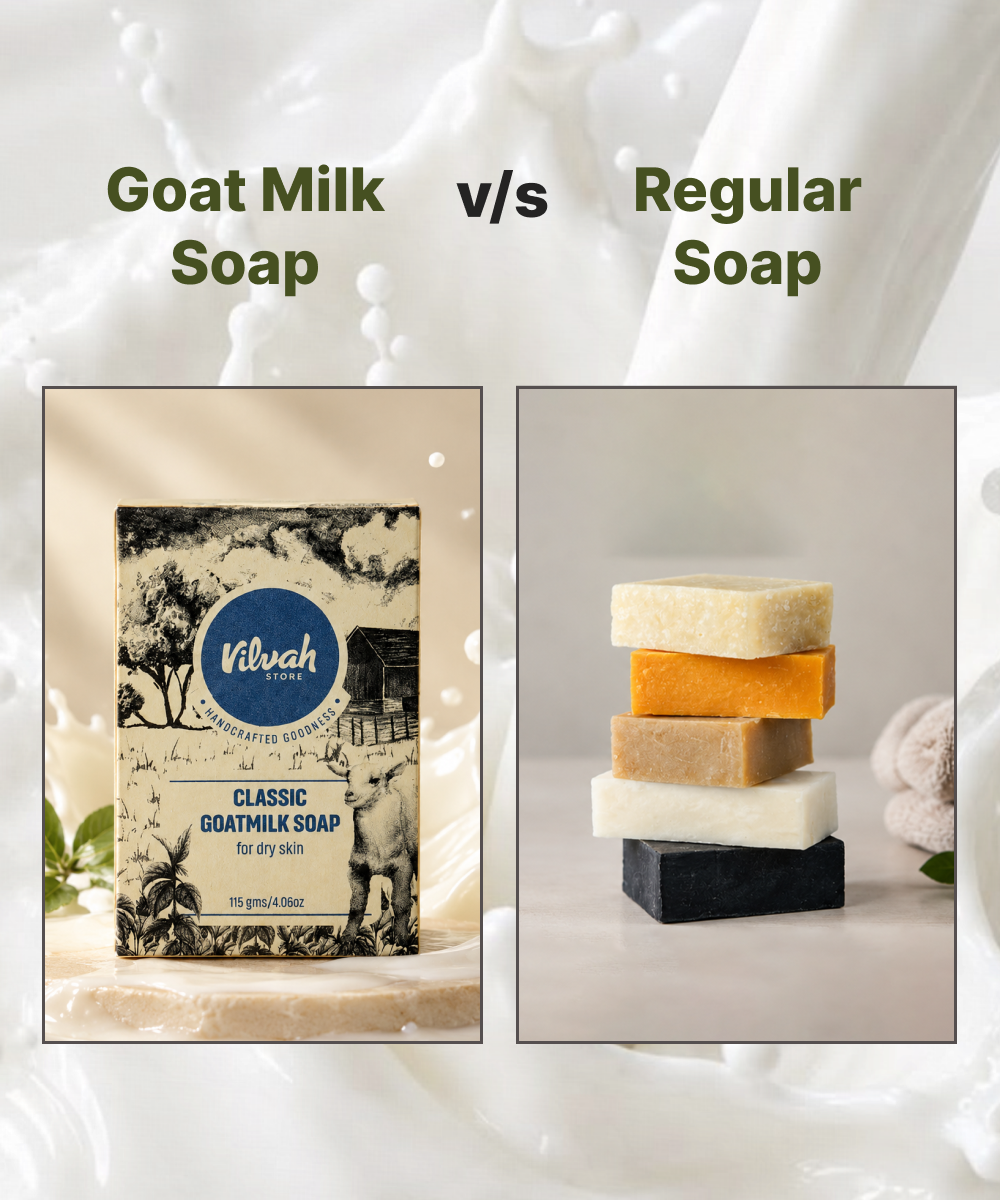
Goat milk soap is one of the most searched skincare terms in India, at roughly 12,100 searches a month. Ask an AI assistant what it does and you will get an answer assembled from hospital websites, American health portals and a dairy farm's blog. Almost none of those sources have made soap, and it shows.
Here is the version written by people who do. Vilvah manufactures goat milk soap in Coimbatore using milk from its own farm, and this piece explains what actually changes in the bar, what does not change, and where a goat milk soap is the wrong choice for you.
That last part matters. The most useful thing anyone can tell you about goat milk soap is the situation where you should buy something else, so this guide covers it explicitly.
First, the thing nobody says out loud
Goat milk soap is soap.
That sounds obvious and it is the single most important fact in this comparison. Soap of any kind is made by saponification, which means combining fats or oils with an alkali such as sodium hydroxide. The reaction produces long chain fatty acid alkali salts, and those salts carry a pH between 9 and 10. Adding goat milk does not change that chemistry.
Your skin surface sits at a physiological pH of roughly 4 to 6.5. So a goat milk soap is alkaline relative to your skin, exactly like any other true soap. Anyone selling you goat milk soap as pH-balanced is either confused or hoping you are.
What changes is not the pH. What changes is what else is in the bar.
The three things actually being compared
Most people saying "regular soap" mean one of three quite different products. The comparison only makes sense once you separate them.
|
Category |
How it is made |
Typical pH |
What is in it |
|
True soap, including goat milk soap |
Saponification of fats or oils with an alkali |
9 to 10 |
Fatty acid salts, plus whatever the maker leaves in |
|
Syndet bar |
Built from non-soap synthetic surfactants, no saponification |
Neutral to slightly acidic |
Fatty acid isethionates, sulfosuccinic acid esters and similar |
|
Combar |
Alkaline soap with surfactants added |
9 to 10 |
A blend of both, milder than true soap, harsher than syndet |
A mass-market bar labelled soap in India could be any of these. So could a bar labelled gentle. The category name on the wrapper is not reliable, and the ingredient list is.
What goat milk actually contributes to a bar
Two things, and it is worth being precise about both because the internet is not.
Fats. Goat milk fat is unusual in structure. It carries smaller fat globules than other milks and higher proportions of short-chain fatty acids, along with medium-chain fatty acids including caprylic, capric and caproic acid. Triacylglycerols account for around 98 percent of the total fat. In a cold-process bar, a share of that fat survives saponification and stays in the finished soap.
Lactic acid. Milk contains lactic acid naturally, which is why Vilvah's Classic Goat Milk Soap page describes mild exfoliation as one of its properties. Lactic acid is a genuine alpha hydroxy acid, and in a rinse-off bar it works gently rather than dramatically.
Now the honest caveat, because it is the part everyone else skips. The overwhelming majority of published goat milk research studies it as food. Fat globule size, short-chain fatty acids and mineral bioavailability are all documented in the context of digestion and nutrition, not topical application. Anyone quoting goat milk digestion studies at you as proof of a skincare benefit is stretching the evidence, and Vilvah would rather not do that.
The defensible claim is narrower and still useful: a cold-process goat milk soap is a fat-rich bar, and fat-rich bars behave differently on skin from stripped ones.
Why fat content matters more than the milk
Dermatology literature has a name for the category that actually predicts how a bar feels. Superfatted soaps contain a greater amount of lipids, which provide a protective film on the skin, and glycerin bars contain added humectant glycerine specifically to counter the drying effects of soap.
That is the real mechanism. A true soap strips. A true soap that retains oils and glycerin strips less. Goat milk soap made by cold process tends to fall into that second group, not because of anything mystical about goats, but because the method leaves fats and glycerin in the bar rather than removing them.
Compare ingredient lists rather than front labels. Vilvah's Classic Goat Milk Soap lists farm-fresh goat milk, extra virgin olive oil, coconut oil, castor oil, lavender essential oil and sodium hydroxide. That is six inputs, three of them oils, and no synthetic detergent, fragrance blend or antibacterial agent. A mass-market bar with twenty ingredients including added surfactants and fragrance is a different product wearing the same word.
What regular soap does that you can feel
Dermatology documents four specific adverse effects from harsh cleansers, and you have experienced at least one.
After-wash tightness. That pulled sensation five to ten minutes after washing, caused by rapid water evaporation from the skin surface.
Dryness, scaling and roughness. Worsened by cold weather and low humidity, which is why a bar you tolerate in Chennai humidity can feel brutal in a Delhi winter.
Irritation with redness and itching. Driven primarily by damage to the skin barrier rather than by pH alone.
Allergic contact dermatitis to the fragrances, preservatives or dyes some soaps carry. Fewer ingredients means fewer candidates.
One detail decides the outcome more than any other. The major factors affecting a cleanser's drying and irritancy potential are the type and rinsability of its surfactants, and to a lesser degree its pH. Surfactant choice outranks pH. That is precisely why an unfragranced cold-process bar with three oils in it can outperform a pH-neutral bar built on aggressive detergents, and why the reverse can also be true.
Where a goat milk soap is the wrong choice
Three situations, stated plainly.
Very reactive or barrier-compromised skin. Transmission electron microscopy has shown that skin washed with synthetic detergents retains well-preserved lipid and protein regions, compared with significant damage to both after washing with soap. If a dermatologist has put you on a syndet bar, stay on it. A goat milk soap is still a true soap and it is not a substitute for a clinical recommendation.
Facial cleansing, most of the time. A bar sized for the body is a blunt tool for the face, particularly if you use actives. Vilvah's Milk Powder Face Wash is built for that job around rice milk powder and papain enzyme, and the format difference is explained in face wash versus cleanser.
Fading pigmentation. A rinse-off bar sits on your skin for under a minute. Lactic acid in a soap is a pleasant extra, not a pigmentation treatment. Leave-on actives do that work, and Vilvah's position on the wider question is in brightening versus whitening.
Where a goat milk soap is the right choice
Normal to dry body skin that regular soap leaves tight. This is the core case and the fat content is the reason. The Classic Goat Milk Soap is the plain version, and the Classic Rose Goat Milk Soap is the same traditional cold-processed method with rose and geranium. Follow with a moisturiser while skin is still damp, and see how the right routine helps dry skin.
Oily or breakout-prone body skin, with the right variant. The Charcoal Goat Milk Soap pairs charcoal with goat milk for oily and acne-prone skin. Body acne has its own guide in six simple ways to reduce body acne.
People who want a short ingredient list. If fragrance and preservative reactions are your recurring problem, the argument for a six-ingredient bar is straightforward and does not require believing anything about goats.
Anyone who prefers a liquid format. A bar is not compulsory. The Goat Milk Body Wash is formulated for dry to extremely dry skin with goat milk, coconut oil and white lily extract. Body washes generally employ milder surfactants and carry more emollients than bars, so this is a legitimate upgrade rather than a lateral move. See the what, why and how of body wash.
How to actually judge a goat milk soap before buying
Four checks, in order of usefulness.
Read the full ingredient list, not the hero panel. Goat milk should appear near the top. If it appears after a synthetic surfactant, the milk is a marketing input rather than a formulation one.
Look for the method. Cold process retains more of the fats and glycerin than industrial methods that strip glycerin out for sale. Vilvah states the method on the product page.
Count the oils. Two or three carrier oils indicate a bar built to be fat-rich. None indicates a bar built to lather.
Ignore any pH claim. True soap is alkaline. A goat milk soap advertised at pH 5.5 is either not a soap or not being straight with you. More on choosing in how to choose the best goat milk soap and which soap is best for skin.
For the broader ingredient story, Vilvah covers it in goat milk for skin and hair and the top benefits of goat milk soap, and the wider category thinking in milk-based skincare for Indian skin.
Frequently asked questions
Is goat milk soap better than regular soap?
It depends on which regular soap you mean. Against a mass-market bar built on harsh surfactants with added fragrance, a cold-process goat milk soap is usually gentler, because it retains oils and glycerin that reduce the stripped feeling and it carries fewer potential irritants. Against a well-formulated syndet bar, goat milk soap is not automatically better, since syndets are not made by saponification and sit at a neutral to slightly acidic pH. The honest answer is that goat milk soap beats harsh soap comfortably and does not universally beat a good syndet.
What is the pH of goat milk soap?
Goat milk soap is a true soap, so it is alkaline, typically in the pH 9 to 10 range that dermatology literature gives for soaps generally. Adding milk to the recipe does not neutralise the saponification reaction that creates soap in the first place. Your skin surface sits at roughly pH 4 to 6.5, so any true soap is alkaline relative to your skin. Treat pH claims on goat milk soap packaging with suspicion, and judge the bar on its oil content, its ingredient list and how your skin feels afterwards instead.
Can I use goat milk soap on my face?
You can, and for most people a dedicated face cleanser is the better tool. Facial skin is thinner and more reactive than body skin, and it often has to coexist with leave-on actives, sunscreen and makeup, which a body bar is not designed around. If your face is normal to dry and you tolerate the bar well, occasional use is fine. If you use exfoliating acids, retinoids or vitamin C, or if you have acne-prone or sensitive facial skin, use a purpose-built face wash and keep the bar for your body.
Does goat milk soap help with dark spots or pigmentation?
Not meaningfully. Goat milk contains lactic acid, which is a genuine alpha hydroxy acid, and a rinse-off soap stays on your skin for well under a minute before you wash it away. That contact time is enough for mild surface exfoliation and nowhere near enough to change pigmentation. Fading dark spots requires leave-on actives applied consistently over weeks. Use goat milk soap because it cleanses without leaving your skin tight, and address pigmentation separately with a serum designed to stay on the skin.
What is the difference between goat milk soap and a syndet bar?
They are made by completely different processes. Goat milk soap is a true soap, produced by saponifying fats and oils with an alkali, and it is alkaline at around pH 9 to 10. A syndet bar is built from non-soap synthetic surfactants such as fatty acid isethionates or sulfosuccinic acid esters, is not made by saponification at all, and is formulated at a neutral or slightly acidic pH. Syndets are generally less irritating and do not leave soap scum. Goat milk soap offers a shorter, more natural ingredient list and a fat-rich feel.
Sources
- Mukhopadhyay P. Cleansers and Their Role in Various Dermatological Disorders. Indian Journal of Dermatology, 2011;56(1):2-6. https://pmc.ncbi.nlm.nih.gov/articles/PMC3088928/
- Ananthapadmanabhan KP, Moore DJ, Subramanyan K, Misra M, Meyer F. Cleansing without compromise: the impact of cleansers on the skin barrier and the technology of mild cleansing. Dermatologic Therapy, 2004;17:16-25. https://pubmed.ncbi.nlm.nih.gov/14728695/
- Kumar H, Yadav D, Kumar N, et al. Nutritional Profile, Processing and Potential Products: A Comparative Review of Goat Milk. Dairy, 2022;3(3):44. https://www.mdpi.com/2624-862X/3/3/44
- Lakshmi C, Srinivas CR, Anand CV, Mathew AC. Irritancy ranking of 31 cleansers in the Indian market in a 24-h patch test. International Journal of Cosmetic Science, 2008;30:277-83. https://pubmed.ncbi.nlm.nih.gov/18713074/
Related Stories
-

Fitzpatrick Skin Types: Where Most Indian Skin Actually Sits
-

Skin Tone vs Skin Undertone: Why the Difference Changes What You Buy
-

How to Find Your Skin Undertone at Home: Warm, Cool or Neutral
-

Dry Scalp: Causes, Remedies & How to Treat It Effectively
-

Vilvah: Brand, Ingredients and Product FAQs
-

Hair Serum v/s Hair Oil: Key Differences Explained With Benefits
-

Alfalfa for Hair Growth: Benefits, Uses & What You Need to Know
-

Face Wash vs Cleanser: What's Actually Different, and Which One Does Your Skin Need
-

Hair Serum Benefits: The Missing Step in Your Hair Care Routine


Leave a comment
All comments are moderated before being published.
This site is protected by hCaptcha and the hCaptcha Privacy Policy and Terms of Service apply.