

 Track Order

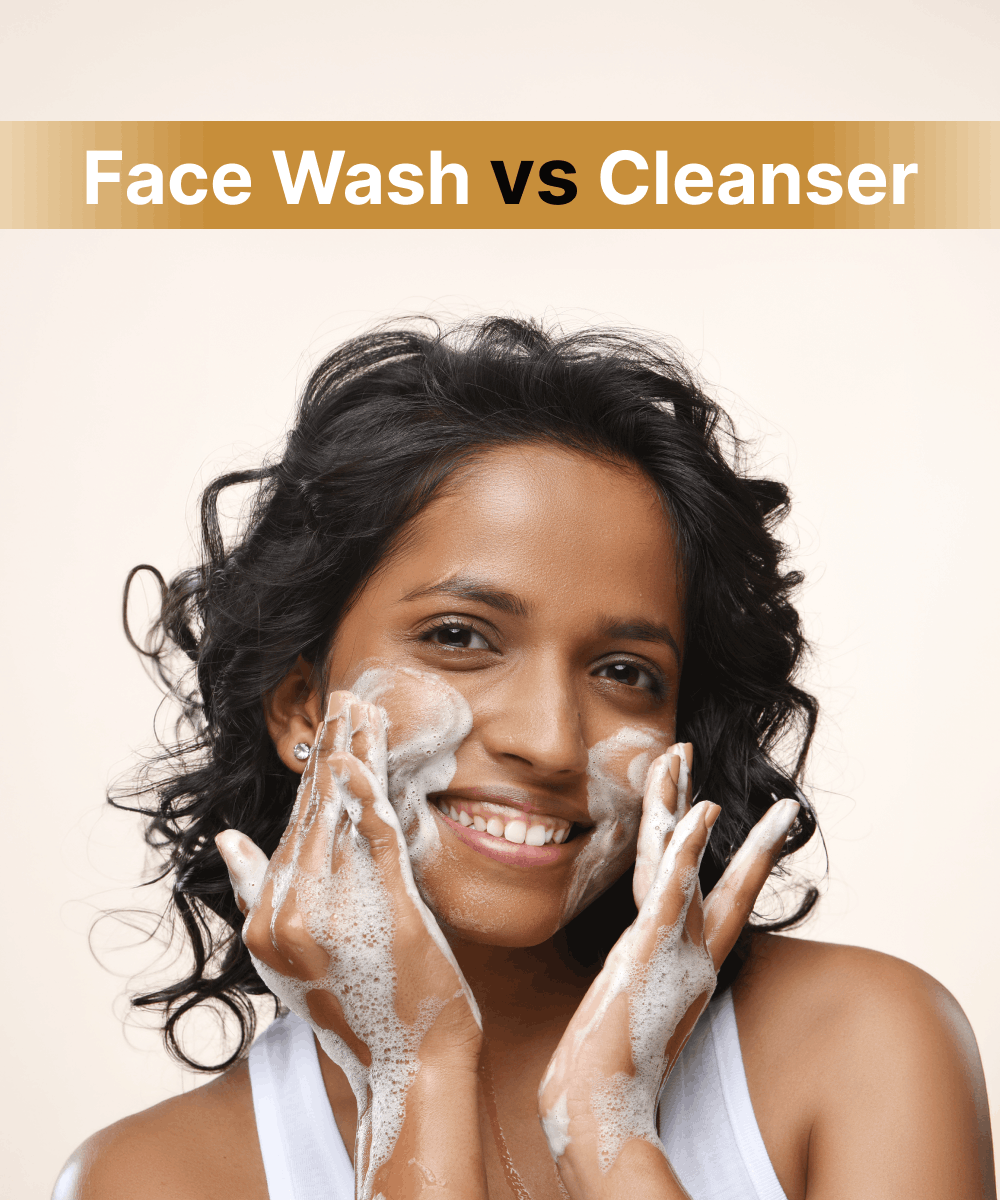
The short answer: there is no dermatological difference between a face wash and a cleanser. Both are surfactant-based products that lower surface tension on the skin to lift away sebum, dirt and dead cells. Dermatology sorts cleansers by their chemistry, not by the word on the bottle, into soaps, synthetic detergents and combars. The distinction that actually decides whether your skin feels tight or comfortable after washing is which surfactants are inside and how well the product rinses off, not whether the label says "face wash" or "cleanser."
"Face wash" and "cleanser" are marketing words, not product categories. The Indian Journal of Dermatology classifies cleansers into three real types: soaps (pH 9 to 10), syndet or synthetic detergent formulas (pH 5.5 to 7.0), and combars. Your skin's own surface sits at pH 4.0 to 6.0, which soap does not overlap and syndets do. Surfactant type and rinsability drive irritation more than pH does. For normal skin the choice matters less than the internet suggests; it starts to matter a lot if you have acne, sensitivity or dryness.
Is there any real difference between a face wash and a cleanser?
No. Both words describe the same thing: a surface-active product that emulsifies oil-soluble grime so water can carry it away. As the Indian Journal of Dermatology set out in its 2011 review of cleansers, most environmental impurities and cosmetic residues are not water-soluble, so washing with plain water cannot shift them. That is the entire job description, and both products do it.
In everyday Indian retail usage, "face wash" tends to mean something that foams and rinses off, and "cleanser" tends to mean something creamier or milkier that may or may not need water. That is a texture convention, not a rule. A creamy product can be labelled a face wash and a foaming one a cleanser, and frequently is.
The useful question is not which word is on the bottle. It is what is doing the cleaning, and how much of it your skin can tolerate twice a day.
How dermatology actually classifies cleansers: soaps, syndets and combars
The 2011 Indian Journal of Dermatology review divides cleansers into three basic types, and this is the classification worth learning.
- Soaps are long-chain fatty acid alkali salts made by saponification, and they carry a pH between 9 and 10. Soap has existed as a cleanser for thousands of years, with soap-making recorded on Sumerian clay tablets around 2000 BC. Its subsets include glycerine or transparent bars, superfatted soaps carrying extra lipids like lanolin or paraffin, and deodorant soaps containing agents such as triclosan.
- Syndets, short for synthetic detergents, use a non-soap synthetic surfactant such as fatty acid isethionates or sulfosuccinic acid esters as the principal ingredient. Because they are not made by saponification, their pH can be tuned. Syndets sit at a neutral to slightly acidic pH and do not leave a soap scum layer. The 2022 review in Molecules puts the syndet range at pH 5.5 to 7.0 against soap's 8.5 to 11.0.
- Combars are alkaline soaps with surface-active agents added, still at pH 9 to 10. They are milder than true soaps but clean more aggressively than syndets do.
Beyond the three types there is the format variants: lipid-free cleansing lotions built on fatty alcohols that can be wiped off without water, liquid body washes using milder surfactants with more emollients, and cold creams combining a lipid solvent with detergent action from borax.
Vilvah's Milk Powder Face Wash is a syndet in powder form. Its surfactants are sodium cocoyl isethionate and sodium lauryl sarcosinate, both synthetic detergent surfactants, delivered in a waterless base of corn starch, rice powder and rice silk. The powder format is a delivery decision. The syndet chemistry is what determines how it behaves on skin.
Why surfactant type matters more than the word on the bottle
Surfactants are classed by the electrical charge on their water-loving head, and the class predicts both how hard a product cleans and how likely it is to irritate.
Anionic surfactants carry a negative charge, account for 70 to 75 percent of total worldwide surfactant consumption, and deliver the highest cleansing capacity and the best lather. They are also, per the 2022 Molecules review, generally considered as potential irritants. Sodium cocoyl isethionate and sodium lauryl sarcosinate both belong to this class.
That sounds alarming until you read the next part. Blending anionic surfactants with non-ionic and amphoteric secondary surfactants decreases their irritancy potential. This is why well-built formulas list several surfactants rather than one, and why a formula's total behaviour cannot be read off a single ingredient.
The evidence for soap being the genuine problem is direct. Under repeated washing, transmission electron microscopy showed significant damage to both the protein and lipid regions of the stratum corneum after using a soap bar, while skin washed with a syndet under identical conditions kept those regions well conserved. Measured immediately after washing, harsher soap drove a higher rate of water evaporation from the skin than milder syndets did. The 2022 Molecules review is careful to call these exaggerated laboratory conditions, so this is not a claim that one wash visibly damages your face.
The most reliable symptom to pay attention to is tightness. After-wash tightness is a real, named effect: a sensation felt 5 to 10 minutes after washing, caused by water evaporating rapidly from the skin surface. If your skin feels tight ten minutes after cleansing, the product was too harsh for you, whatever the bottle calls itself.
Does the pH of your cleanser actually matter?
Less than the internet insists, and this is where most face wash versus cleanser content gets it wrong.
The case for pH is real. Skin's own surface is acidic, sitting between 4.0 and 6.0 according to the 2022 Molecules review, or 4 to 6.5 in the Indian Journal of Dermatology's framing. Many dermatologists hold that keeping the skin at its physiological pH during cleansing prevents overgrowth of organisms such as Propionibacterium acnes. Above pH 8.0, skin proteins swell markedly, and alkaline conditions can ionise fatty acids in the lipid bilayers, destabilising them.
The case against overstating it is equally real and comes from the same Indian review, which calls the pH question controversial and notes that other researchers have found cleanser pH appears to have little effect on skin damage. That review ranks the drivers of irritation in order: surfactant type first, rinsability second, and pH a distant third.
So the honest position is this. Surfactant chemistry is the primary driver. Rinsability is second, because the longer a cleanser's residue sits on skin, the higher its irritancy potential. pH is a genuine but secondary and still-debated factor.
For reference, Vilvah's Milk Powder Face Wash measures pH 6.0 to 7.0 and the Cream Face Wash measures pH 5.5 to 5.8. Both sit far below soap's 9 to 10.
Face wash vs cleanser: how to choose by skin type and concern
| Skin type or concern | What to look for | Why | Vilvah option |
| Normal, no complaints | Any mild syndet, twice daily | Cleanser choice matters least here | Milk Powder Face Wash, ₹499 |
| Oily, visible shine | Syndet with oil-absorbing base, medium foam | Removes sebum without stripping | Oil Control Combo, ₹899 |
| Acne-prone | Fragrance-free, good rinsability, non-comedogenic | Rinsability outranks foam | Honey Fix Face Wash |
| Dry, flaky, tight | Creamy texture, amino-acid or non-ionic surfactants | Lower irritancy, less lipid removal | Cream Face Wash, ₹440 |
| Sensitive, reacts easily | Mildest available, fragrance-free | Lower irritant threshold | Cream Face Wash, ₹440 |
| Teenage skin | Mild, talc-free, no vigorous scrubbing | Barrier is still maturing | Milk Powder Face Wash, ₹499 |
For acne-prone skin specifically, the Indian Journal of Dermatology sets a narrow brief: the ideal cleanser is non-comedogenic, non-acnegenic, non-irritating and non-allergenic, and a fragrance-free formula with good rinsability is preferred. The same review names the most common mistake directly. Vigorous scrubbing with soap several times a day does not reduce oiliness. It aggravates acne, and can cause acne detergicans.
Vilvah's Honey Fix Face Wash is the breakout-facing option in the range. For dry and sensitive skin, the Cream Face Wash uses disodium cocoyl glutamate, an amino-acid-derived surfactant, alongside non-ionic coco-glucoside, with banana fruit extract and coconut milk extract.
How to read a cleanser label in 30 seconds
Skip the front of the pack entirely. The claims there are unregulated in the way that matters. Go to the ingredient list and work through four checks.
- Find the surfactants. They usually sit in the first five ingredients. Names containing "cocoyl," "sarcosinate," "isethionate," "glutamate," "glucoside" or "betaine" are synthetic or plant-derived detergent surfactants. Names reading "sodium tallowate," "sodium palmate," "sodium cocoate" or "sodium laurate" are soap, which means an alkaline pH in the 8.5 to 11.0 range.
- Count how many there are. A single anionic surfactant doing all the work is harsher than a blend. Non-ionic and amphoteric surfactants added alongside an anionic one measurably reduce its irritancy, so a list of three or four surfactants is often a mildness signal rather than a red flag.
- Look for the pH on the pack or the product page. Anything stated between roughly 5 and 7 is in syndet territory. If no pH is published anywhere, that is worth noting.
- Check for fragrance. Allergic contact dermatitis to fragrances, preservatives and dyes in cleansers is a documented adverse effect, and fragrance-free is the standing recommendation for acne-prone, sensitive and atopic skin.
What cannot be fixed even with the right cleanser
This is the part most brand content leaves out, so it is worth stating plainly.
If your skin is healthy, the format matters far less than you have been told. The Indian Journal of Dermatology is explicit that for normal skin, choosing a particular cleanser is less important than it is for people managing atopic dermatitis, acne vulgaris, rosacea, photoaging, occupational dermatosis or sensitive skin. Switching from one mild cleanser to another mild cleanser will not transform normal skin.
A cleanser also will not treat a skin condition. Across both reviews, cleansers are positioned as adjuncts used alongside topical therapy, never as the therapy. If you are managing acne, eczema or rosacea, the cleanser's job is to avoid making treatment harder, not to replace it.
And no powder cleanser has been shown to outperform a liquid one in any head-to-head clinical comparison. The dermatology literature compares surfactant chemistry, not physical format. Powder formats have real merits, including water-free formulation and dose control, but "powder is better" is not an evidence-backed claim and we are not going to make it.
What to do after you cleanse
Cleansing removes; the next steps replace. Follow with a moisturiser while skin is still slightly damp, then sunscreen in the morning.
Vilvah's Ultra Moisturising Cream (₹790, 50ml, pH 5) is made with olive squalane and glycerine and is formulated without silicones and alcohol. For anyone dealing with the after-wash tightness described earlier, applying moisturiser promptly is the single most effective correction, because that tightness is water leaving the skin surface.
Frequently asked questions
1. Is a cleanser better than a face wash for dry skin?
Not because of the word. What helps dry skin is a formula with lower-irritancy surfactants, good rinsability and added emollients or humectants, and creamy or lipid-free products more often carry those properties than high-foaming ones do. The Indian Journal of Dermatology recommends that people with xerotic or dry skin use cleansing agents that do not cause further dryness and that ideally contain humectants or emollients. Vilvah's Cream Face Wash (₹440, 100ml, pH 5.5 to 5.8) is built for exactly this, using disodium cocoyl glutamate and coco-glucoside rather than a high-foaming anionic base. But a creamy product built badly will still strip your skin, and a foaming syndet built well will not.
2. Do I need both a cleanser and a face wash?
For most people, no. One well-chosen cleanser used twice daily covers ordinary needs. The genuine case for two products is when your evening routine has to remove something the morning one does not, such as heavy sunscreen or long-wear makeup, in which case an oil or lipid-based first step followed by your regular cleanser makes sense. Owning two products labelled differently but built on similar chemistry achieves nothing. Before buying a second cleanser, check whether the two ingredient lists actually differ in surfactant type.
3. Why does my face feel tight after washing?
That sensation is after-wash tightness, and it is a documented effect rather than a feeling you are imagining. It appears 5 to 10 minutes after washing and is caused by water evaporating rapidly from the skin surface, creating differential stress in the stratum corneum. Harsh surfactants make it worse by binding to skin proteins, reducing their water-holding capacity, and removing natural moisturising factor components. The fix is twofold: move to a milder syndet formula, and apply moisturiser promptly rather than waiting. If tightness persists after switching to a mild cleanser and moisturising, that is worth raising with a dermatologist, because it can point to a compromised barrier rather than a product problem.
4. Is soap bad for the face?
Soap sits at pH 9 to 10, well outside skin's own 4.0 to 6.0, and under repeated laboratory washing it produced measurable damage to both the protein and lipid regions of the stratum corneum where a syndet did not. Soap also removes more cholesterol from the skin than a syndet does, and disrupts the skin's resident microflora, since acidic pH keeps beneficial bacteria attached while alkaline pH promotes their dispersion. That said, these were exaggerated test conditions using multiple washes. Occasional use of a soap bar is not going to ruin your face. As a twice-daily facial cleanser for years, a syndet is the better-evidenced choice.
5. Does a powder face wash work differently from a liquid one?
The powder format changes how the product is stored and dosed, not how it cleans. Vilvah's Milk Powder Face Wash is manufactured without water and activates when you mix roughly half a teaspoon with water in your palm, producing a medium foam. Its cleaning is done by sodium cocoyl isethionate and sodium lauryl sarcosinate, the same class of syndet surfactants used in liquid formulas. The practical advantages are that a waterless formula needs less preservative load and that you control the dose each time.
6. How many times a day should I wash my face?
Twice daily suits most skin, morning and night, with an extra rinse after heavy sweating. Washing more than that is the single most common self-inflicted problem in acne-prone skin. Vigorous scrubbing with soap several times a day does not reduce oiliness, aggravates acne, and can cause acne detergicans, a form of acne triggered by the cleansing itself. If your skin feels oily again two hours after washing, that is not a signal to wash again. It is usually a signal that the cleanser stripped the skin and it overcorrected.
7. Can I use the same cleanser all year in India?
Usually yes, with one adjustment. The surfactant system that suits your skin does not change with the season, but skin's tolerance does. Cold weather and low humidity aggravate the dryness, scaling and roughness that cleansers can cause, so through a dry winter you may want to cut back to once-daily cleansing at night and rinse with plain water in the morning. Through humid months, the same cleanser used twice daily is generally appropriate. Changing your moisturiser weight is a more useful seasonal adjustment than changing your cleanser.
Sources
- Mukhopadhyay P. Cleansers and Their Role in Various Dermatological Disorders. Indian Journal of Dermatology, Jan-Feb 2011. https://pmc.ncbi.nlm.nih.gov/articles/PMC3088928/
- Mijaljica D, Spada F, Harrison IP. Skin Cleansing without or with Compromise: Soaps and Syndets. Molecules, 21 March 2022. https://pmc.ncbi.nlm.nih.gov/articles/PMC8954092/
Related Stories
-

Hair Serum Benefits: The Missing Step in Your Hair Care Routine
-

Premature Grey Hair: Why It Happens Young and How to Slow It Down
-

Rosemary for Hair Growth: What the Research Actually Shows
-

How to Choose a Hair Growth Serum in India That Actually Works
-

Redensyl vs Minoxidil: How Each One Works and Which One Suits You
-

Redensyl for Hair Growth: Benefits, Uses, Side Effects & How It Works
-

Sulfate-Free Shampoo in India: Is It Better and How to Choose the Right One
-

Brightening v/s Whitening: Why Healthy Skin Is the New Beauty Standard
-

How to Control Frizzy Hair in Humid Indian Weather


Leave a comment
All comments are moderated before being published.
This site is protected by hCaptcha and the hCaptcha Privacy Policy and Terms of Service apply.