

 Track Order

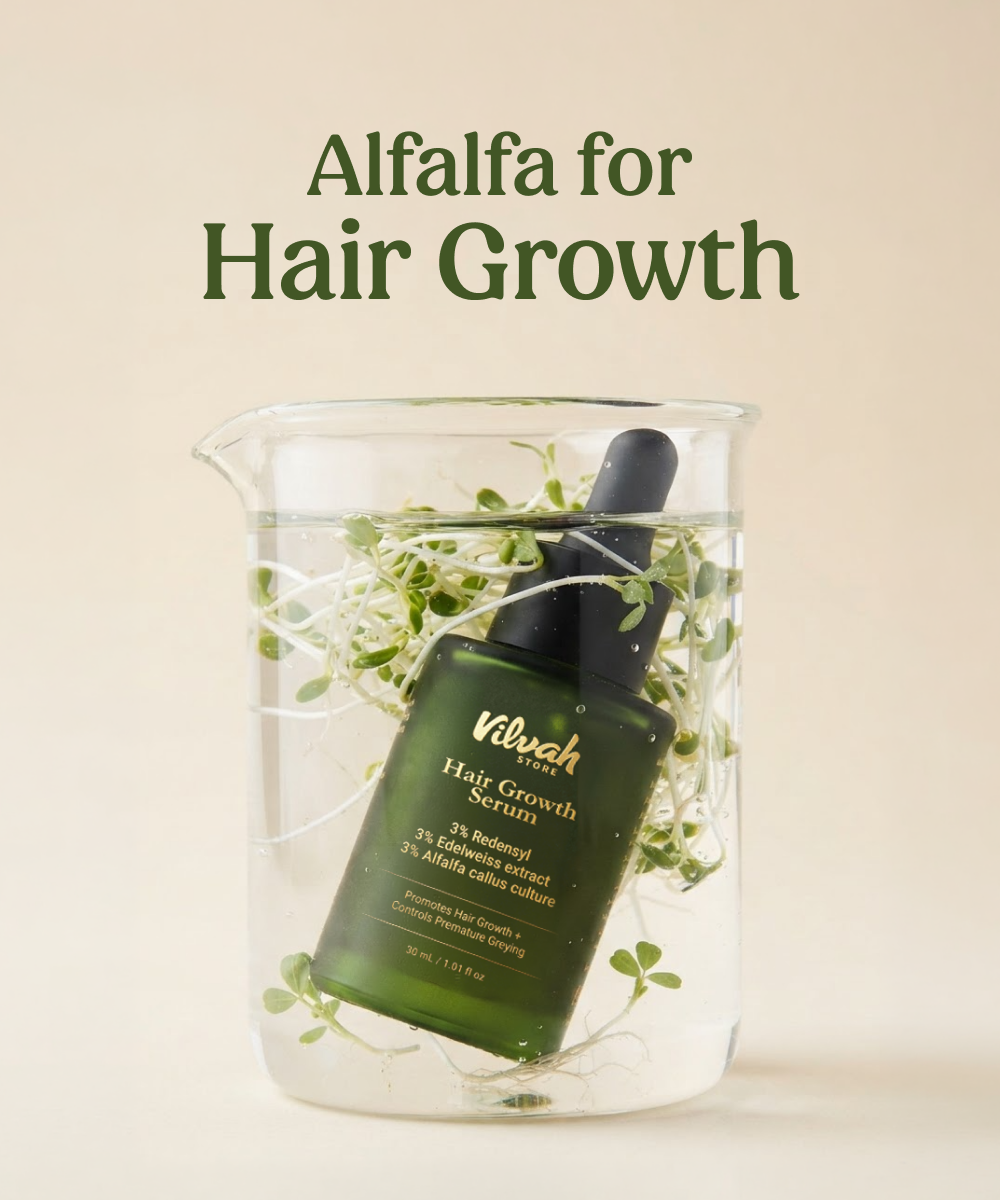
If you've been exploring newer ingredients for healthier, stronger-looking hair, you may have come across Alfalfa. Better known as a nutrient-rich plant and agricultural crop, alfalfa is now finding its way into modern hair and scalp care, particularly in formulations focused on supporting scalp health and hair growth.
But what is alfalfa, and what makes it interesting for hair care? Does eating alfalfa have the same benefits as using an alfalfa-based hair serum? And how does alfalfa hair growth care actually work?
This guide breaks down the science and skincare-to-haircare connection behind alfalfa, including its potential benefits, common uses, and how it fits into a modern hair-growth routine. We'll also look at Vilvah Hair Growth Serum, which contains 3% Alfalfa Callus Culture alongside Redensyl and other targeted actives.
By the end, you'll understand what alfalfa can and can't do for your hair, and why the form of alfalfa used in a product matters.
What is Alfalfa?
Alfalfa, scientifically known as Medicago sativa, is a flowering plant that has traditionally been used as a nutrient-rich food and botanical ingredient. It contains a variety of naturally occurring compounds, including proteins, minerals, vitamins and plant antioxidants.
In hair care, however, you may encounter a more specialised form: alfalfa callus culture.
What is Alfalfa Callus Culture?
Alfalfa callus culture is a plant-cell-derived ingredient produced by growing undifferentiated plant cells under controlled conditions. Instead of simply adding powdered or crushed alfalfa to a formulation, callus culture allows specific plant-derived compounds to be incorporated into targeted cosmetic formulations.
This distinction matters when you're reading a hair serum's ingredient list. "Alfalfa" isn't necessarily the same as "Alfalfa Callus Culture," and different forms can have different intended uses.
Quick answer: Alfalfa is a nutrient-rich botanical known as Medicago sativa. In modern hair care, alfalfa callus culture is a specialised plant-cell-derived ingredient used in formulations designed to support scalp and hair health.
Alfalfa Benefits for Hair: Why is it Used?
So, what are the potential alfalfa benefits when it comes to hair care?
Alfalfa is attracting interest because of its nutrient and antioxidant profile, while specialised alfalfa-derived cosmetic ingredients are being explored for their role in supporting the scalp environment.
1. Supports a Healthy Scalp Environment
A healthy scalp provides the foundation for healthy-looking hair. Alfalfa-derived ingredients can be incorporated into formulations designed to support scalp vitality and maintain a balanced scalp environment, preventing inflamed, infected, or itchy scalps.
2. Helps Support the Hair Growth Cycle
One of the reasons alfalfa has become interesting in modern hair-growth formulations is its potential role in supporting the conditions around the hair follicle.
However, it's important to keep expectations realistic: evidence for plant-derived ingredients can vary significantly depending on the specific extract, concentration, formulation and study design.
3. Provides Plant-Derived Antioxidant Support
Alfalfa contains naturally occurring antioxidant compounds. Antioxidants are commonly used in scalp care to help protect against oxidative stress caused by environmental factors.
4. Supports Healthier-Looking Hair
When combined with other targeted ingredients in a well-designed formula, alfalfa-derived ingredients can complement a broader approach to maintaining stronger, healthier-looking hair.
Alfalfa Hair Growth: Does it Actually Help?
This is probably the question you're really here for: does alfalfa help hair growth? The answer requires a little nuance.
Alfalfa has nutritional and botanical properties that make it an interesting ingredient for hair and scalp care, but you shouldn't treat alfalfa alone as a guaranteed hair-growth treatment. Research into plant-based hair-growth ingredients is growing, but the evidence isn't equally strong for every plant or every formulation. A recent review of plant-derived approaches to hair growth found that much of the existing research is still based on experimental and animal models, highlighting the need for stronger human clinical evidence.
This is why the formulation matters. A hair-growth serum that combines alfalfa-derived ingredients with other targeted actives may offer a more comprehensive approach than relying on alfalfa alone.
Why Alfalfa Callus Culture is Used in Vilvah Hair Growth Serum?
This is where alfalfa becomes particularly relevant to Vilvah Hair Growth Serum.
Vilvah's formula contains 3% Alfalfa Callus Culture, alongside 3% Redensyl and 3% Swiss Alpine Edelweiss Extract. The brand positions Alfalfa Callus Culture as an ingredient that supports scalp health and creates a healthier environment for hair growth.
Rather than making alfalfa the sole hero ingredient, Vilvah uses it as part of a multi-active formulation.
A Multi-Active Approach to Hair Growth
The serum combines:
- 3% Redensyl: Supports hair growth and the appearance of hair density.
- 3% Alfalfa Callus Culture: Supports scalp vitality and the scalp environment.
- 3% Swiss Alpine Edelweiss: Provides antioxidant support to reduce premature greys.
- Rosemary Extract: Promotes microcirculation to hair follicles.
- Bhringaraj: Included for scalp and follicle-focused care.
- Hyaluronic Acid: Helps hydrate the scalp.
- Hydrolysed Keratin & Panthenol: Help condition and strengthen the hair fibre.
- Lactobacillus Ferment Lysate: Supports the scalp barrier and microbiome.
“Healthy-looking hair isn't just about one ingredient. It's about creating a supportive environment for both the scalp and the hair fibre.”
Alfalfa Uses: How is it Used in Hair Care?
The uses of alfalfa can differ depending on how it is processed and incorporated into a product.
1. In Nutritional Supplements
Alfalfa may be consumed as part of a diet or used in supplement products because of its nutritional profile. However, eating alfalfa should not be considered a direct substitute for a topical hair-growth treatment.
2. In Hair Care Products
Alfalfa-derived ingredients can be found in formulations designed for scalp nourishment and to reduce hair thinning due to an imbalanced scalp.
3. In Hair Growth Serums
Specialised forms such as alfalfa callus culture can be incorporated into leave-on scalp formulations alongside other targeted actives.
Important distinction: The benefits associated with consuming a nutrient-rich plant should not automatically be attributed to a topical cosmetic ingredient. The ingredient's form, concentration and intended function all matter.
How to Use an Alfalfa-Based Hair Growth Serum
If you're using an alfalfa-containing scalp serum, application and consistency matter.
Step 1: Apply to the Scalp
Part your hair and apply the recommended amount directly to the scalp, especially around areas where thinning is noticeable.
Step 2: Massage Gently
Use your fingertips to massage the serum into your scalp for a couple of minutes. Avoid aggressive rubbing.
Step 3: Leave It On
Vilvah Hair Growth Serum is designed as an overnight, leave-on treatment. The brand recommends applying up to one full pipette directly to the scalp, gently massaging for 2–3 minutes and leaving it overnight without rinsing.
Step 4: Stay Consistent
Vilvah recommends using the serum 4-7 nights a week. Hair growth follows a natural cycle, so consistency is more important than expecting instant results.
Alfalfa vs Other Hair Growth Ingredients
Alfalfa doesn't have to compete with other hair-growth ingredients. In fact, it can work as part of a broader formulation.
1. Alfalfa + Redensyl
Redensyl is used in hair-growth formulations to target processes associated with the hair follicle and growth cycle, while alfalfa callus culture can complement the formula with scalp-focused support.
2. Alfalfa + Rosemary
Rosemary is another popular botanical in scalp care. Rosemary is known to increase blood flow to follicles, thereby improving hair growth and thickness. Alfalfa can help by improving the scalp’s environment and promote healthy hair growth.
3. Alfalfa + Hydrating Ingredients
A well-hydrated scalp can be an important part of maintaining a comfortable scalp environment. Ingredients such as hyaluronic acid can complement botanical actives by supporting scalp hydration.
This multi-active approach is one of the reasons Vilvah Hair Growth Serum combines alfalfa with Redensyl, Rosemary, Edelweiss, Hyaluronic Acid, Keratin etc. and other complementary ingredients rather than relying on a single botanical.
Who Can Benefit From an Alfalfa-Based Hair Serum?
An alfalfa-containing hair-growth serum may be worth considering if you're looking to:
- Support a consistent scalp-care routine
- Address the appearance of hair thinning
- Improve the appearance of hair density
- Nourish and hydrate the scalp
- Incorporate plant-derived actives into your hair care routine
However, if you're experiencing sudden, severe or patchy hair loss, a cosmetic serum shouldn't be your only step. Hair loss can have many underlying causes, and persistent concerns are best discussed with a dermatologist.
Conclusion: Is Alfalfa Worth Adding to your Hair Care Routine?
The growing interest in alfalfa hair growth care comes from a larger shift toward plant-derived, science-led hair formulations. Alfalfa's nutritional and botanical profile makes it an interesting ingredient, while specialised forms such as Alfalfa Callus Culture are finding a place in modern scalp-care products.
But the key takeaway is simple: alfalfa isn't a magic ingredient for hair growth. Its value depends on the form used, its concentration, the rest of the formulation and consistent application.
That's why Vilvah Hair Growth Serum takes a multi-active approach, combining 3% Alfalfa Callus Culture with 3% Redensyl, 3% Swiss Alpine Edelweiss and complementary scalp- and hair-supporting ingredients.
If you're looking to build a more targeted hair-growth routine, understanding individual ingredients is a great place to start. And when those ingredients work together in a thoughtfully formulated serum, your scalp gets more than just a single-ingredient solution, it gets a complete care routine designed around healthier-looking hair.
Frequently Asked Questions
1. What is Alfalfa?
Alfalfa is a plant scientifically known as Medicago sativa. It is naturally rich in various nutrients and plant compounds and is used in food, nutritional products and cosmetic formulations.
2. What are the benefits of Alfalfa for hair?
Potential alfalfa benefits in hair care include supporting scalp vitality and providing plant-derived antioxidant and conditioning support. However, the evidence for direct hair-growth effects depends on the specific alfalfa-derived ingredient and formulation.
3. Does Alfalfa help hair growth?
Alfalfa is an interesting botanical ingredient for scalp and hair care, but evidence for direct hair-growth benefits is still developing. It is better viewed as one component of a comprehensive formulation rather than a standalone hair-loss treatment.
4. What are the uses of Alfalfa in hair care?
Alfalfa uses in hair care include incorporation into scalp treatments, hair-growth serums and conditioning formulations. Specialised forms such as alfalfa callus culture are used in some modern cosmetic products.
5. Is Alfalfa present in Vilvah Hair Growth Serum?
Yes. Vilvah Hair Growth Serum contains 3% Alfalfa Callus Culture, alongside 3% Redensyl and 3% Swiss Alpine Edelweiss Extract. The formulation also includes Rosemary, Bhringaraj, Hyaluronic acid, Keratin, Panthenol and Lactobacillus ferment lysate.
6. Is alfalfa better than Redensyl for hair growth?
They serve different roles within a formulation. Redensyl is a targeted hair-growth active, while Alfalfa Callus Culture is positioned as a scalp-supporting ingredient. A multi-active formula can combine both rather than treating them as competing ingredients.
Related Stories
-

Face Wash vs Cleanser: What's Actually Different, and Which One Does Your Skin Need
-

Hair Serum Benefits: The Missing Step in Your Hair Care Routine
-

Premature Grey Hair: Why It Happens Young and How to Slow It Down
-

Rosemary for Hair Growth: What the Research Actually Shows
-

How to Choose a Hair Growth Serum in India That Actually Works
-

Redensyl vs Minoxidil: How Each One Works and Which One Suits You
-

Redensyl for Hair Growth: Benefits, Uses, Side Effects & How It Works
-

Sulfate-Free Shampoo in India: Is It Better and How to Choose the Right One
-

Brightening v/s Whitening: Why Healthy Skin Is the New Beauty Standard


Leave a comment
All comments are moderated before being published.
This site is protected by hCaptcha and the hCaptcha Privacy Policy and Terms of Service apply.